TL;DR
If you're building a stablecoin product — payments, remittances, payouts, or a neobank — you need wallet infrastructure, not a consumer wallet. The best embedded wallet providers for stablecoin payments in 2026 are Openfort, Privy, Crossmint, Circle, Turnkey, Dynamic, Magic, and Thirdweb, and they differ most on custody model (smart account vs MPC vs enclave), chain coverage, gas sponsorship for USDC/USDT UX, self-hosting, and pricing. Openfort is the pick when you want smart accounts, gas sponsorship, and a self-hostable signer in one SDK; Crossmint when you need card rails and EU compliance; Circle when you want issuer-level USDC integration. This guide disambiguates consumer wallets from infrastructure and compares the providers for builders.
A stablecoin wallet holds, sends, and receives dollar-pegged tokens like USDC and USDT. The word covers two entirely different products, and which one you want depends on whether you are spending stablecoins or building something that moves them for other people.
Search "best stablecoin wallet" and you'll mostly get the first kind: consumer roundups of where to hold your own USDC or USDT (Ledger, MetaMask, Trust, Phantom). This guide is the second kind — the embedded wallet infrastructure you build into a stablecoin product so every user gets a wallet, without installing anything or touching a seed phrase. If you're shipping payments, remittances, payouts, or a neobank on stablecoins, this is the shortlist you actually need.
What is a stablecoin wallet? Consumer app vs. wallet infrastructure
A stablecoin wallet is a keypair plus the software around it: it holds a balance of USDC, USDT, or another stablecoin, signs transactions to send it, and receives transfers from anyone else. That much is true of both kinds. What differs is who operates it, and it is not a small difference — the two are built by different people, bought in different ways, and compared on different things.
These are two products for two audiences:
- A consumer stablecoin wallet is an app or device an end user installs to custody their own USDC/USDT — MetaMask, Trust Wallet, Phantom, or a hardware wallet like Ledger. If you're a person looking to store stablecoins, that's your category, and this guide won't help.
- Stablecoin wallet infrastructure (WaaS) is the API/SDK layer a developer embeds so their product can create and operate stablecoin wallets for every user — signing, recovery, gas sponsorship, and payment orchestration behind one integration.
Everything below is about the second category.
Stablecoin wallets for businesses
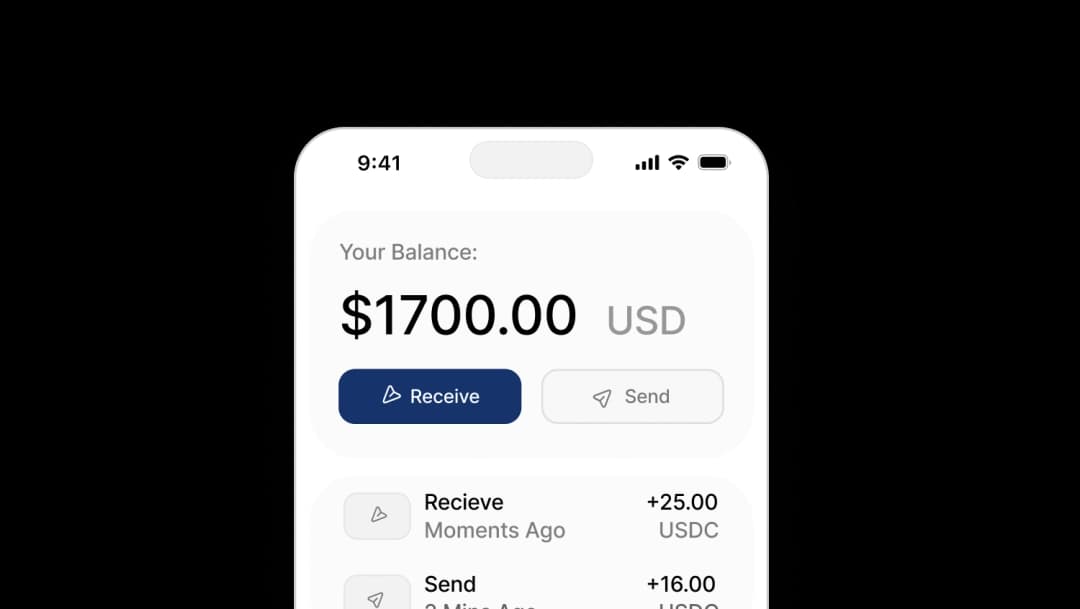
Businesses are putting stablecoin wallets inside products people already use. Deel chose Stripe to give millions of contractors a stablecoin wallet, and Corpay partnered with BVNK to add stablecoin wallets for its global customers. In both cases, the end user never installs a wallet app. The wallet is a feature of a payroll or payments product.
That's the decision this guide helps with. If your business holds its own stablecoin treasury, you want approval controls and custody; see Fireblocks alternatives for that comparison. If your business gives stablecoin wallets to customers, workers, or merchants, you want embedded wallet infrastructure, compared below. It's the wallet infrastructure view, narrowed to the requirements that matter when the asset moving through the wallet is a stablecoin.
Quick comparison: stablecoin wallet SDKs
| Provider | Custody model | Chain coverage | Gas abstraction | Self-hostable | Best for |
|---|---|---|---|---|---|
| Openfort | Smart account + open signer | EVM + Solana | Paymaster incl. ERC-20 gas (free tier) | Yes (OpenSigner) | Stablecoin payments, remittances, payroll, neobanks |
| Privy | TEE + Shamir (MPC) | EVM, Solana, Bitcoin | Via integration | No | Stripe-integrated apps (Bridge rails) |
| Crossmint | Dual-key (owner + TEE agent key) | EVM, Solana, Stellar | Via platform | No | Card rails + onramps + EU compliance |
| Circle | MPC / programmable | EVM + others | Yes (Gas Station) | No | Issuer-level USDC integration |
| Turnkey | Secure enclave (Nitro) | 50+ chains | Custom plans only | No | Treasury, regulated, high-frequency signing |
| Dynamic | MPC or smart contract | EVM, Solana, Cosmos | No native | No | Auth + wallet connection UX |
| Magic | Delegated key (MPC) | EVM + others | Not native | No | Email-first consumer onboarding |
| Thirdweb | Smart account | 700+ EVM | Yes | Yes (Engine) | Broad EVM tooling alongside wallets |
The best stablecoin wallet providers for apps
Openfort — smart accounts + gas sponsorship in one SDK
Openfort is open-source wallet infrastructure built for teams shipping stablecoin products. One SDK bundles embedded wallets, ERC-4337 and EIP-7702 smart accounts, gas sponsorship, session keys, and transaction orchestration. For stablecoin UX specifically, the paymaster can sponsor gas or let users pay fees in the stablecoin itself — so a user can send USDC without ever holding ETH. It's the only provider here with a self-hostable, open-source signer (OpenSigner), which matters when a regulated team needs to audit and own the full signing path.
Best for: payments, remittances, payroll, and neobanks that need wallets, smart accounts, and gas management in a single integration. Free tier: 2,000 operations/month including gas sponsorship.
Privy — fastest path on Stripe
Privy (acquired by Stripe in 2025) couples auth and embedded wallets into one onboarding flow and connects to Stripe's Bridge stablecoin rails. If Stripe is already your payment layer, Privy is the shortest path from signup to a funded stablecoin wallet. Trade-offs: closed-source, no native smart accounts or paymaster (gas sponsorship comes via third-party integration), and MAU-based pricing.
Crossmint — card rails and EU compliance
Crossmint bundles stablecoin orchestration across 50+ chains with onramps, offramps, and — uniquely — card network rails, plus KYC/AML/Travel Rule compliance and a MiCA CASP license across the EU. The pick when your stablecoin product also has to touch card networks or ship into regulated EU markets. Proprietary infrastructure, so no self-hosting. If you're weighing Crossmint alternatives, the comparison page covers the trade-offs side by side.
Circle — issuer-level USDC
Circle's Programmable Wallets come from the USDC issuer, with Gas Station for gas abstraction and deep USDC/EURC tooling. If your roadmap is USDC-native — global payouts, treasury, regulated flows — Circle gives you an issuer-level line into the stablecoin plus wallet infrastructure tuned for payments.
Turnkey — enclave keys for regulated and treasury apps
Turnkey runs signing inside AWS Nitro Enclaves with full remote attestation, making it the strongest MPC/enclave key management option for regulated stablecoin apps and treasury operations. You own the wallet UX and orchestration; Turnkey owns the key layer. Gasless flows are on custom plans, and there's no bundled onramp or card rail.
Dynamic, Magic, and Thirdweb
Dynamic (now part of Fireblocks) leads on auth and multi-wallet connection UX but has no native gas management — you'll pair it with paymaster infrastructure for stablecoin UX. Magic is a clean email-first embedded wallet for consumer onboarding, without native smart accounts. Thirdweb offers embedded wallets and paymaster tooling inside a broad EVM platform, a fit when wallets sit alongside contracts and tokens.
How to add a USDC or USDT wallet to your app
Embedding a stablecoin wallet follows the same shape as any embedded wallet SDK — wrap your app, drop in a button, and the SDK provisions a non-custodial smart account on signup. With @openfort/react:
_14// npm i @openfort/react_14import { OpenfortProvider, OpenfortButton } from '@openfort/react'_14_14function App() {_14 return (_14 <OpenfortProvider_14 publishableKey={process.env.NEXT_PUBLIC_OPENFORT_PUBLISHABLE_KEY!}_14 // walletConfig, recovery, and supported chains trimmed for brevity_14 >_14 {/* Provisions a smart account that can hold and send USDC/USDT */}_14 <OpenfortButton />_14 </OpenfortProvider>_14 )_14}
From there you configure a gas policy so users can transact in stablecoins without holding a gas token. See the embedded wallet quickstart and the stablecoin payments guide for the full flow.
Gas sponsorship and paymasters for stablecoin UX
The single biggest UX break in a stablecoin app is gas. A user holding only USDC has no ETH, MATIC, or SOL to pay fees, so their first transaction fails. Two patterns fix it:
- Sponsored gas (paymaster): your app pays the fee on the user's behalf, via an ERC-4337 paymaster. The user never sees gas.
- ERC-20 gas payment: the user pays the fee in the stablecoin itself, so no native token is needed.
Openfort, Circle (Gas Station), and Thirdweb support paymaster-based sponsorship; Openfort includes it on the free tier and supports paying gas in ERC-20 stablecoins. If your provider has no native paymaster (Privy, Dynamic, Magic), plan to add one.
Custodial vs non-custodial stablecoin wallets for fintech
For a fintech moving stablecoins, custody model is a regulatory decision as much as a technical one:
- Non-custodial infrastructure (smart accounts, MPC, or enclave signing) means the provider never holds unilateral control of user keys. This reduces money-transmission and custody exposure in many jurisdictions and is the default for modern stablecoin builders. Openfort, Privy, Turnkey, Circle, and Dfns all offer non-custodial models.
- Custodial setups can simplify UX but pull you into custody and MTL regulation faster, and concentrate liability.
If you're building in a regulated market, the ability to audit the signing path is decisive — which is why Openfort's self-hostable OpenSigner and Turnkey's remote attestation stand out for this use case.
If you specifically want an MPC wallet SDK, Privy and Circle are MPC-based, Openfort and Alchemy Account Kit use smart accounts, and Turnkey uses secure enclaves — all non-custodial, with different trust models to audit.
Wallet infrastructure for remittances, payouts, and neobanks
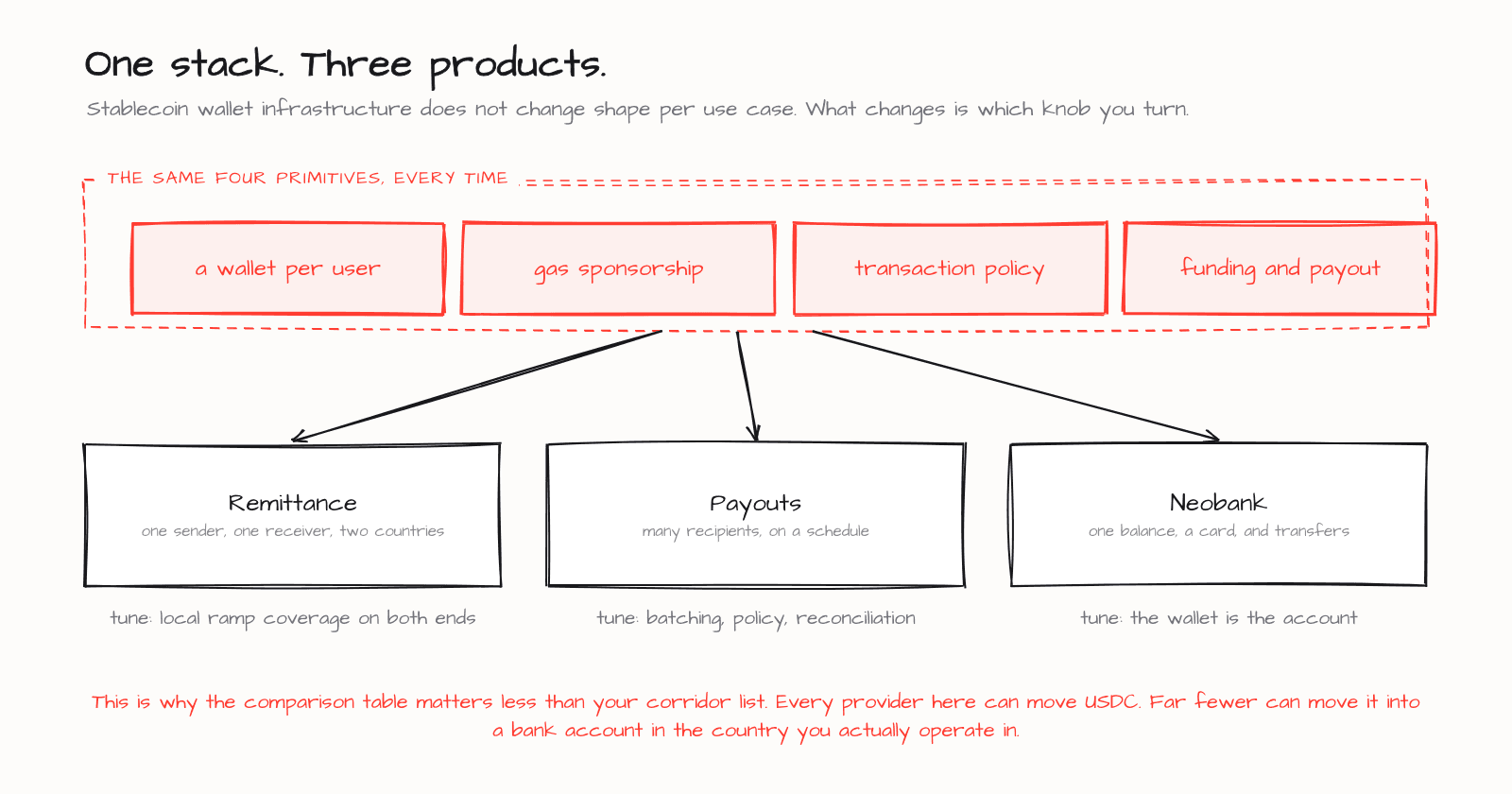
Different stablecoin products stress different parts of the stack:
- Remittances need multi-chain coverage, cheap fees (gas abstraction), and often onramp/offramp — pair Openfort or Circle with a payout rail, or use Crossmint for bundled onramps. See building stablecoin remittance infrastructure.
- Payouts need backend/server wallets that sign programmatically at volume — Openfort backend wallets, Turnkey, or Circle.
- Neobanks need the full stack: embedded wallets, smart accounts, gas sponsorship, and transaction orchestration in one integration, which is Openfort's core design.
Privy, Dynamic, Turnkey, and Magic alternatives for stablecoin apps
If you're already evaluating one of the common names and specifically building for stablecoins, the deciding factors usually come down to smart accounts, native gas sponsorship, and self-hosting:
- A Privy alternative with native smart accounts and free-tier gas sponsorship → Openfort. See Openfort vs Privy.
- A Dynamic alternative that adds transaction orchestration and paymasters, not just auth → Openfort. See Openfort vs Dynamic.
- A Turnkey alternative that bundles smart accounts, bundler, and paymaster instead of a bare key primitive → Openfort.
- A Magic alternative with native ERC-4337/7702 and self-hosting → Openfort.
Related guides
- Best Wallet-as-a-Service (WaaS) providers — the wallet-infrastructure pillar this post sits under
- Best embedded wallets in 2026 — the general embedded wallet SDK view
- Best Ethereum wallets for developers — the EVM developer-wallet view
- Best agent wallets for developers — wallets for autonomous AI agents
- What is stablecoin infrastructure? — the full stack the wallet sits inside
- Crypto onramp: how to let users fund a wallet — getting money into the wallet once it exists
Building a stablecoin product? Try Openfort free — embedded wallets, smart accounts, gas sponsorship, and transaction orchestration in one SDK.