Last updated: July 11, 2026.
Most wallet developer tooling in 2026 still lives on Ethereum and EVM L2s. Between ERC-4337 smart accounts, EIP-7702 delegation, and dozens of rollups, the wallet provider you pick is the decision that ends up shaping your onboarding UX, your gas economics, and your migration cost for years. This guide compares the providers developers actually pick — across features, pricing, and fit.
Developer wallet tools vs. a wallet you install to test dApps
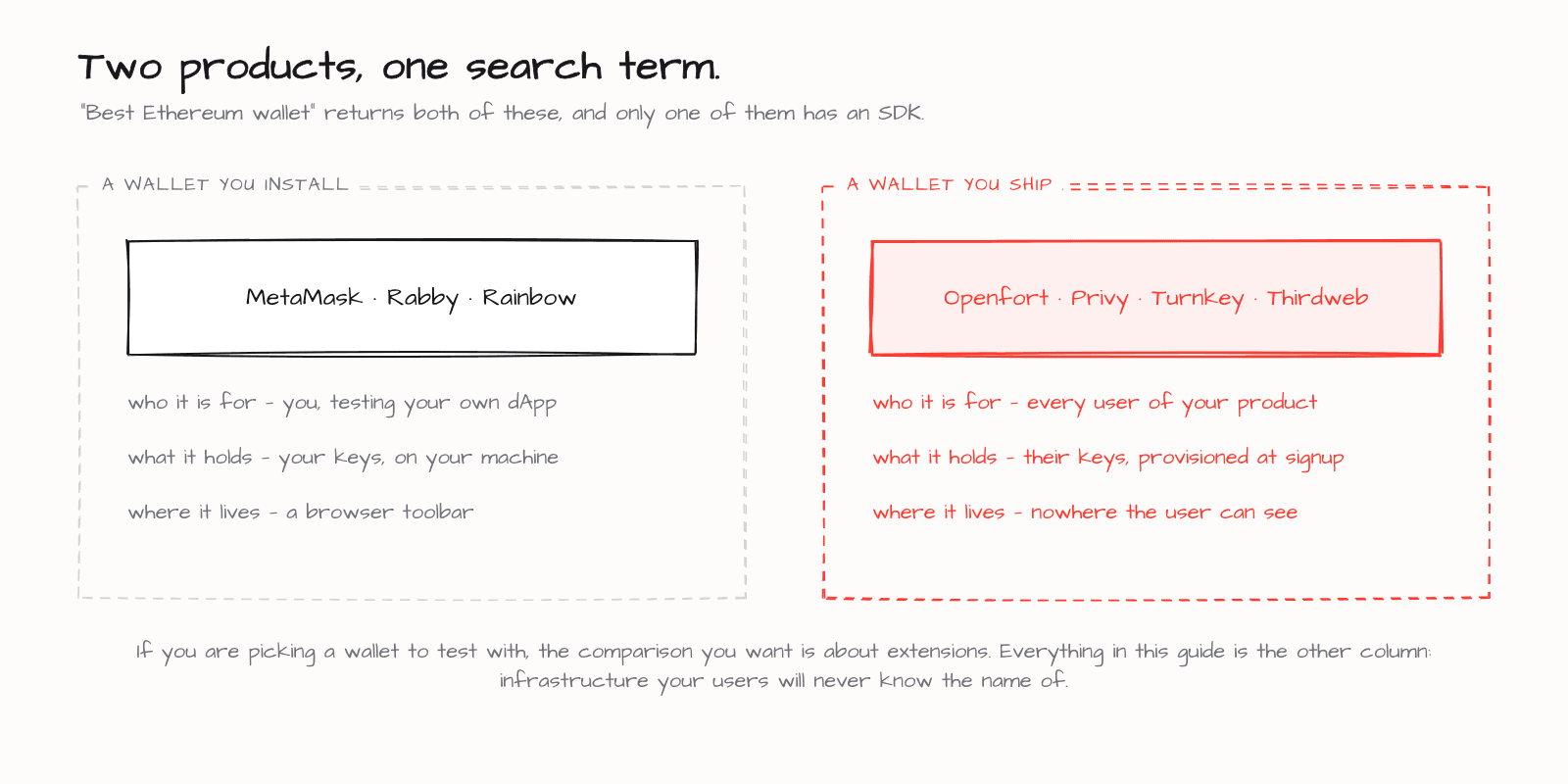
"Best developer wallet tool" splits two ways, and it's worth disambiguating before you shortlist:
- Wallet developer tools / embedded wallet SDKs — infrastructure you build into your product so every user gets a wallet (Openfort, Privy, Turnkey, Dynamic, Thirdweb). This is what the rest of this guide ranks.
- A wallet you install to test dApps — a browser extension or mobile wallet a developer uses to interact with contracts during development (Rabby, MetaMask, Rainbow, Frame). Great for testing; not something you embed for your users.
If you're building onboarding, gas sponsorship, or an EVM embedded wallet for your users, you want category 1 — an embedded wallet SDK with smart-account support. If you just need a wallet to click through your own dApp on testnet, Rabby and MetaMask are the usual picks, and this guide isn't for that. Everything below is about the embedded wallet SDK layer.
This post is the EVM developer-wallet spoke of a larger set: the Wallet-as-a-Service pillar covers wallet infrastructure broadly, while embedded wallets, agent wallets, and stablecoin-payment wallets each have their own deep dive.
Quick Comparison
| Provider | Best For | Smart Account Support | Pricing Model | Key Strength | Key Limitation |
|---|---|---|---|---|---|
| Openfort | Stablecoin, fintech, gaming, AI agents | Native ERC-4337 and EIP-7702 | Free tier + usage-based | Open-source, self-hostable, native smart accounts, gas sponsorship on free tier | Smaller brand vs. Privy and Thirdweb |
| Privy | Consumer apps with Stripe integration | Third-party integrations (Alchemy, ZeroDev) | Free tier + $299/mo Core, usage over 10K MAU | Polished onboarding, Stripe ecosystem, agentic CLI | Closed-source, per-wallet policy scoping, MAU pricing |
| Turnkey | Enterprise, treasury, high-frequency signing | EIP-7702 on Enterprise/custom plans | Usage-based, $99/mo Pro | Hardware-isolated TEE, full remote attestation, 100–150ms signing | Gasless on custom plans only, Pro capped at 2,000 wallets |
| Thirdweb | General-purpose EVM tooling | Native ERC-4337 | Free tier + usage-based | 700+ EVM chains, broad SDK coverage | Wide product surface, AA is one feature among many |
| Dynamic | Multi-wallet auth + embedded wallets | MPC or smart contract (configurable) | Free tier + usage-based | Polished auth UI, multi-wallet aggregation | No native transaction orchestration, acquired by Fireblocks |
| Web3Auth | Social login with low per-MAU cost | Not native | Free tier + $69/mo for 3K MAUs | Wide ecosystem adoption, MPC-based social login | No native smart accounts, acquired by MetaMask/Consensys |
| Coinbase CDP | Base-native apps in the Coinbase ecosystem | Coinbase smart wallets | Free tier + usage-based | Onramp/offramp built in, Base-native | Limited outside Coinbase ecosystem |
| Sequence | Gaming studios on EVM | Native smart accounts | Custom pricing | Unity and Unreal SDKs, built-in marketplace tooling | Gaming vertical, Polygon-acquired, strategy shifting |
Openfort
Openfort is open-source wallet infrastructure with native smart accounts. One SDK covers embedded wallets, ERC-4337 and EIP-7702 smart accounts, gas sponsorship, session keys, and backend wallet automations. It is the only embedded wallet provider in the EVM ecosystem with a self-hostable signer.
Key features:
- Embedded wallets with social login, email, and passkey authentication
- Native ERC-4337 smart accounts with configurable policies
- EIP-7702 delegation for existing EOAs
- Gas sponsorship and gasless transactions from the free tier
- Session keys for delegated, scoped signing
- Any OIDC provider for authentication (Auth0, Firebase, Cognito, custom)
- Custom JWT authentication
- Open-source signer (OpenSigner) — self-hostable for full custody control
- Backend wallets for server-side signing (AI agents, automation)
- SDKs for JavaScript, TypeScript, React, React Native, Swift, Unity, and Node.js
- Multi-chain EVM support with bundler and paymaster infrastructure
Pricing: Free tier includes 2,000 operations per month with gas sponsorship, session keys, and smart accounts. Paid plans are usage-based — no MAU ceiling, no separate per-signature fees.
Best for: Teams that want an open-source Ethereum wallet stack with smart accounts, gas sponsorship, and session keys in one SDK — and the option to self-host the signer when sovereignty matters.
Limitations: Smaller brand footprint than Privy or Thirdweb. EVM-focused today — native smart account support on Solana is not yet available. No pre-built consumer onboarding widget like Dynamic's polished modal.
Differentiator: Openfort is the only embedded wallet provider that ships native ERC-4337 and EIP-7702 smart accounts, gas sponsorship on the free tier, and a self-hostable open-source signer. Every other provider on this list requires you to trade one of those three off.
Privy
Privy (acquired by Stripe in June 2025) is the consumer-focused embedded wallet product. It couples auth and wallets into a single onboarding flow and integrates with Stripe's Bridge stablecoin rails post-acquisition.
Key features:
- Embedded wallets provisioned on user signup
- Email, phone, social, and passkey authentication
- JWT-based auth with Auth0, Firebase, or custom providers
- Cross-app "Global wallet" for user portability within Stripe ecosystem
- Stablecoin integration via Bridge (Stripe)
- Server wallets with off-chain policy API
- Multi-chain support (EVM primary; Solana and Bitcoin available)
- Smart account support via third-party integrations (Alchemy, ZeroDev)
- Agentic CLI for AI-driven wallet operations
Pricing: Free tier up to 499 MAUs. Core tier at $299/month for up to 2,500 MAUs. Scale tier adds whitelabel and webhooks. Apps exceeding 10K MAUs, 50K monthly signatures, or $1M monthly transaction volume move to usage-based billing.
Best for: Consumer apps that want polished onboarding and Stripe-native payments, or teams already on Stripe that want wallets plus fiat rails from one vendor.
Limitations: Smart accounts only via third-party integration — ERC-4337 and 7702 support is not native. Closed-source and proprietary infrastructure with no remote attestation of the TEE. Per-wallet policy scoping means a missed API call can leave a wallet without guardrails. MAU pricing escalates for consumer apps with moderate signature volume.
Differentiator: The Stripe ecosystem integration. If your product already uses Stripe for payments, Privy is the shortest path from signup to a funded wallet with fiat on-ramp and stablecoin settlement in one flow.
Turnkey
Turnkey is an infrastructure-first programmable key management primitive. Keys are generated and signed inside AWS Nitro Enclaves, never reconstructed externally, with full remote attestation and reproducible builds. Turnkey operates at the cryptographic curve layer, so it is chain-agnostic by design — but its sweet spot is enterprise, treasury, and high-frequency EVM signing.
Key features:
- TEE-based key management (AWS Nitro Enclaves)
- Full remote attestation and reproducible builds
- 100–150ms signing latency
- Org-level policy engine enforced inside the TEE
- Key import and export
- Passkey, email, SMS (custom), OAuth, Telegram, and custom auth flows
- 7702 smart account support on Enterprise and custom plans
- Key quorum and multi-party approvals
- Multichain support across EVM, Solana, Bitcoin, and 50+ L1/L2s
Pricing: Free tier: 25 signatures per month, up to 100 wallets. Pay-as-you-go: $0.10 per signature, up to 1,000 wallets. Pro: $99/month, $0.05 per signature, up to 2,000 wallets. Enterprise: custom, as low as $0.0015 per signature.
Best for: Treasury operations, WaaS platform builders, high-frequency autonomous signers, and multi-tenant architectures that need hardware-isolated key custody with independent attestation.
Limitations: Gasless transactions only on Enterprise and custom plans. Custom JWT/OIDC authentication is not supported. Custom email templates, custom domains, and SMS are on custom tiers only. Pro tier caps at 2,000 wallets — not suited for high-volume consumer apps. BYO stack means more assembly burden: no bundler, no paymaster, no pre-built consumer onboarding UI.
Differentiator: The security model. Turnkey's keys never leave the enclave and can be independently verified by third parties through remote attestation. For teams where cryptographic verifiability is a regulatory requirement, Turnkey sets the ceiling.
Thirdweb
Thirdweb is an all-in-one EVM developer platform. It bundles embedded wallets, ERC-4337 smart accounts, gas sponsorship, contract deployment, token and NFT tooling, marketplace infrastructure, and payments into a single dashboard. If your product spans multiple EVM primitives, Thirdweb reduces vendor count.
Key features:
- In-app (embedded) wallets with email and social login
- Native ERC-4337 smart wallets with audited account factories
- Gas sponsorship for frictionless onboarding
- 700+ EVM chains supported
- Contract deployment, NFT and token APIs, marketplace tools
- Engine for backend wallet automations (session keys, gas queuing)
- Composable API supporting third-party paymasters and bundlers
- SDKs across JavaScript, React, Unity, Unreal, and mobile
Pricing: Generous free tier. Usage-based pricing for advanced features, higher volumes, and premium Engine plans.
Best for: Teams building across multiple EVM primitives (NFTs, tokens, marketplaces, wallets, payments) that want one integrated platform. Also a fit for gaming and entertainment studios that want Unity and Unreal SDKs alongside AA support.
Limitations: The product surface is wide but sometimes shallow — individual features like AA or smart wallets may lack the depth of focused providers. "Walled garden" effects: pieces work best together and harder to compose with external tools. Proprietary infrastructure with no self-hosting option for the managed cloud.
Differentiator: The breadth. Thirdweb is the fastest way to stand up a multi-primitive EVM product — wallets plus contracts plus marketplace plus payments — without stitching five vendors together.
Dynamic
Dynamic (acquired by Fireblocks in 2025) focuses on wallet connection and multi-wallet authentication with a polished onboarding modal. It supports embedded wallets alongside external wallet connectors, with configurable MPC or smart contract architectures.
Key features:
- Embedded wallets with social and email login
- Multi-wallet aggregation (link multiple wallets to one user)
- Branded auth UI with extensive customization
- Multi-chain support across EVM, Solana, and Cosmos
- Session management and JWT-based auth
- Sandbox environment for testing
- Configurable MPC or smart contract wallet architecture
Pricing: Free tier available. Usage-based pricing for growth and enterprise tiers.
Best for: Teams that want a polished, customizable auth and wallet connection experience, especially apps where users bring existing wallets alongside an embedded fallback.
Limitations: Focused on auth and wallet connection. No native gas sponsorship, no transaction orchestration, no native smart account management. Strategic direction is in flux post-Fireblocks acquisition. You will likely need a second provider for anything beyond wallet creation and connection.
Differentiator: The wallet linking model. Dynamic lets users attach multiple wallets (embedded and external) to a single identity, which fits products where existing crypto-native users connect their own wallet but new users get an embedded one.
Web3Auth
Web3Auth (acquired by MetaMask/Consensys in 2025–2026) pioneered MPC-based social login. Key shares are distributed across devices, recovery systems, and the provider, and recombined when a user signs. Web3Auth is the most cost-effective option for teams that primarily need social login at scale.
Key features:
- MPC key management with Shamir Secret Sharing
- Social logins (Google, Apple, Discord, Facebook, custom)
- Distributed key shares across device, server, and recovery
- Wide ecosystem adoption and integrations
- SDKs for JavaScript, iOS, Android, Unity
Pricing: Free tier available. Paid plans start at $69/month for 3,000 MAUs — the lowest per-MAU of any provider on this list.
Best for: Apps that want familiar social login UX at low per-MAU cost and do not need native smart account support.
Limitations: No native smart account support — no ERC-4337 or EIP-7702 out of the box. MPC ceremony adds latency compared to TEE-based signing, and the "reconstruct key" model means keys briefly exist in memory. Now owned by MetaMask/Consensys — product direction is uncertain.
Differentiator: Cost at scale. If your product needs social login for a large MAU base and does not need smart account features, Web3Auth's per-MAU pricing is hard to beat.
Coinbase CDP
Coinbase Developer Platform (CDP) provides wallet APIs, onramp and offramp, and staking infrastructure tightly integrated with the Coinbase ecosystem. It is the path of least resistance if your product lives on Base or wants Coinbase brand recognition in the onboarding flow.
Key features:
- MPC wallets with Coinbase-grade security
- Built-in fiat onramp and offramp (Coinbase Pay)
- Staking APIs
- Base-native smart wallets
- AgentKit for AI agent wallet operations
- Coinbase Commerce integration
Pricing: Free tier available. Usage-based pricing at scale.
Best for: Teams building on Base or within the Coinbase ecosystem that want onramp and offramp built in.
Limitations: Tightly coupled to Coinbase infrastructure and Base. Limited chain support outside the Coinbase ecosystem. Less flexible for teams that need chain-agnostic or self-hostable infrastructure.
Differentiator: The onramp and offramp. CDP is the only provider on this list where fiat-to-crypto settlement is a first-class product feature, not a third-party integration.
Sequence
Sequence (acquired by Polygon Labs for $125M in January 2026) is the gaming-focused wallet infrastructure in the EVM ecosystem. It ships player-facing embedded wallets with Unity and Unreal SDKs, an in-game marketplace, and gas sponsorship tuned for gaming chains.
Key features:
- Player-facing embedded wallets with zero-friction onboarding
- Unity SDK (verified on Asset Store) and Unreal SDK
- In-game marketplace and collectible management
- Gas sponsorship for player transactions
- Multi-chain support optimized for gaming chains
- Analytics dashboard for player wallet activity
Pricing: Contact sales — custom pricing for gaming studio packages.
Best for: Gaming studios that need player wallet infrastructure integrated with game engines and in-game economies.
Limitations: Built for gaming — abstractions, SDKs, and documentation assume a gaming context. Not suited for fintech, payments, or general-purpose wallet infrastructure. Post-acquisition, the focus is shifting toward Polygon's stablecoin payments initiative.
Differentiator: The Unity and Unreal SDKs. If you are shipping a game on EVM, Sequence is the only provider with engine-native wallet SDKs at production quality.
How to Choose an Ethereum Wallet
The right provider depends on what you are building, not which feature matrix is longest.
If you are building a stablecoin product, fintech app, or AI agent backend: Choose Openfort. Native ERC-4337 and EIP-7702, gas sponsorship on the free tier, session keys for agent delegation, and an open-source self-hostable signer.
If you are building a consumer app with Stripe payments: Choose Privy. The Stripe acquisition means Bridge stablecoin rails and fiat settlement in the same flow as wallet provisioning.
If you are operating a treasury, running a WaaS platform, or signing at high frequency: Choose Turnkey. TEE-isolated keys, full remote attestation, sub-150ms signing, and per-signature pricing that scales down to $0.0015 at enterprise volume.
If your product spans NFTs, tokens, marketplaces, and wallets: Choose Thirdweb. One dashboard, 700+ EVM chains, and AA as part of a broader toolkit.
If you need a polished wallet connection modal with external wallet aggregation: Choose Dynamic. The wallet linking model fits apps where crypto-native users bring their own wallet.
If you need social login at the lowest per-MAU cost: Choose Web3Auth — provided you do not need native smart accounts.
If you are building on Base and want fiat on-ramp built in: Choose Coinbase CDP. Onramp and offramp are first-class, and AgentKit covers the AI agent path.
If you are shipping a game with Unity or Unreal: Choose Sequence. Engine-native wallet SDKs and in-game marketplace are the differentiators.
Detailed Feature Comparison
| Feature | Openfort | Privy | Turnkey | Thirdweb | Dynamic | Web3Auth | Coinbase CDP | Sequence |
|---|---|---|---|---|---|---|---|---|
| Embedded wallets | Yes | Yes | Yes | Yes | Yes | Yes | Yes | Yes |
| Native ERC-4337 | Yes | Via third party | No | Yes | Smart contract option | No | Yes (Coinbase smart wallet) | Yes |
| EIP-7702 support | Yes | Via third party | Enterprise/custom | Yes | No | No | No | Yes |
| Gas sponsorship | Free tier | Paid tier | Custom plans only | Yes | No | No | Yes | Yes |
| Session keys | Yes | No | Policy engine | Yes (Engine) | No | No | No | Yes |
| Open-source | Yes | No | No | Partial | No | Partial | No | No |
| Self-hostable signer | Yes (OpenSigner) | No | No | No | No | No | No | No |
| Any OIDC / custom JWT | Yes | Yes | No | Yes | Yes | Partial | Limited | No |
| Free tier | 2,000 ops/mo | 499 MAUs | 25 signatures/mo | Yes | Yes | Yes | Yes | No |
| Unity / Unreal SDK | Unity | No | No | Yes | No | Unity | No | Yes |
Other wallet developer tools to know
The eight providers above cover most shortlists, but the neutral directories list more. Depending on your constraints, these are worth a look too:
| Tool | Angle | When it fits |
|---|---|---|
| Magic | Email-first embedded wallets | Consumer apps that want familiar passwordless login |
| Reown (WalletConnect) | Wallet connection + AppKit | Connecting existing wallets alongside an embedded fallback |
| Crossmint | Wallets + payments + compliance | Card rails, onramps, and EU compliance out of the box |
| Dfns | Delegated-signing key infrastructure | Security models where no single party holds a full key |
| Portal | MPC wallet SDK for fintech | Regulated fintech products embedding self-custody |
| Fireblocks | Institutional MPC custody | Enterprise treasury and compliance-grade controls |
| Alchemy Account Kit | Smart-wallet SDK + bundler/paymaster | Teams already on Alchemy RPC and infra |
| Gelato | Smart wallet + relay/paymaster infra | Rollup and gasless-relay-heavy stacks |
For a wider embedded-wallet field beyond EVM, see Best Embedded Wallets in 2026.
Building on Ethereum in 2026
Ethereum's wallet stack is the most mature in crypto, but the 2026 default has shifted. Smart accounts — whether ERC-4337 or EIP-7702-delegated (7702 shipped in Ethereum's Pectra upgrade) — are the expected pattern for new products, not an add-on. Gas sponsorship is a baseline UX, not a premium feature. And the question of who holds the signer is back on the table as teams look for sovereignty options.
If you are starting a new EVM product and want native smart accounts, gas sponsorship on the free tier, and the option to self-host the signer when it matters, Openfort is the open-source starting point. Read the docs or talk to the team.