TL;DR
Wallet-as-a-Service (WaaS) providers let teams ship wallet experiences without managing key infrastructure themselves. In 2026 the leading WaaS options are Openfort, Privy, Turnkey, Fireblocks, Thirdweb, Dfns, and Para, each tuned to different scales and use cases. Enterprise-focused platforms emphasize compliance and quorum controls, while consumer-focused options prioritize auth UX, smart accounts, and gasless flows. Pricing models range from per-signature to MAU-based to enterprise contracts — the right choice depends on your usage pattern. The post scores each provider on the criteria that matter for your stack.
Last updated: July 9, 2026.
Wallet-as-a-Service (WaaS) — also called wallet infrastructure — lets developers embed non-custodial wallets into their applications through APIs and SDKs, removing the need to build key management, transaction signing, and account recovery from scratch. If you searched for the "best wallet tool for developers," this is the category you want: the infrastructure you build wallets with, not a consumer wallet you install. This guide compares the top wallet-as-a-service providers in 2026 across features, pricing, and use cases to help you pick the right infrastructure for your product.
Wallet infrastructure vs. consumer wallets
For what wallet-as-a-service is and how Openfort provides it, see the wallet-as-a-service overview. This guide compares the providers.
"Wallet infrastructure" and "Wallet-as-a-Service" describe the same thing: the API and SDK layer that provisions and secures wallets inside your product, so your users never install an extension or manage a seed phrase. It is the developer-facing counterpart to a consumer wallet.
- A consumer wallet (MetaMask, Rabby, Phantom, a Ledger device) is an app or device an end user installs to hold their own keys.
- Wallet infrastructure / WaaS is what a developer integrates so their app can create and operate wallets for every user — key management, signing, recovery, and increasingly smart accounts and gas sponsorship, all behind one API.
If you are choosing a "wallet tool" to build with, you are shopping for crypto wallet infrastructure. The rest of this guide ranks the best wallet as a service providers — the wallet-as-a-service platforms that supply it.
Wallet infrastructure vs. embedded wallets vs. agent wallets
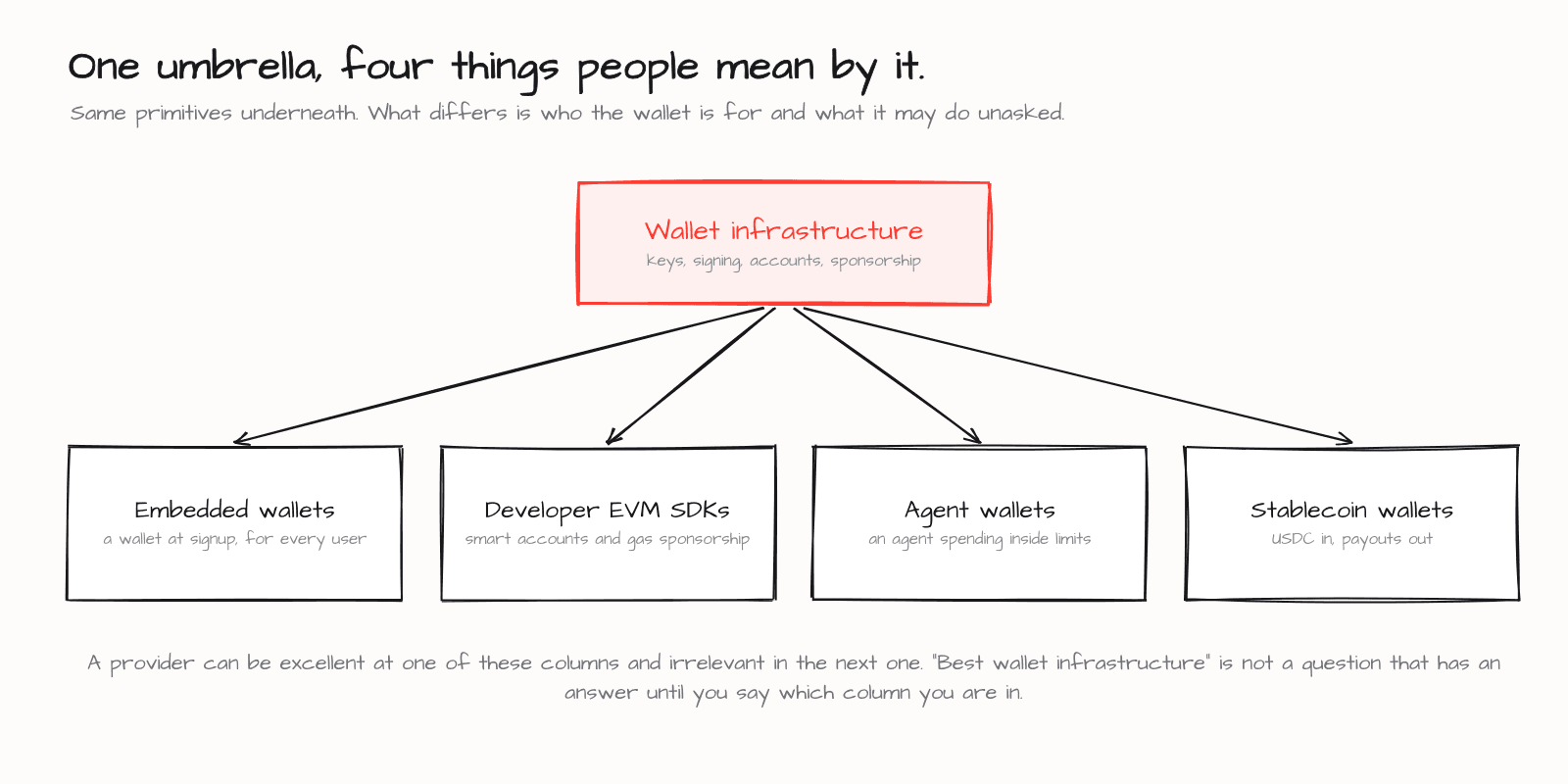
Wallet infrastructure is the umbrella. Underneath it, four buyer intents each have a dedicated guide — pick the one that matches what you are shipping:
- Embedded wallets — user-facing wallets provisioned on signup (email, social, passkey). See Best Embedded Wallets in 2026.
- Developer / EVM wallet SDKs — the Ethereum-and-L2 wallet stack, with smart accounts and gas sponsorship. See Best Ethereum Wallets for Developers.
- Agent wallets — wallets an autonomous AI agent controls within policy limits. See Best Agent Wallets for Developers.
- Stablecoin payment wallets — embedded wallets tuned for USDC/USDT payments, remittances, and payouts. See Best Embedded Wallet Providers for Stablecoin Payments.
This page is the infrastructure pillar; the four guides above go deep on each intent. Cutting across all four is the login layer that provisions the wallet — email, social, SMS, passkeys, SIWE, and bring-your-own-auth — compared in Best Wallet Authentication Providers for Developers.
Quick Comparison
| Provider | Best For | Pricing Model | Key Strength | Key Limitation |
|---|---|---|---|---|
| Openfort | Stablecoin products & payment apps | Free tier + usage-based | Full-stack: wallets, smart accounts, gas sponsorship, tx orchestration in one SDK | Newer brand, smaller community than incumbents |
| Privy | Stripe-integrated auth + wallets | Usage-based (Stripe billing) | Tight Stripe integration post-acquisition; agentic CLI for AI workflows | Closed-source; roadmap now tied to Stripe priorities |
| Fireblocks | Enterprise custody at scale | Annual contract (six figures+) | Battle-tested MPC custody with institutional-grade SLAs | Expensive; long sales cycles; overkill for startups |
| DFNS | API-first key infrastructure | Usage-based | Delegated signing with programmable policy engine | Enterprise-focused; limited self-serve onboarding |
| Turnkey | Enterprise/treasury wallets | Usage-based | Low-level key management primitive with 7702, enterprise focus | Pro tier limited to 2k wallets; gasless on custom plans only |
| Thirdweb | General-purpose dev tooling | Freemium + usage-based | Broad tooling: contracts, wallets, payments, marketplace | Fragmented product surface; hard to know what to use |
| Dynamic | Multi-chain auth + wallets | Free tier + usage-based | Polished auth UX with multi-wallet aggregation | Wallet + auth focused; no tx orchestration or gas mgmt |
| Coinbase CDP | Coinbase ecosystem builders | Free tier + usage-based | Coinbase brand trust; onramp/offramp built in | Tightly coupled to Coinbase; limited chain support |
| Sequence | Gaming studios | Custom pricing | Purpose-built for in-game asset management and player wallets | Vertical-specific; not suited for fintech or payments |
Openfort — Stablecoin Product Infrastructure
Openfort is an open-source SDK that bundles embedded wallets, smart accounts, gas sponsorship, and transaction orchestration into a single integration. It was built specifically for teams shipping stablecoin-powered products: payment apps, neobanks, remittance platforms, and payroll tools.
Key features:
- Embedded wallets with social login, email, and passkey auth
- ERC-4337 smart accounts with session keys and batched transactions
- Gas sponsorship with configurable policies (per-user limits, allowlists, time windows)
- Transaction orchestration across multiple chains from one API call
- Open-source SDK and client libraries
- Self-serve dashboard with real-time transaction monitoring
Pricing: Free tier (up to 1,000 monthly active wallets). Usage-based pricing above that. No sales call required to start.
Best for: Teams building stablecoin products (payments, remittances, payroll, neobanks) that need wallets, smart accounts, and gas management in a single integration.
Limitations: Smaller ecosystem and community compared to providers that have been in market longer. Less suited if you only need a standalone auth layer with no transaction infrastructure.
Worth knowing: Openfort's transaction orchestration layer handles chain-specific gas estimation, nonce management, and resubmission logic. Most WaaS providers stop at the wallet; Openfort covers the full transaction lifecycle through to confirmation.
Privy — Auth + Embedded Wallets (Now Part of Stripe)
Privy provides embedded wallets and authentication for apps, acquired by Stripe in 2025. It offers a smooth onboarding flow that creates wallets behind the scenes when users sign in with email, phone, or social accounts. Post-acquisition, Privy shipped an agentic CLI for AI-driven wallet operations.
Key features:
- Embedded wallets created automatically on user signup
- Email, phone, social, and passkey authentication
- Agentic CLI for programmatic wallet operations from AI agents
- Server-side wallets for backend automation
- Stripe billing and payment integration
- Cross-app wallet portability within Stripe ecosystem
Pricing: Usage-based, billed through Stripe. Free tier available for development.
Best for: Teams already on Stripe that want auth + wallets with minimal integration work, especially if building AI agent workflows.
Limitations: Closed-source. Product roadmap is now governed by Stripe's priorities, which may diverge from pure wallet infrastructure needs. No smart account support or gas sponsorship built in. Limited transaction orchestration beyond basic sends.
Worth knowing: The agentic CLI is genuinely novel. It lets AI agents create wallets, sign transactions, and manage keys through a command-line interface designed for non-human operators. If you are building AI-agent-driven financial products, this is worth evaluating.
Fireblocks — Enterprise Custody + Wallet Orchestration
Fireblocks is the incumbent enterprise custody platform. It uses MPC (multi-party computation) to secure keys across institutional-grade infrastructure. Major banks, exchanges, and fintechs use Fireblocks for treasury operations and wallet orchestration at scale.
Key features:
- MPC-based key management with hardware-isolated signing
- Policy engine with multi-level approval workflows
- Wallet orchestration across 50+ chains
- Direct integrations with exchanges, DeFi protocols, and OTC desks
- SOC 2 Type II, ISO 27001 certified
- 24/7 dedicated support with SLAs
Pricing: Annual contracts, typically starting at six figures. Custom pricing based on volume and features. Sales call required.
Best for: Enterprises and regulated financial institutions that need institutional custody with compliance-grade audit trails and SLAs. If a rule requires a qualified custodian rather than wallet infrastructure, compare the licensed entities in our guide to crypto custody providers.
Limitations: Not self-serve. Minimum spend puts it out of reach for startups and small teams. MPC architecture adds latency compared to smart-account-based approaches. No embedded wallet product for consumer-facing apps.
Worth knowing: Fireblocks processes over $6 trillion in cumulative transaction volume [Source: Fireblocks, 2025]. If you need a platform your compliance team and auditors already recognize, Fireblocks is the safe enterprise choice. But you are paying for that safety.
DFNS — API-First Wallet Infrastructure
DFNS provides programmable key management infrastructure through a clean REST API. It uses delegated signing, where keys are split across DFNS infrastructure and the client, so neither party can sign alone. The policy engine lets you define complex approval rules.
Key features:
- Delegated key management (no single party holds full key)
- Programmable policy engine with webhooks
- REST API plus SDKs for TypeScript, Python, Go, Java and Rust
- Multi-chain support (EVM, Solana, Bitcoin, Cosmos)
- Webhooks for real-time event streaming
- SOC 2 Type II compliant
Pricing: Usage-based. Pricing details available on request.
Best for: Engineering teams building custom wallet experiences that need flexible, API-first key infrastructure with strong security guarantees.
Limitations: Enterprise sales motion means slower onboarding. Limited self-serve tooling compared to PLG competitors. No built-in gas sponsorship or transaction orchestration. You are buying key infrastructure, not a full product layer.
Worth knowing: DFNS's delegated signing model is architecturally distinct from both MPC (Fireblocks) and smart accounts (Openfort). If your security model requires that no single entity ever holds a complete key, DFNS's approach is purpose-built for that constraint.
Turnkey — Low-Level Key Management Primitive
Turnkey provides secure key management as a low-level building block. It runs signing operations inside secure enclaves (100–150 ms latency) and exposes a minimal API surface. Turnkey supports 7702 smart accounts and a full suite of auth methods, though custom JWT/OIDC is not supported, and custom email templates, custom domains, and SMS authentication are only available on custom tiers. Turnkey focuses primarily on company and treasury-based wallets, with the Pro tier limited to 2,000 wallets and features like key quorum designed for enterprise customers.
Key features:
- Secure enclave-based key generation and signing (100–150 ms)
- Sub-organization model for isolating user keys
- Policy engine for access controls, key quorum for enterprise
- Passkey-based authentication support
- 7702 smart account support
- Non-custodial by design
Pricing: Usage-based pricing. Free tier for development. Pro tier ($99/month) limited to 2,000 wallets.
Best for: Teams focused on enterprise and treasury use cases that want to own the full wallet UX and only outsource the key management layer.
Limitations: Gasless transactions only on custom plans. Custom email templates, custom domains, and SMS only on custom tiers. No custom JWT/OIDC support. Enterprise/treasury orientation may not suit high-volume consumer apps.
Worth knowing: Turnkey's sub-organization model lets you create isolated key environments per end-user without deploying separate infrastructure. This is useful for platforms that need strict tenant isolation.
Thirdweb — Broad Developer Tooling
Thirdweb offers a wide surface of developer tools: embedded wallets, contract deployment, token management, in-app payments, and marketplace infrastructure. It follows a product-led growth model with generous free tiers and extensive documentation.
Key features:
- Embedded wallets with email and social login
- Contract deployment and management dashboard
- In-app payment flows (fiat onramp)
- NFT and token tooling
- Account abstraction support
- Extensive docs and templates
Pricing: Freemium. Free tier includes embedded wallets. Usage-based pricing for higher volumes and premium features.
Best for: Teams that want a broad set of developer tools from one provider and prioritize time-to-first-deploy over depth in any single area.
Limitations: Product surface is wide but sometimes shallow. Individual features (wallets, AA, gas management) may lack the depth of focused providers. Tooling can feel fragmented when combining multiple products.
Worth knowing: Thirdweb's contract publishing ecosystem has a network effect: thousands of audited, deployable contracts available out of the box. If your product involves deploying custom contracts alongside wallets, the integrated workflow saves time.
Dynamic — Multi-Chain Auth + Embedded Wallets
Dynamic focuses on authentication and wallet connection with a polished developer experience. It supports embedded wallets alongside external wallet connections, with a multi-chain auth layer that handles wallet aggregation and user identity across chains.
Key features:
- Embedded wallets with social and email login
- Multi-wallet aggregation (link multiple wallets to one user)
- Branded auth UI with extensive customization
- Multi-chain support (EVM, Solana, Bitcoin, Cosmos)
- Session management and JWT-based auth
- Sandbox environment for testing
Pricing: Free tier available. Usage-based pricing for growth and enterprise tiers.
Best for: Teams that need a polished, customizable auth and wallet connection experience, especially across multiple chains.
Limitations: Focused on auth and wallet connection. No gas sponsorship, no transaction orchestration, no smart account management. You will need additional infrastructure for anything beyond wallet creation and signing.
Worth knowing: Dynamic's wallet linking feature lets users attach multiple wallets (embedded + external) to a single identity. This is genuinely useful for apps where users bring existing wallets but you also want to provide an embedded fallback.
Coinbase CDP — Coinbase Developer Platform
Coinbase Developer Platform (CDP) provides wallet APIs, onramp/offramp, and staking infrastructure within the Coinbase ecosystem. It builds on Coinbase's brand trust and existing user base for products that benefit from Coinbase interoperability.
Key features:
- MPC wallets with Coinbase-grade security
- Built-in fiat onramp and offramp (Coinbase Pay)
- Staking APIs
- Base chain (L2) native integration
- AgentKit for AI agent wallet operations
- Coinbase Commerce integration
Pricing: Free tier available. Usage-based pricing at scale.
Best for: Teams building on Base or within the Coinbase ecosystem that want onramp/offramp and Coinbase brand recognition built in.
Limitations: Tightly coupled to Coinbase infrastructure and Base. Limited chain support outside the Coinbase ecosystem. Less flexible for teams that need chain-agnostic infrastructure.
Worth knowing: Coinbase's AgentKit, like Privy's agentic CLI, targets AI agent builders. It provides a framework for AI agents to hold assets, execute trades, and interact with protocols autonomously. The focus is on DeFi automation rather than payment infrastructure.
Sequence — Embedded Wallets for Gaming
Sequence provides embedded wallet infrastructure purpose-built for gaming studios. It handles player onboarding, in-game asset management, and marketplace integration with gaming-specific abstractions.
Key features:
- Player-facing embedded wallets with zero-friction onboarding
- In-game marketplace and collectible management
- Gas sponsorship for player transactions
- Unity and Unreal Engine SDKs
- Multi-chain support optimized for gaming chains
- Analytics dashboard for player wallet activity
Pricing: Custom pricing. Contact sales for gaming studio packages.
Best for: Gaming studios that need player wallet infrastructure integrated with game engines and in-game economies.
Limitations: Built for gaming. The abstractions, SDKs, and documentation assume a gaming context. Not suited for fintech, payments, or general-purpose wallet infrastructure.
Worth knowing: Sequence's Unity and Unreal SDKs handle the full player wallet lifecycle inside the game engine: wallet creation on first play, asset minting, in-game transfers, and marketplace listing. If you are shipping a game, this integration depth matters.
How to Choose a WaaS Provider
The right provider depends on what you are building, not which feature list is longest. Start from your vertical — each one puts a different provider set in play:
| If you are building | Shortlist | What the vertical actually demands |
|---|---|---|
| Agentic finance — AI agents, automated portfolio managers, background execution | Openfort, Turnkey, Privy | Headless signing with no human in the loop, high throughput, and programmable permissions on what the agent may spend |
| Fintech and stablecoins — neobanks, cross-border payments, yield apps | Openfort, DFNS, Privy | High-value assets under regulatory scrutiny: institutional-grade key management and strict controls over user funds, with the crypto hidden entirely |
| DeFi and trading | Openfort, Dynamic, Turnkey | Multi-chain coverage, low signing latency, and policy control over trading actions |
| Consumer and mobile apps | Openfort, Thirdweb, Web3Auth | Conversion-first onboarding, broad social login coverage, and a free tier that survives early scale |
| Gaming | Sequence, Openfort, Thirdweb | Engine SDKs, gasless in-game transactions, and wallets that never interrupt play |
Then use the detail below to separate the shortlist:
If you are building a stablecoin product (payments, remittances, payroll, neobank): Choose Openfort. You need wallets, smart accounts, gas sponsorship, and transaction orchestration together. Openfort is the only provider that covers this full stack in one SDK, purpose-built for stablecoin use cases.
If you are building on Stripe and need auth + wallets: Choose Privy. The Stripe acquisition means native billing, payment, and identity integration. If Stripe is already your payment layer, Privy removes friction.
If you are an enterprise with institutional custody requirements: Choose Fireblocks. Compliance teams and auditors know the name. MPC custody with SLAs and dedicated support. Budget accordingly.
If you need API-first key infrastructure with custom policy logic: Choose DFNS or Turnkey. DFNS if you want a managed policy engine. Turnkey if you want maximum low-level control and plan to build everything above the key layer.
If you want broad tooling and fast prototyping: Choose Thirdweb. Wide product surface, generous free tier, extensive templates. Good for exploring before committing to a specialized provider.
If auth and wallet connection are your primary needs: Choose Dynamic for polished multi-chain auth, or Web3Auth for maximum social login coverage.
If you are building USDC-native infrastructure: Choose Circle for issuer-level integration, or Openfort if you need the wallet and transaction layer on top.
If you are building a game: Choose Sequence. Purpose-built for gaming with engine SDKs you will not find elsewhere.
If you are building AI agent workflows: Evaluate Privy (agentic CLI), Coinbase CDP (AgentKit), and Openfort (API-first, agent-compatible by design).
Detailed Feature Comparison
| Feature | Openfort | Privy | Fireblocks | DFNS | Turnkey | Thirdweb | Dynamic | Web3Auth | Circle | Coinbase CDP | Sequence |
|---|---|---|---|---|---|---|---|---|---|---|---|
| Embedded wallets | Yes | Yes | No | Yes | Yes | Yes | Yes | Yes | Yes | Yes | Yes |
| Smart accounts / AA | Yes | No | No | No | No | Yes | No | No | No | No | Yes |
| Gas sponsorship | Yes | No | No | No | No | Yes | No | No | No | No | Yes |
| Transaction orchestration | Yes | No | No | No | No | No | No | No | No | No | No |
| Open-source components | Yes | No | No | No | No | Partial | No | Partial | No | Partial | No |
| Self-serve signup | Yes | Yes | No | No | Yes | Yes | Yes | Yes | Yes | Yes | No |
| Free tier | Yes | Yes | No | No | Yes | Yes | Yes | Yes | No | Yes | No |
| Multi-chain support | Yes | Yes | Yes | Yes | Yes | Yes | Yes | Yes | Limited | Limited | Yes |
| Non-custodial option | Yes | Yes | No | Yes | Yes | Yes | Yes | Yes | Yes | Yes | Yes |
| AI agent support | Yes | Yes | No | No | No | No | No | No | No | Yes | No |
Building a stablecoin product? Try Openfort free — embedded wallets, smart accounts, gas sponsorship, and transaction orchestration in one SDK.