Wallet authentication that converts
Plug in any provider: social, email, passkeys, or your own JWT and create non-custodial wallets behind the scenes. Bring-your-own-auth on the free tier, no vendor lock-in.
No credit card required • Free testnet accounts








One wallet connector for every auth method
Email magic links, OAuth, passkeys, or external wallets — one wallet connector handles them all. Openfort creates a non-custodial wallet per user behind the scenes without seed phrases.
Wallet authentication without vendor lock-in
Self-host key management with OpenSigner, migrate auth providers later without changing wallet addresses. Your wallet authentication, your rules.
Everything you need to onboard users
Sign-in flows that convert — embedded wallets, social logins, and passkeys behind one connector.
Social & Email Login
Smooth onboarding with wallets and authentication through email and social accounts.
Wallet Connector
Connect to existing wallets and enable users to sign transactions and manage their accounts.


Identity Management
Link web3 and web2 identities enabling unified digital identity across platforms.
Pre-generated Wallets
Generate non-custodial wallets programmatically through email addresses, enabling guest mode capabilities.
Authentication UI elements
Use the pre-built UI components or build custom UIs with headless components that can be styled to match your brand.
Custom Authentication
Integrate with existing authentication systems using SIWE, OIDC, or JWT tokens.
- 1M+
- wallets created
- 10M+
- transactions
- <200ms
- signing speed
- 99.99%
- uptime
From developers that use Openfort
"Moonlit Games with Rogue Nation reached 150K users in 3 months"

Moonlit Games
"Multi-platform game studio, GFAL, increases engagement in their marketplace by 3x"

GFAL
"DePin-focused gaming project, Gaimin, uses smart accounts for best UX"

Gaimin
"Moonlit Games with Rogue Nation reached 150K users in 3 months"
Moonlit Games
"Multi-platform game studio, GFAL, increases engagement in their marketplace by 3x"
GFAL
"DePin-focused gaming project, Gaimin, uses smart accounts for best UX"
Gaimin
Responsive team to help you go to market with wallets on day zero
Technical Support
Get answers within 24 hours from our engineering team who understands startup challenges.
Startup Success Team
Work with a team that has helped launch successful web3 projects and can guide your growth.
Growth Support
Access resources, best practices, and introductions to help scale your project effectively.
Learn more about wallet authentication
Guides and best practices for authentication and wallet connectors
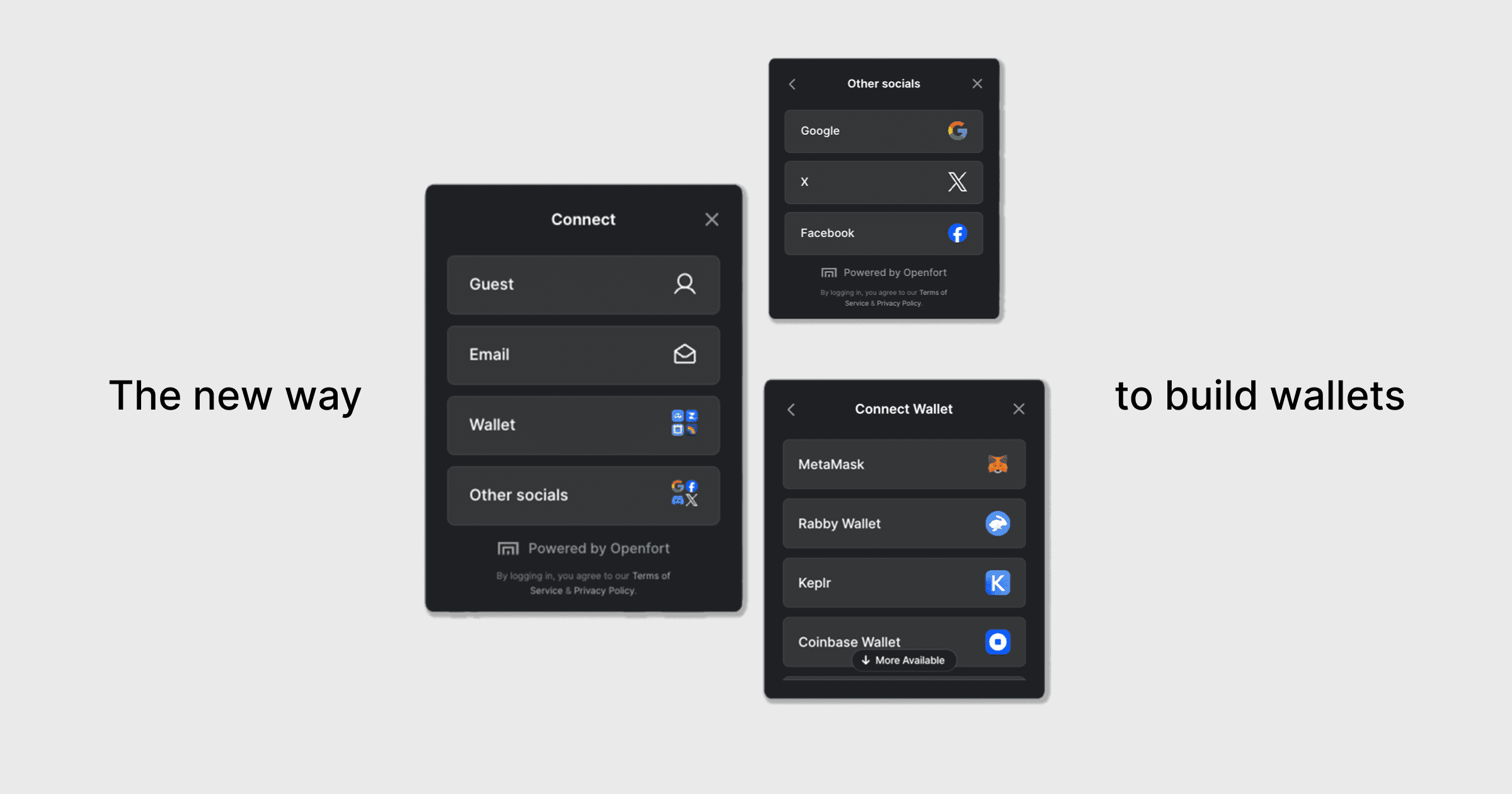
Openfort React, an Open-Source WalletKit for Developers
A plug-and-play React SDK combining authentication UI elements with a modern wallet connector for professional connection flows.
Building a Passwordless EVM Wallet
Technical guide to building passkey-based wallets combining WebAuthn, EIP-7702, and ERC-4337 for seamless authentication.
Passkeys and Account Abstraction
How passkeys integrate with blockchain wallets as account signers, covering onchain vs. offchain verification and WebAuthn.
OTP Login Is Boring. That's Why It Works.
Deep dive on OTP authentication in Openfort SDKs — why passwordless one-time codes are the right auth front door for onchain apps.
Top 7 Web3Auth Alternatives in 2026
Compare Web3Auth with alternatives for wallet authentication, covering smart accounts, gas sponsorship, and orchestration.

How to Migrate from RainbowKit
Step-by-step migration guide from RainbowKit to Openfort Kit, unlocking embedded wallets, gas sponsorship, and session keys.
Frequently Asked Questions
Can't find your answer?
Openfort wallet authentication works with your existing auth stack — email magic links, OAuth, social logins, passkeys, or external wallet connectors. When a user authenticates, your system issues a trusted identity (JWT or OIDC token). Openfort uses that identity to deterministically create or retrieve a non-custodial wallet for that user, without seed phrases. To the user, it feels like a normal sign-in.
A wallet connector bridges your app to a user's wallet. Openfort acts as a universal wallet connector that supports social logins (Google, Apple), passkeys, email magic links, and traditional external wallets like MetaMask or WalletConnect. Unlike standalone wallet connectors, Openfort also creates and manages non-custodial smart wallets behind the scenes, so every user gets a wallet regardless of how they authenticate.
Yes. Openfort is designed to sit behind your auth, not replace it. You keep your OAuth, SSO, or passkey flow, and once a user is authenticated, Openfort links that identity to a non-custodial smart wallet. You get passwordless wallet authentication UX while keeping full control over wallet policies and infrastructure.
Most wallet connectors only handle connecting to existing wallets. Openfort goes further: it combines wallet authentication with embedded wallet creation, gas sponsorship, session keys, and account abstraction — all in one SDK. You can start with hosted key infrastructure and later self-host with OpenSigner, without forcing users to migrate wallet addresses.
Openfort ships TypeScript/JS SDKs and React helpers that integrate with Next.js, React, and other frameworks. It also supports Firebase Auth, custom JWTs, Telegram Mini App initData, and Unity. The wallet connector works with whatever auth provider you already use — Openfort handles wallet creation, orchestration, and signing.