TL;DR
Nine platforms provide agent wallets in 2026. They split on two axes: where the agent's private key lives and signs, and where the spending policy is enforced. Openfort signs inside a GCP Confidential Space TEE with per-wallet envelope encryption, enforces policy fail-closed on every operation, scopes agent authority with on-chain session keys, and publishes five dated third-party audits plus an open-source signer. Privy shards keys inside AWS Nitro Enclaves and states it holds SOC 2 Type I and Type II; Turnkey signs inside secure enclaves attested at every deploy. Crossmint is the only platform with card network rails. Most vendors do not publish key rotation or revocation mechanics at all.
Last updated: September 13, 2026.
An agent wallet has two jobs: sign autonomously inside tight guardrails, and route payments on the rails the agent transacts against. Nine platforms cover that market in 2026, splitting roughly into full-stack bundles (wallet plus payments plus compliance) and signing primitives (wallet only, bring your own payment layer). The ranking below is for developers picking a stack.
For the architectural walkthrough and the custody model, see the AI agents solution page and agent wallet identity, permissions, and compliance. This post is the agent-wallet spoke of a larger set — the Wallet-as-a-Service pillar, plus embedded wallets, Ethereum developer wallets, and stablecoin-payment wallets.
What is an agentic wallet?
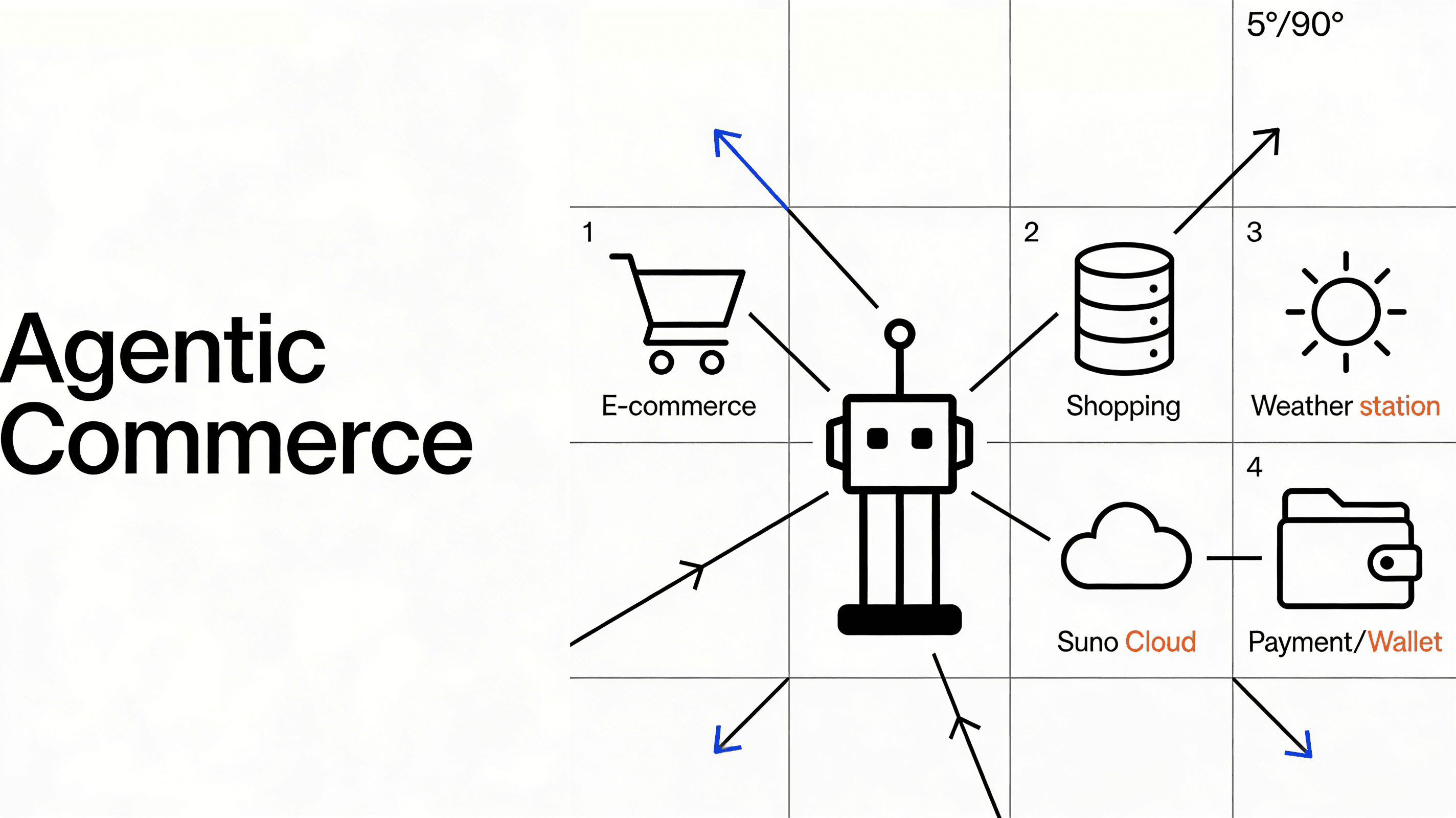
An agentic wallet — also called an AI agent wallet — is the core of any agent wallet infrastructure stack: a wallet an autonomous AI agent controls to hold funds and transact on its own, inside limits a developer sets. Unlike a normal embedded wallet (operated by a human clicking "confirm"), an agent wallet is designed to sign without a human in the loop while staying bounded by policy: which contracts it can call, how much it can spend, and over what time window.
Two design choices define an agentic wallet:
- Where the policy lives — enforced on-chain (encoded in a smart account / session key, independently verifiable) or off-chain (checked by the provider's API before signing).
- Which rails it pays on — stablecoin/crypto only, or dual-rail with card networks (Visa/Mastercard) — and whether it speaks agent-payment protocols like x402, AP2, or MCP.
The best agentic wallet for your build depends on those two axes plus your framework stack and whether you need to self-host. The rest of this post compares the platforms on exactly that.
How agent wallets store keys and sign
The question a buyer asks second, after "who provides agent wallets", is "where does the key live and who can use it". Four terms cover almost every answer on the market:
- TEE (trusted execution environment) — a hardware-isolated compute environment, such as AWS Nitro Enclaves or GCP Confidential Space. Memory is encrypted by the CPU, so even an operator with root on the host cannot read key material out of it. Remote attestation produces a cryptographic proof of exactly which code is running inside, which is what makes the isolation checkable rather than promised.
- Envelope encryption — the private key is encrypted by a short-lived data encryption key (DEK), and the DEK is encrypted by a key encryption key (KEK) held in an HSM. Stealing the database gets you neither, because unwrapping the DEK requires the KMS and, when it is bound to attestation, a verified enclave.
- Secret sharing (Shamir / SSS) and MPC — the key is split into shares held in separate security boundaries. Under Shamir the key is reassembled to sign; under threshold MPC the shares sign cooperatively and the whole key is never reconstructed anywhere.
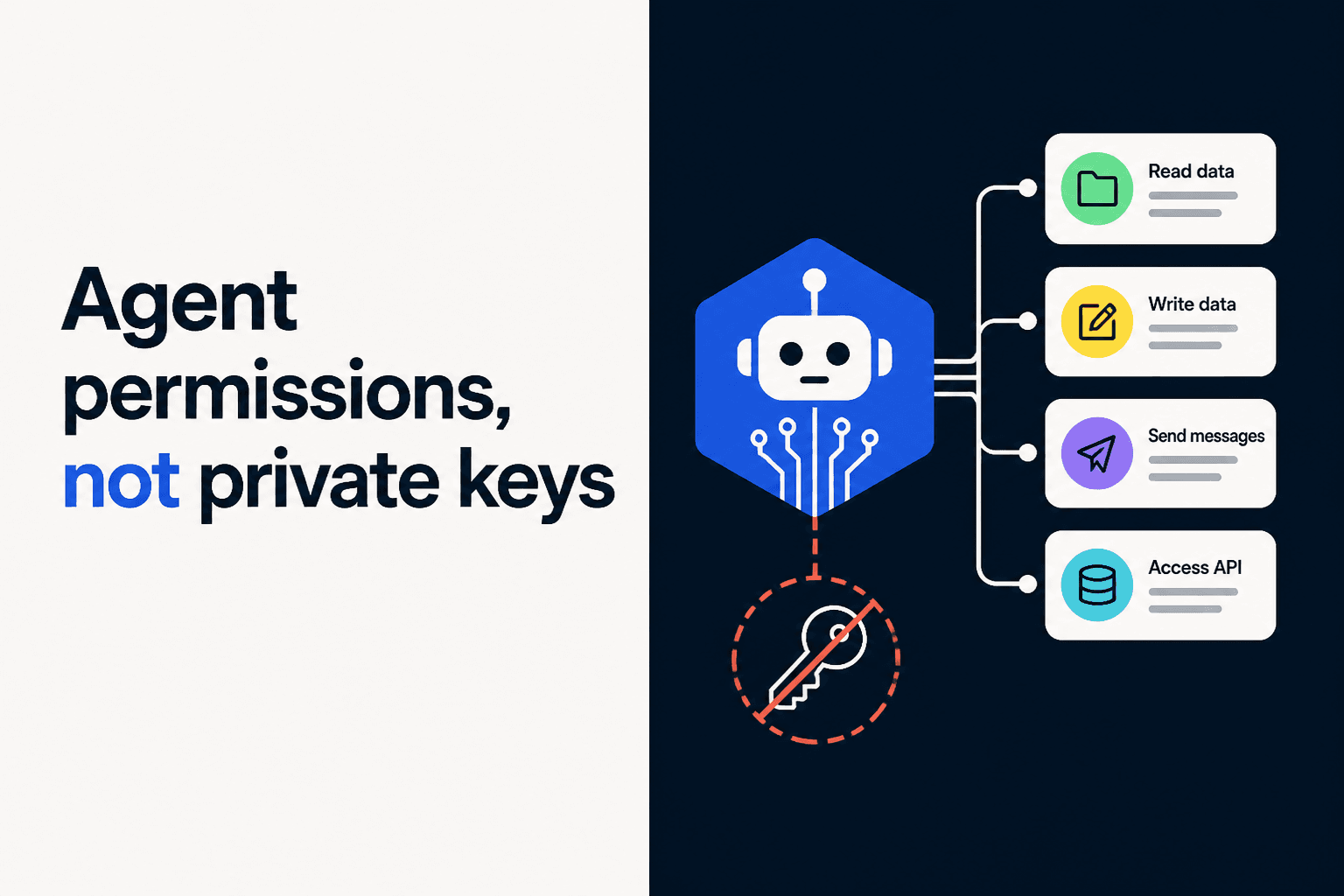
- Session keys / scoped keys — a second, disposable keypair that is authorized to act for the wallet within explicit limits: which contracts, which methods, what spend cap, what expiry. This is what lets an agent sign without holding the wallet's root authority.
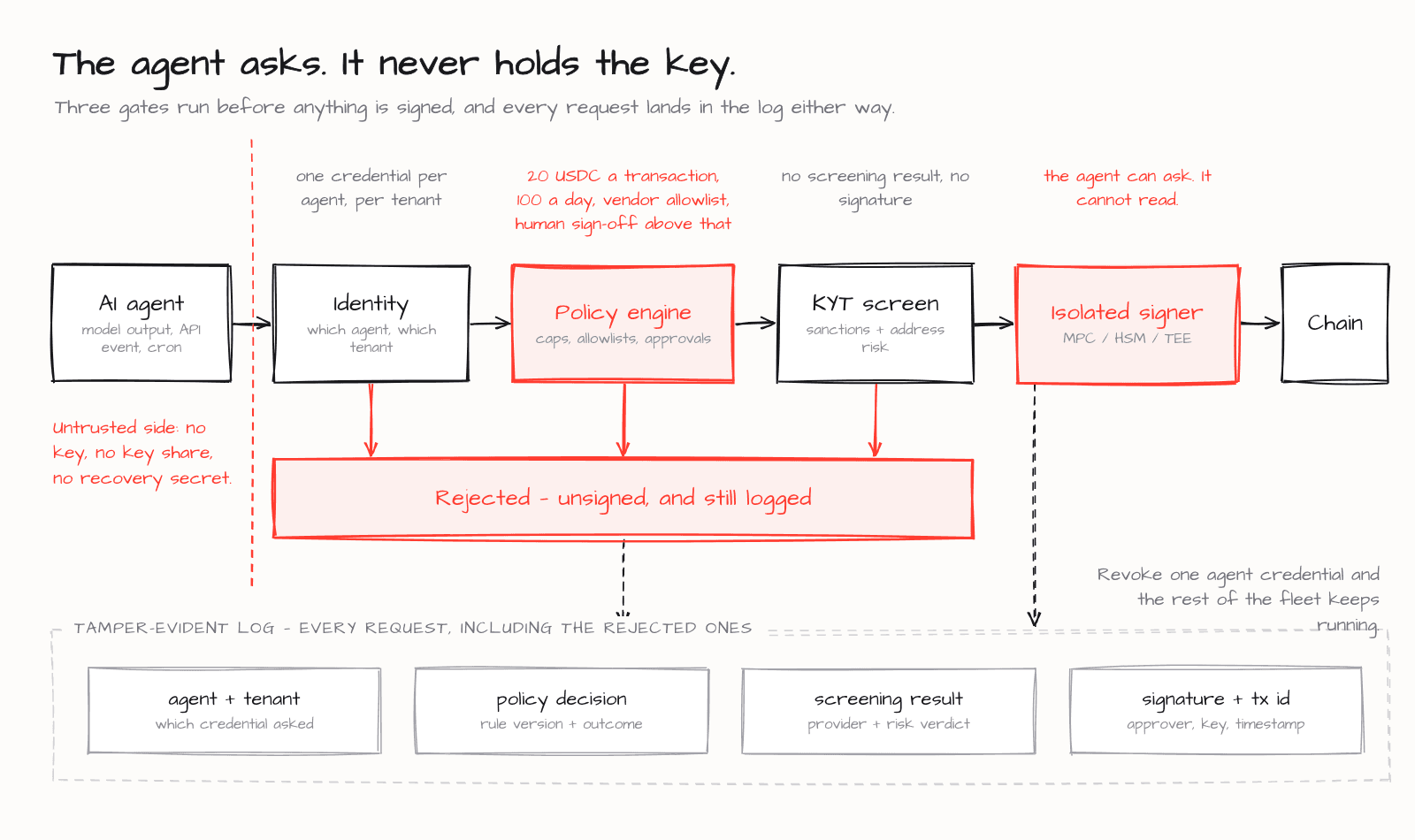
The distinction that matters most for agents is where the policy is evaluated. If a spending limit is enforced only in the prompt, the agent can talk its way past it; every platform below enforces at the infrastructure layer instead. If it is enforced on-chain in the smart account, any third party can verify the constraint without trusting the vendor's API.
The second distinction is what happens when it goes wrong. Agent keys leak differently than user keys: through a prompt injection, a poisoned tool result, or a compromised orchestration server, not through a phished user. So key rotation and revocation are not paperwork — they are the incident response path, and they are also the least documented part of most vendors' stacks.
Quick Comparison
| Provider | Tier | Best for | Key storage | Policy enforced | Self-hostable | Free tier |
|---|---|---|---|---|---|---|
| Openfort | Signing primitive | On-chain verifiable agent permissions, self-hosting | TEE + per-wallet envelope encryption | On-chain session keys + fail-closed API policy | Yes (OpenSigner) | 2,000 ops/mo |
| Crossmint | Full-stack | Card rails and EU compliance | Dual-key, TEE-sealed agent key | Dual-key limits + approval flows | No | 1,000 MAW |
| Turnkey | Signing primitive | High-frequency signing, attestation requirements | Secure enclave, keys not reconstructed externally | Inside the enclave, at the curve layer | No | 25 sigs/mo |
| Coinbase AgentKit | Full-stack | Base-native agents on a free SDK | CDP-managed smart wallets | None built in | Yes (SDK) | Free |
| Privy | Signing primitive | Consumer agent products in the Stripe ecosystem | Shamir sharding inside AWS Nitro Enclaves | Off-chain, per-wallet scoped | No | 499 MAUs |
| Dynamic | Signing primitive | Shared human + agent onboarding UX | Configurable (MPC or smart contract) | Basic | No | Yes |
| Alchemy x402 | Signing primitive | Pay-per-call API metering on Base | TEE-based signing | Auto top-up only | No | Not published |
| Phantom MCP | Signing primitive | Agents acting on a user's existing Solana wallet | Consumer Phantom wallet custody | User's wallet settings | No | Free |
| Thirdweb Engine | Full-stack | Many AI frameworks, wide EVM footprint | Not published | Scoped session keys | Yes (Engine) | Free (self-hosted) |
Agent key security, compared
This is the table most agent-wallet roundups skip. Blank cells are deliberate: they mean the vendor does not publish the mechanism, not that it is absent. Never fill a cell like this from a marketing page.
| Openfort | Privy | Turnkey | Crossmint | Thirdweb Engine | Coinbase AgentKit | Alchemy x402 | Dynamic | Phantom MCP | |
|---|---|---|---|---|---|---|---|---|---|
| Key storage model | AES-256-GCM under a per-wallet DEK; DEK wrapped by an HSM-backed KEK in Cloud KMS | Shamir secret sharing, sharded across separate security boundaries | Generated in enclave, "never reconstructed externally" | Dual-key: owner key + TEE-sealed agent key | — | CDP-managed smart wallet | — | MPC or smart contract, configurable | Consumer wallet custody |
| Signing location | GCP Confidential Space TEE (AMD SEV-SNP) | AWS Nitro Enclaves | Secure enclaves, policy evaluated in-enclave | TEE | Server-side (self-hosted or managed) | Coinbase CDP | TEE | — | User's device |
| Plaintext key ever outside the TEE | No — plaintext exists only in TEE memory during an operation | No | No | — | — | — | — | — | — |
| Attestation required to unwrap keys | Yes — KMS decrypt requires an attested Confidential Space workload | Nitro attestation | Yes — attested at every deploy via QuorumOS | — | — | — | — | — | — |
| Signing latency (published) | 104–327 ms EVM / 97–322 ms Solana, median round trip across 5 regions (benchmarks) | <20 ms signature time (vendor-published) | 100–150 ms (vendor-published) | — | — | — | — | — | — |
| Session / scoped keys | Yes — ERC-7715 wallet_grantPermissions, scoped by contract, method, spend cap and expiry | Session signers with scoped permissions | Policy-scoped P-256 API keys | Delegated signers with spending limits | Scoped session keys | No | No | Session management | No |
| Where the scope is enforced | On-chain in the smart account, and again by the API policy engine | Off-chain, infrastructure level | In-enclave at signing time | On-chain transaction rules | Session key scope | — | — | — | — |
| Policy is fail-closed | Yes — no matching rule means reject | — | — | — | — | No policy engine | No policy engine | — | — |
| Pre-flight policy check | Yes — policies.evaluate() returns the matched policy and rule before spending gas | — | — | — | — | — | — | — | — |
| Key rotation | Wallet secret rotation via dashboard and API | — | — | — | — | — | — | — | — |
| Revocation path | On-chain POST /v1/sessions/revoke (owner-signed) and policy disable/update, effective next operation | Policy update | — | — | — | — | — | — | User revokes in Phantom |
| Agent identity binding | One backend wallet per agent; the account ID is the policy scope | Per-wallet scoping | — | Agent key is distinct from owner key | — | — | — | — | Shared user wallet |
| Key export | Yes — RSA-4096 OAEP SHA-256 to an ephemeral client key | Yes | Yes | — | — | — | — | — | Yes |
| Signer source available | Yes — OpenSigner | Shamir implementation open-source | No | No | Engine open-source | SDK open-source | No | No | No |
| Dated third-party audits | 5, all dated (see below) | Cure53, Zellic, Doyensec — firms named, dates not published | — | — | — | — | — | — | — |
| SOC 2 Type II | No | Yes (Type I and Type II) | — | — | — | — | — | — | — |
On the latency row
The three published numbers measure different things and should not be read as a ranking.
Openfort's figures are end-to-end round trips, measured with the open-source Slate benchmark at 20 iterations per region and reported as medians per region, last updated January 2026. The spread is geographic: 104 ms in Frankfurt, 106 ms in London, 175 ms in N. Virginia, 247 ms in Oregon, 327 ms in Tokyo. Openfort is not fastest in every region, and the benchmarks page shows the comparison set anonymized, so no competitor number can be attributed from it.
Privy's <20 ms and Turnkey's 100–150 ms are vendor-published figures for the enclave signing operation. Neither includes the network path from your agent to the signer, which is the part that dominates the number you will actually observe. For an agent doing one transaction per task, none of these differences are load-bearing; for a trading agent doing thousands, benchmark from your own region before it drives the decision.
On the audit row
Openfort publishes five independent audits with dates and scopes:
| Auditor | Scope | Date |
|---|---|---|
| CertiK | Smart Contract Wallet | December 2023 |
| Cure53 | Shamir Secret Sharing | September 2024 |
| Omniscia | Smart Contract Wallet | December 2024 |
| Quantstamp | 7702 Contract Delegator | September 2025 |
| Quantstamp | Key Management | October 2025 |
Privy names Cure53, Zellic and Doyensec as auditors but does not publish dates alongside them. A named firm without a date does not tell you whether the audited code is the code running today.
These are not a substitute for SOC 2, and SOC 2 is not a substitute for them. A SOC 2 Type II attestation audits a company's operational controls over a period of time. A code audit audits a specific commit of a specific component. Privy holds SOC 2 Type I and Type II; Openfort does not. Openfort publishes dated code audits and the signer source; Privy publishes its Shamir implementation but not the full signer. Buy against whichever question your risk review actually asks — and for the regulated version of that question, see agent wallet compliance and custody controls.
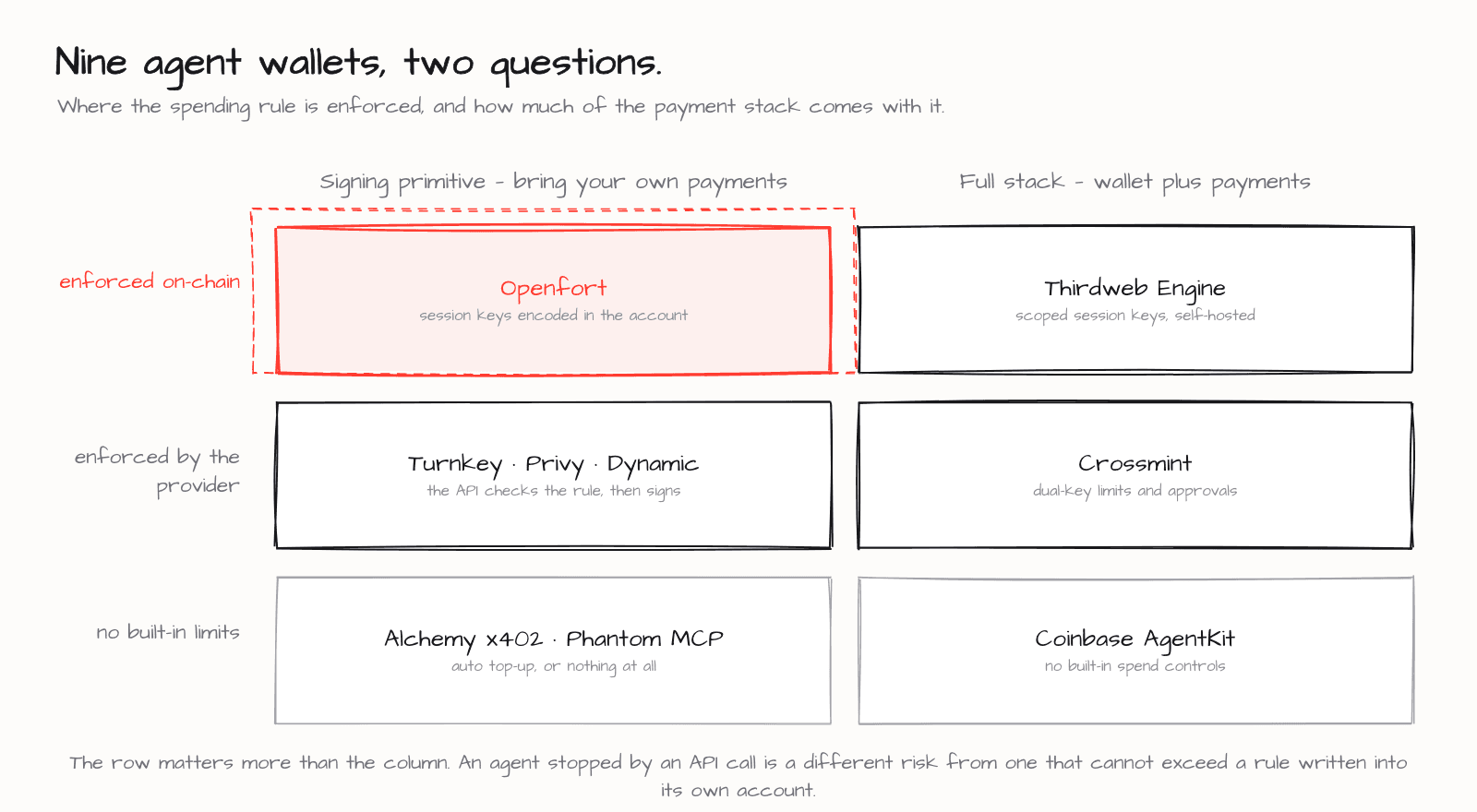
The 9 Agent Wallet Platforms at a Glance
| Rank | Provider | Tier | Payment Rails | Spending Controls | Self-hostable | Free Tier |
|---|---|---|---|---|---|---|
| 1 | Openfort | Signing primitive | Stablecoin / crypto (BYO) | On-chain session keys | Yes (OpenSigner) | 2,000 ops/mo |
| 2 | Crossmint | Full-stack | Stablecoin + Card (Visa/MC) | Dual-key + limits | No | 1,000 MAW |
| 3 | Turnkey | Signing primitive | Stablecoin / crypto (BYO) | TEE policy engine | No | 25 signatures/mo |
| 4 | Coinbase AgentKit | Full-stack | Stablecoin (Base only) | None built-in | Yes (SDK) | Free |
| 5 | Privy | Signing primitive | Stablecoin / crypto (BYO) | Off-chain policy API | No | 499 MAUs |
| 6 | Dynamic | Signing primitive | Stablecoin / crypto (BYO) | Basic | No | Free tier |
| 7 | Alchemy x402 | Signing primitive | USDC (Base) | Auto top-up only | No | Not specified |
| 8 | Phantom MCP | Signing primitive | Stablecoin / crypto | None specified | No | Free |
| 9 | Thirdweb Engine | Full-stack | Stablecoin / crypto (BYO) | Scoped session keys | Yes (self-hosted) | Free (self-hosted) |
1. Openfort
Openfort (that's us 👋) is open-source wallet infrastructure with native smart accounts. Its backend wallet product is the agent wallet layer: ERC-4337 and EIP-7702 smart accounts with on-chain session keys that encode what the agent key can do — which contracts, which methods, what spend cap, what time window. Policy enforcement is on-chain, which makes it transparent, composable, and independently verifiable.
Unlike every other agent wallet on this list, Openfort's signer (OpenSigner) is open-source and self-hostable. For teams with regulatory or sovereignty requirements, that is the only path to audit the full signing infrastructure and remove vendor lock-in. For teams building agents that interact with other on-chain contracts, on-chain policy enforcement composes naturally — any contract can verify the agent's permissions without trusting an API.
Key security
Backend wallet keys are generated inside a GCP Confidential Space TEE with AMD SEV-SNP memory encryption. The private key is encrypted with AES-256-GCM under a data encryption key unique to that wallet; the DEK is wrapped by an HSM-backed key encryption key in Cloud KMS, using the wallet address as additional authenticated data so a DEK cannot be swapped between wallets. Unwrapping requires a valid attestation token, so a stolen database is inert and a compromised API server cannot decrypt anything. Plaintext key material exists only in TEE memory during an operation and is zeroed afterwards.
Agent authority is scoped in two independent places. A session key is a separate keypair authorized on the smart account through ERC-7715 wallet_grantPermissions, bounded by contract address, function selector, validAfter/validUntil window, and spend cap — enforced on-chain, so any third party can verify it without calling Openfort. A signing policy is evaluated by the API on every operation, matching on value caps, address allowlists and denylists, chain IDs, decoded calldata against an ABI, and Solana mint and program addresses. The engine is fail-closed: once any policy exists, an operation that matches no rule is rejected. policies.evaluate() pre-flights an action and returns the matched policy and rule ID, so an agent can check whether something is permitted before spending gas on it.
Revocation runs down both paths too. POST /v1/sessions/revoke, signed by the account owner, removes the session key's authority on-chain. Disabling or updating a policy takes effect on the agent's next operation. The wallet secret that authorizes backend signing can be rotated from the dashboard. Openfort's guidance is one wallet per agent precisely so each can be audited, rate-limited and revoked independently.
Key Features
- Native ERC-4337 and EIP-7702 smart accounts with session keys
- On-chain policy enforcement (transparent, composable, auditable)
- Fail-closed API policy engine with pre-flight evaluation
- Open-source signer with self-hosting path via OpenSigner
- Gas sponsorship included from the free tier
- Backend wallets in TEE, or self-hosted, for autonomous signing
- MCP server via the Openfort CLI — any MCP-capable agent framework can drive a policy-bounded wallet
- Any OIDC authentication provider + custom JWT
- Multi-chain EVM support with Solana on the wallet and signing layer
Pricing
Included in the Openfort platform. Free tier covers 2,000 operations per month across wallet creation, signing, and gas sponsorship. Paid plans are usage-based — one operation is a wallet creation or a transaction, no per-signature premium.
Openfort Agent Wallet Snapshot
| Feature | Openfort |
|---|---|
| Tier | Signing primitive |
| Key storage | Per-wallet DEK (AES-256-GCM), KEK in HSM-backed Cloud KMS |
| Signing location | GCP Confidential Space TEE (AMD SEV-SNP) |
| Policy enforcement | On-chain session keys + fail-closed API policy engine |
| Revocation | On-chain session revoke + policy disable |
| Key rotation | Wallet secret rotation (dashboard/API) |
| Chain support | Multi-chain EVM (+ Solana wallet/signing) |
| Self-hosting | Yes (OpenSigner) |
| AI framework support | API-first + MCP server via CLI |
| Best for | On-chain verifiable agent permissions, self-hosting, multi-chain agent products |
Why developers choose Openfort
Openfort is the only agent wallet with on-chain enforceable policies, an open-source signer, and a self-hosting path. For teams that want architectural control — because of compliance, because of composability, or because they plan to run agents at scale and do not want signer pricing baked into every transaction — Openfort is the default starting point. The payments layer is BYO: if the agent needs onramps or card rails, pair Openfort with a payment provider. Openfort does not hold SOC 2 Type II; if a procurement checklist requires one, Privy publishes Type I and Type II today.
2. Crossmint
Crossmint is the full-stack agent wallet platform. It ships wallets, stablecoin orchestration across 50+ chains, onramps and offramps, KYC/AML/Travel Rule compliance, and — uniquely — card network integration via Lobster Cash. Lobster Cash is an open payment standard built with Visa, Solana, Circle, and Stytch that gives agents virtual credit cards with spending limits alongside USDC wallets with human approval flows. Raw card data and private keys are never exposed to the agent's context.
Crossmint is MiCA CASP licensed across all 27 EU member states and is working toward a PSD2 Payment Institution license in Spain. For regulated products, the compliance surface is the biggest differentiator.
Key security
Crossmint's documented model is dual-key: an owner key plus a TEE-sealed agent key, so the agent's signing authority is a distinct credential from the account's root authority. Crossmint lists passkeys, TEEs, server keys and HSMs as available signer types, and describes transaction rules as enforced on-chain. Crossmint does not publish the encryption scheme protecting keys at rest, signing latency figures, key rotation mechanics, or a documented revocation path.
Key Features
- Dual-key non-custodial architecture (owner key + TEE-sealed agent key)
- Stablecoin rails + Visa/Mastercard agentic payment protocols via Lobster Cash
- Smart contract wallets by default (EVM, Solana, Stellar)
- Native onramps (card, Apple Pay, Google Pay in 160+ countries)
- Native offramps (100+ countries, mobile money, cash agents)
- Built-in KYC/AML/Travel Rule compliance
- MiCA CASP licensed in the EU
- Spending limits, human approval flows, policy-based guardrails
Pricing
1,000 monthly active wallets free — includes wallets, payments, and compliance. Paid tiers are usage-based.
Openfort vs. Crossmint
| Feature | Openfort | Crossmint |
|---|---|---|
| Signer source available | Yes (OpenSigner) | No |
| Self-hostable signer | Yes | No |
| Key storage published | Yes (envelope encryption detail) | Partial (dual-key, TEE-sealed) |
| Card network rails | No | Yes (Visa, Mastercard) |
| Native onramps/offramps | No | Yes |
| MiCA CASP license | No | Yes |
| Policy enforcement | On-chain session keys + fail-closed engine | Dual-key + spending limits |
Why developers choose Crossmint
Crossmint is the pick when the agent has to transact with merchants that do not accept crypto, or when EU compliance is a product requirement. No other platform bundles card networks, onramps, offramps, and a MiCA license with an agent wallet. The trade-off is ecosystem depth: Crossmint runs on proprietary infrastructure, so you cannot self-host the signer or audit the full path end to end.
3. Turnkey
Turnkey provides the strongest key-level security model in the agent wallet market. Keys are generated and signed inside secure enclaves and, per Turnkey's documentation, never reconstructed externally. Turnkey built QuorumOS to attest the code running in the enclaves at every deploy, before posting shares of core secrets — so the isolation claim is independently checkable rather than asserted. Turnkey publishes 100–150ms signing latency, and operates at the cryptographic curve layer (Ed25519, Secp256k1) so chain coverage is wide by default.
Turnkey's agent wallet offering is Enterprise-only, with per-signature pricing as low as $0.0015 at scale. It is the platform for high-frequency autonomous systems, trading desks, and multi-tenant signing architectures.
Key security
Key generation, transaction signing, and policy evaluation all happen inside the enclave — the policy is not a separate service that can be bypassed by reaching the signer directly. Every change to an organization's data must be approved and cryptographically stamped inside an enclave before the policy engine considers it. Agent authority is expressed through policy-scoped P-256 API keys. Turnkey does not publish key rotation mechanics or a documented revocation path in its policy or security overview documentation.
Key Features
- TEE-based key management (secure enclaves), keys never reconstructed externally
- Full remote attestation via QuorumOS and reproducible builds
- Org-level policy engine enforced inside the TEE at signing time
- Curve-layer signing (Ed25519 + Secp256k1) — 50+ chains
- 100–150ms signing latency (vendor-published)
- Key import/export, key quorum, multi-party approvals
- Full auth suite: passkeys, email, SMS (custom), OAuth, Telegram, custom flows
Pricing
Free tier: 25 signatures per month, up to 100 wallets. Pro: $99/month, $0.05/signature, up to 2,000 wallets. Enterprise (required for agent use cases): custom, as low as $0.0015/signature.
Openfort vs. Turnkey
| Feature | Openfort | Turnkey |
|---|---|---|
| Signer source available | Yes (OpenSigner) | No |
| Self-hostable signer | Yes | No |
| Policy enforcement | On-chain session keys + fail-closed API engine | Inside TEE (curve layer) |
| Attestation | Required for KMS key unwrap | Attested at every deploy |
| Published latency | 104–327 ms measured round trip | 100–150 ms vendor figure |
| Custom JWT/OIDC | Yes | No |
| Gas sponsorship | Free tier | Enterprise/custom only |
| Per-signature floor | Operation-based (no per-sig fee) | $0.0015 at enterprise scale |
Why developers choose Turnkey
Turnkey is the pick when the signing layer has to be cryptographically verifiable — independently — and when signing frequency pushes per-transaction costs to the center of the pricing conversation. Trading desks, market makers, custodians, and high-volume autonomous systems build on Turnkey for the TEE plus attestation model. BYO stack means onramps, offramps, card rails, and consumer UX are all your responsibility.
4. Coinbase AgentKit
Coinbase AgentKit is Coinbase's open-source SDK for agent wallets on Base. It provisions CDP smart wallets, supports the OpenAI Agents SDK, and ships with no built-in spending limits — you add them through the application layer. AgentKit is free, open-source, and the fastest path to an agent wallet on Base.
Key security
Custody follows the Coinbase Developer Platform smart wallet model; AgentKit itself does not add a key storage or policy layer. With no built-in spending controls, every limit an agent respects has to be implemented and enforced in your own application code — which means a prompt injection that reaches the SDK directly is bounded only by whatever you wrote. Budget for that before shipping an autonomous agent on it.
Key Features
- Open-source SDK
- Coinbase Developer Platform smart wallets on Base
- OpenAI Agents SDK integration
- Free to use (blockchain gas fees apply)
- Composable with CDP onramp/offramp (Coinbase Pay)
Pricing
Free SDK. Blockchain gas fees apply. Coinbase's managed services (onramp, staking) have their own pricing.
Openfort vs. Coinbase AgentKit
| Feature | Openfort | Coinbase AgentKit |
|---|---|---|
| Open-source | Signer (OpenSigner) | SDK |
| Chain support | Multi-chain EVM (+ Solana) | Base |
| Built-in spending controls | On-chain session keys + policy engine | None |
| Policy fail-closed | Yes | No policy engine |
| Card network rails | No | No |
| AI framework coverage | API-first + MCP | OpenAI Agents SDK |
| Onramp/offramp | No | Yes (Coinbase Pay) |
Why developers choose Coinbase AgentKit
AgentKit is the pick for Base-native agents that want free, open-source wallet infrastructure with onramp and offramp in the same ecosystem. It is narrow — Base only, no built-in spending controls, no multi-framework support — but if that is the fit, it is the shortest path.
5. Privy
Privy (acquired by Stripe in June 2025) provides Server Wallets as its agent wallet offering. Privy's coupling with Stripe and the Bridge stablecoin rails makes it a natural fit for agents in the Stripe ecosystem.
Key security
Privy shards private keys using Shamir secret sharing across separate security boundaries — its Shamir implementation is published at privy-io/shamir-secret-sharing — and performs sensitive operations inside AWS Nitro Enclaves. Privy's agent wallets page states keys are never stored whole, and publishes a <20ms signature time against 115M+ monthly signatures.
Policy is enforced off-chain at the infrastructure level: transfer limits, contract allowlists, recipient restrictions and time-based windows, scoped per wallet. Privy states it is SOC 2 Type I and Type II compliant, runs a HackerOne bug bounty, and names Cure53, Zellic and Doyensec as third-party auditors — without publishing audit dates. Key rotation and revocation mechanics are not documented in Privy's public security pages.
Key Features
- Server wallets with Shamir sharding inside AWS Nitro Enclaves
- Off-chain policy enforcement with transfer limits, allowlists, time windows
- Session signers with scoped permissions for delegated agents
- SOC 2 Type I and Type II
- EVM, Solana, Bitcoin support
- Agentic CLI for AI-driven wallet operations
- Stripe/Bridge integration for indirect fiat payment paths
Pricing
Included in Privy platform pricing. Free tier up to 499 MAUs; Core $299/month for up to 2,500 MAUs; usage-based above 10K MAUs, 50K signatures, or $1M monthly transaction volume.
Openfort vs. Privy
| Feature | Openfort | Privy |
|---|---|---|
| Key storage | TEE + per-wallet envelope encryption | Shamir sharding + AWS Nitro Enclaves |
| Policy enforcement | On-chain session keys + fail-closed API engine | Off-chain API, per-wallet scoped |
| Pre-flight policy check | Yes (policies.evaluate()) | Not published |
| Documented revocation path | On-chain session revoke + policy disable | Policy update |
| Autonomous (sessionless) agents | Yes (native) | Requires user sessions |
| Self-hostable signer | Yes (OpenSigner) | No |
| Native smart accounts | Yes (ERC-4337, 7702) | Via third-party integration |
| SOC 2 Type II | No | Yes |
| Dated third-party audits | 5, all dated | Firms named, dates not published |
| Free tier | 2,000 ops/mo | 499 MAUs |
Why developers choose Privy
Privy is the fast path for consumer agent products in the Stripe ecosystem. The agentic CLI, user-sessioned server wallets, SOC 2 Type II, and Stripe billing integration shorten the ramp — especially through enterprise procurement. Limitations: per-wallet policy scoping means a missed API call leaves a wallet uncovered, the user-session requirement doesn't natively fit fully autonomous sessionless agents, and the policy layer is off-chain, so a counterparty contract cannot verify the agent's constraints without trusting Privy's API.
6. Dynamic
Dynamic (acquired by Fireblocks in 2025) covers embedded wallets for hybrid human-plus-agent products. The architecture is configurable (MPC or smart contract wallet) and spans EVM, Solana, and Cosmos. Dynamic's strongest card is onboarding UX — a polished auth modal that fits products where users and agents share the same wallet surface.
Key security
Key custody is configurable rather than fixed: MPC or a smart contract wallet, chosen per deployment. Dynamic ships session management and JWT-based auth, but agent-specific spending controls are basic compared with the dedicated agent platforms, and Dynamic does not publish a signing latency figure, key rotation mechanics, or a documented agent revocation path.
Key Features
- Embedded wallets: MPC or smart contract architecture
- EVM, Solana, Cosmos chain support
- Polished auth UI with extensive customization
- Multi-wallet aggregation for users bringing external wallets
- Session management and JWT-based auth
Pricing
Included in platform pricing. Free tier available; usage-based pricing for growth and enterprise tiers.
Openfort vs. Dynamic
| Feature | Openfort | Dynamic |
|---|---|---|
| Native smart accounts | Yes (ERC-4337, 7702) | Configurable (MPC or SC) |
| Agent-specific spending controls | On-chain session keys + policy engine | Basic |
| Signer source available | Yes (OpenSigner) | No |
| Chain support | Multi-chain EVM (+ Solana) | EVM, Solana, Cosmos |
| Strategic direction | Independent | Part of Fireblocks |
Why developers choose Dynamic
Dynamic is the pick when the product serves both humans and agents and the onboarding UX has to be shared across both. Agent-specific capabilities are less developed than dedicated agent platforms — Dynamic's strength is the UX layer, not the policy engine. Post-Fireblocks, strategic direction for agent use cases is unclear.
7. Alchemy Agent Wallet (x402)
Alchemy's Agent Wallet is purpose-built for the x402 pay-per-call API protocol on Base. When an agent's compute credits run out, the wallet auto-tops up with USDC. The fit is narrow but clean: API metering and micropayment-for-compute use cases on Base. For how the protocol itself works, see how x402 works.
Key security
Signing is TEE-based. Beyond that, the spending control surface is an auto top-up threshold — there is no policy engine, no scoped session key, and no documented revocation path, so the blast radius of a compromised agent is whatever USDC balance the top-up maintains. Keep that balance small.
Key Features
- TEE-based signing
- x402 protocol integration
- Automated USDC top-up on Base when compute credits run out
- Base-native USDC support
Pricing
Not specified.
Openfort vs. Alchemy x402
| Feature | Openfort | Alchemy x402 |
|---|---|---|
| Use case | General-purpose agent wallets | Pay-per-call API metering |
| Chain support | Multi-chain EVM (+ Solana) | Base (USDC) |
| Spending controls | On-chain session keys + policy engine | Auto top-up only |
| Signer source available | Yes (OpenSigner) | No |
| Framework support | API-first + MCP | Not specified |
Why developers choose Alchemy x402
Alchemy x402 is the pick when the agent's transaction surface is literally pay-per-call APIs on Base. For any broader agent use case, it does not cover enough of the wallet layer on its own.
8. Phantom MCP Server
Phantom's MCP Server lets MCP-compatible AI clients connect to a user's Phantom wallet on Solana. Agents can sign transactions, execute swaps, and transfer tokens within whatever limits the user configures on their Phantom wallet. Free, low-friction, and the fastest way to let an agent transact from a user's existing Solana wallet — but Phantom is a consumer wallet, not a purpose-built agent platform.
Key security
Custody is the consumer Phantom wallet's, on the user's device — there is no platform-provisioned agent key, and therefore no separate credential to scope, rotate or revoke independently of the user's own wallet. The agent operates with whatever the user's wallet permits, and revocation means the user disconnecting it in Phantom. That is a materially different risk model from a per-agent wallet, and it does not fit a product where you are accountable for what the agent spends.
Key Features
- MCP server integration with consumer Phantom wallet
- Sign transactions, execute swaps, transfer tokens
- Solana-native (plus Phantom-supported chains)
- Free (consumer wallet)
Pricing
Free.
Openfort vs. Phantom MCP
| Feature | Openfort | Phantom MCP |
|---|---|---|
| Purpose | Purpose-built agent infrastructure | Consumer wallet + MCP layer |
| Programmatic wallet provisioning | Yes | No (users bring their Phantom wallet) |
| Per-agent credential | Yes (one wallet per agent) | No (shared user wallet) |
| Spending controls | On-chain session keys + policy engine | User's wallet settings |
| Fleet management | Yes | No |
| Chain support | Multi-chain EVM (+ Solana) | Phantom-supported chains |
Why developers choose Phantom MCP
Phantom MCP is the pick when the agent needs to operate a user's existing Solana wallet, not a platform-provisioned agent wallet. Useful for consumer-facing agents that act on behalf of Phantom users. Not a replacement for a purpose-built agent wallet platform.
9. Thirdweb Engine
Thirdweb Engine is the backend wallet and transaction layer of the broader Thirdweb platform, and it doubles as an agent wallet with the widest AI-framework coverage on this list. Engine manages server-side wallets, scoped session keys, and a transaction queue with automatic gas handling across 700+ EVM chains. It is open-source and free when self-hosted.
Key security
Agent authority is scoped through session keys, and Engine is open-source and self-hostable, so the transaction path can be inspected and run in your own infrastructure. Thirdweb does not publish the key storage model, signing latency, key rotation mechanics, or a documented revocation path for Engine's managed offering — if you self-host, the storage model becomes whatever you deploy it against.
Key Features
- Backend/server wallets with scoped session keys for agents
- Transaction queue with nonce management and gas handling
- Broad AI-framework coverage: OpenAI Agents SDK, LangChain, CrewAI, AutoGen, LlamaIndex, and MCP
- 700+ EVM chains
- Open-source; self-hostable or managed cloud
- Composable with third-party paymasters and bundlers
Pricing
Free when self-hosted (blockchain gas fees apply). Managed Engine plans and premium features are usage-based.
Openfort vs. Thirdweb Engine
| Feature | Openfort | Thirdweb Engine |
|---|---|---|
| Signer source available | Yes (OpenSigner) | Engine is open-source |
| Self-hostable | Yes | Yes |
| Key storage published | Yes | No |
| Policy enforcement | On-chain session keys + fail-closed engine | Scoped session keys |
| Chain support | Multi-chain EVM (+ Solana) | 700+ EVM |
| AI framework coverage | API-first + MCP | 6+ frameworks |
| Native smart accounts | Yes (4337 + 7702) | Yes (4337) |
Why developers choose Thirdweb Engine
Engine is the pick when the agent has to plug into many AI frameworks and you want a self-hostable transaction backend across a wide EVM footprint. The trade-off is that agent wallets are one feature inside a large platform, so policy depth and agent-specific tooling are less focused than a dedicated primitive. Solana and card rails are out of scope.
How to choose an agent wallet
| If you are building | Shortlist | What it actually demands |
|---|---|---|
| A fully autonomous agent with no human session — treasury automation, trading bots, background execution | Openfort, Turnkey | Sessionless signing, a policy engine that is fail-closed by default, and one credential per agent so a compromise is contained |
| An agent that must prove its limits to a counterparty | Openfort | On-chain scope a third-party contract can verify without trusting a vendor API |
| An agent transacting with merchants that don't take crypto | Crossmint | Card network rails and the compliance surface to issue them |
| A regulated product going through enterprise procurement | Privy, Turnkey, Crossmint | SOC 2 Type II, named compliance attestations, and an enterprise contract vehicle |
| A high-frequency signer — market making, thousands of tx/day | Turnkey, Openfort | Per-signature cost at volume, and latency measured from your own region |
| Self-hosted or data-resident key management | Openfort, Thirdweb Engine | Signer source you can deploy and audit yourself |
| A consumer agent acting on a user's own wallet | Phantom MCP | An MCP bridge, not a provisioned agent wallet |
| Pay-per-call API metering on Base | Alchemy x402 | x402 support and an auto top-up threshold |
Detailed Feature Comparison
| Feature | Openfort | Crossmint | Turnkey | Thirdweb | Coinbase AgentKit | Privy | Dynamic | Alchemy x402 | Phantom MCP |
|---|---|---|---|---|---|---|---|---|---|
| Tier | Primitive | Full-stack | Primitive | Full-stack | Full-stack | Primitive | Primitive | Primitive | Primitive |
| Key storage published | Yes | Partial | Partial | No | No | Yes | Partial | No | n/a |
| Signing inside a TEE | Yes | Yes | Yes | — | — | Yes | — | Yes | No (user device) |
| Attestation-gated key unwrap | Yes | — | Yes | — | — | Yes | — | — | — |
| Published signing latency | Measured round trip | — | Vendor figure | — | — | Vendor figure | — | — | — |
| Session / scoped keys | Yes | Yes | Yes | Yes | No | Yes | Session mgmt | No | No |
| On-chain policy | Yes (session keys) | Partial | Enclave | Session keys | No | No | No | No | No |
| Fail-closed policy default | Yes | — | — | — | No | — | — | No | No |
| Pre-flight policy evaluation | Yes | — | — | — | No | — | — | No | No |
| Documented key rotation | Yes | — | — | — | — | — | — | — | — |
| Documented revocation path | Yes | — | — | — | — | Partial | — | — | User-side |
| One credential per agent | Yes | Yes | Yes | Yes | Yes | Yes | — | Yes | No |
| Key export | Yes (RSA-4096 OAEP) | — | Yes | — | — | Yes | — | — | Yes |
| Signer source available | Yes (OpenSigner) | No | No | Engine OSS | SDK OSS | Shamir impl only | No | No | No |
| Self-hostable | Yes (OpenSigner) | No | No | Yes (Engine) | Yes (SDK) | No | No | No | No |
| Dated third-party audits | 5 | — | — | — | — | Firms named, undated | — | — | — |
| SOC 2 Type II | No | — | — | — | — | Yes | — | — | — |
| Native smart accounts | Yes (4337 + 7702) | Yes (SC) | 7702 on custom | Yes | Yes (CDP SC) | Via integration | Configurable | No | No |
| Gas sponsorship | Yes (free tier) | Yes | Enterprise only | Yes | Via CDP | No | No | No | No |
| Stablecoin rails | Yes | Yes | Yes | Yes | Yes (Base) | Yes | Yes | Yes (USDC) | Yes |
| Card network rails | No | Yes | No | No | No | No | No | No | No |
| Chain coverage | Multi-chain EVM + Solana | 50+ chains | 50+ chains | 700+ EVM | Base | EVM, Solana, Bitcoin | EVM, Solana, Cosmos | Base | Solana |
| Framework coverage | API-first + MCP | API-first | API-first | 6+ frameworks | OpenAI SDK | Agentic CLI | API-first | Not specified | MCP |
| Agent-payment protocols | MCP server; x402 | Card + x402 | — | MCP | x402 | — | — | x402 | MCP |
| EU/MiCA compliance | No | Yes | No | No | No | No | No | No | No |
| Free tier | 2,000 ops/mo | 1,000 MAW | 25 sigs/mo | Free (self-hosted) | Free | 499 MAUs | Yes | Not specified | Free |
Other agentic wallets and agent-payment tools to consider
The nine above are the platforms most developers shortlist, but the category is moving fast and a few more names show up in 2026 agent-wallet roundups. They cover adjacent slices — smart-account standards, agent-payment networks, and decentralized key management:
| Tool | Angle |
|---|---|
| Safe | Smart-account and multisig standard; agents run on Safe accounts with modules and guards for policy |
| Cobo | MPC custody and wallet-as-a-service with policy controls, for agent treasuries |
| Circle | Programmable wallets, USDC, and Gas Station; agent-oriented wallet tooling |
| Fireblocks | MPC custody with policy engine; now also owns Dynamic |
| Skyfire | Payment and identity network purpose-built for agent-to-agent and agent-to-service payments |
| Nevermined | Metering and payments rails for agent-to-agent services |
| Lit Protocol | Decentralized key management (MPC/TSS) with programmable signing for agents |
| Composio / GOAT | Agent tool/action frameworks that add on-chain wallet actions to agents |
| Coca, FluxA | Newer smart-account wallet entrants aimed at consumer and agent use |
These are worth tracking, but for a production agent stack the nine ranked platforms remain the primary options.
Where to Start
If you are building an agent product from scratch and do not yet know which constraints matter most, Openfort is a defensible default: an open-source self-hostable signer, native smart accounts with on-chain session keys, a fail-closed policy engine with pre-flight evaluation, and a free tier that covers 2,000 operations per month including gas sponsorship. If the agent needs card network rails or EU compliance out of the box, start with Crossmint instead. If signing frequency and attestation drive the pick, start with Turnkey. If your procurement process requires SOC 2 Type II today, Openfort does not have one — Privy publishes both Type I and Type II.
For the longer-form walkthrough of the architecture decisions behind each platform, see the AI agents solution page, or go straight to the agent wallets product page for the key handling and revocation detail.
Related guides
- Best Wallet-as-a-Service (WaaS) providers — the wallet-infrastructure pillar
- Best embedded wallets in 2026 — user-facing embedded wallet SDKs
- Best Ethereum wallets for developers — the EVM developer-wallet view
- Best embedded wallet providers for stablecoin payments — wallets tuned for USDC/USDT payments
- AI agent wallet compliance and custody controls — the regulated view of the same stack
- How x402 works — the HTTP-native payment protocol agents pay with
- Agent permissions, identity and scope — how session key scope is designed
- Session keys, technical deep dive — the mechanics behind the scoping model