TL;DR
Stablecoin infrastructure is the developer stack a team integrates to move stablecoins on behalf of its users: embedded wallets, smart accounts, gas sponsorship, transaction orchestration, key management, multi-chain support, authentication, and funding. Wallet-as-a-service is one layer of it, not a synonym for it. The components are worth buying together rather than separately because they have to share context — the wallet has to know about the smart account, which has to know about the gas policy, which has to know about the orchestration rules. Evaluate any provider on coverage of the full stack, whether key management is open-source and auditable, per-operation rather than percentage-of-volume pricing, self-serve access, a non-custodial model, multi-chain support, and SDK coverage on the platforms your users are actually on.
Stablecoin infrastructure is the developer stack purpose-built for stablecoin-native applications: embedded wallets, smart accounts, gas sponsorship, transaction orchestration, and key management bundled into a single SDK. The point is to let a remittance app, a payout platform, or a payment product ship on stablecoins without integrating five separate vendors.
Three terms get used interchangeably and mean different things:
- Stablecoin infrastructure is the whole stack a product team integrates to move stablecoins on behalf of users. That is what this page covers.
- Wallet-as-a-service is one layer inside it — wallets and key management, and nothing above them.
- Stablecoin payment infrastructure is the same stack described from the payment flow rather than from the developer's integration.
Where the distinction matters below, this page says stablecoin product infrastructure to mean the stack assembled specifically for a product that moves money, as opposed to a general-purpose crypto toolkit that happens to support stablecoins.
Why this category exists
Building a stablecoin product in 2025 meant integrating 2-5 separate vendors: one for wallets, one for gas abstraction, one for key management, one for transaction policies, maybe another for authentication. Each vendor meant separate documentation, separate billing, separate failure modes, and separate vendor lock-in risk.
This fragmented approach worked — barely — when the market was small. Wallet-as-a-service (WaaS) providers emerged to solve the key management problem. But stablecoin product teams don't just need key management. They need wallets that talk to gas relayers that talk to policy engines that talk to orchestration layers.
Stablecoin transaction volume surpassed $27.6 trillion in 2024, more than Visa and Mastercard combined [Source: Visa Onchain Analytics / CEX.IO, 2025]. Regulatory frameworks are landing: MiCA enforcement in Europe, the GENIUS Act and STABLE Act advancing in the US. The teams building for this market need purpose-built infrastructure, not a patchwork of horizontal tools.
The cost of fragmentation is concrete:
| Problem | Impact |
|---|---|
| Multiple SDKs to maintain | Slower development cycles, higher eng cost |
| Separate billing per vendor | Unpredictable unit economics |
| No shared context between layers | Failed transactions, stuck funds, poor UX |
| Vendor lock-in at each layer | Migration requires rewriting core payment logic |
| Inconsistent auth across services | Security gaps, duplicated user management |
Stablecoin infrastructure exists because the alternative — assembling it yourself from parts — is too slow, too expensive, and too fragile for teams shipping real payment products.
What stablecoin infrastructure includes
A complete stablecoin infrastructure stack covers eight capabilities. Each solves a problem specific to stablecoin product teams, not generic application development.
| Component | What it does | Why stablecoin product teams need it |
|---|---|---|
| Embedded wallets | Non-custodial wallets created programmatically, tied to user identity | Users sending remittances or making payments should never manage seed phrases. The wallet is invisible — a means to move value, not an end in itself. |
| Smart accounts (ERC-4337) | Programmable accounts with session keys, batched transactions, and recovery | Stablecoin apps need spending limits, multi-sig approvals for large transfers, and gasless batched payouts. Standard EOA wallets can't do this. |
| Gas sponsorship | Application covers transaction fees so users pay zero gas | A remittance user sending $50 to family shouldn't see a $0.02 gas fee. It breaks the mental model of "I send $50, they get $50." Sponsored gas match matches fintech UX. |
| Transaction orchestration | Policies, automation rules, spending controls, and compliance hooks | Payout platforms need per-transaction limits, velocity checks, geographic restrictions, and audit trails. Orchestration turns raw transactions into governed financial operations. |
| Key management | Generation, storage, and signing of cryptographic keys — ideally open-source and auditable | Stablecoin products hold real monetary value. Closed-source key management means trusting a vendor with your users' funds without the ability to verify the security model. |
| Multi-chain support | Deploy on multiple L1s and L2s from one integration | Stablecoin liquidity lives on different chains in different regions. LATAM teams may need USDC on Base. SEA teams may need USDT on Tron. One SDK should cover both. |
| Authentication | Social login, email OTP, passkeys — no wallet extensions | Stablecoin product users are not "crypto users." They're people sending money, receiving payouts, or saving in dollars. Authentication must feel like any other fintech app. |
| Funding | Getting value into the wallet: crypto from another wallet or exchange, or a card or Apple Pay purchase | A stablecoin balance is useless until someone can top it up. Where your users' money starts — a bank card in Lisbon, an exchange balance in Lagos — decides whether they ever reach the product at all. |
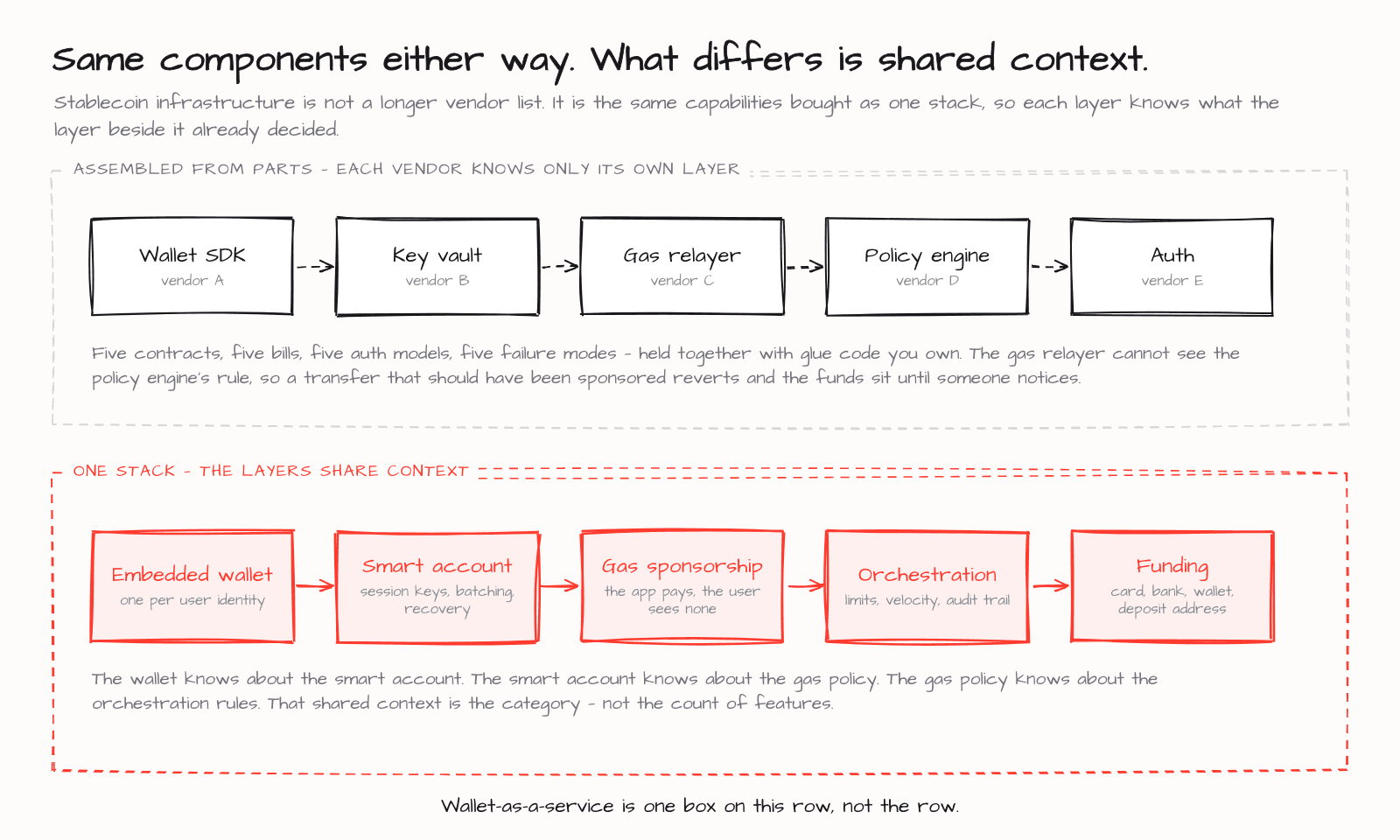
These eight components are not independent tools that happen to coexist. In stablecoin infrastructure, they share context. The wallet knows about the smart account. The smart account knows about the gas policy. The gas policy knows about the orchestration rules. This shared context is what separates integrated infrastructure from a vendor stack held together with glue code.
The funding layer
Funding is the layer teams discover last and need first. A remittance app can have flawless wallets and sponsored gas and still fail because a user in Lagos has no way to put money in.
There are two directions and they are not symmetric. On-ramps convert fiat into stablecoins and are gated by geography — a provider that covers the US and the EU is useless to a product built for Southeast Asia. Off-ramps convert back, and there the constraint is fees and local banking partners rather than coverage.
Openfort funding covers all four paths — a transfer from another wallet, a withdrawal from an exchange, a universal deposit address that bridges whatever the user already holds, and a fiat purchase by card, Apple Pay, Google Pay, or bank transfer. All of them advance through one funding session with the same statuses, so the failure handling is written once rather than once per rail. We go through the whole build in the crypto onramp guide.
Whichever provider you pick, check the country list against your actual users before you check anything else. Coverage is the constraint that decides whether the product works at all, and it is the one that vendor comparison tables cover worst.
Who needs stablecoin infrastructure
Teams building stablecoin remittance apps
Remittance products move money between people across borders. Users expect to enter an amount, pick a recipient, and send. Behind the scenes, the app must create a wallet for each user, abstract away gas costs, enforce per-transaction and daily limits, and settle on whichever chain has the best liquidity for that corridor. Stitching this from separate vendors means weeks of integration work for each corridor. Integrated infrastructure means one SDK call per operation.
Teams building cross-border payout platforms
Payout platforms send stablecoins from a business to hundreds or thousands of recipients — freelancers, contractors, suppliers. They need batched transactions (pay 500 people in one operation), spending policies (no single payout above $10,000 without approval), and audit trails for compliance. Transaction orchestration is not optional for these teams. It's the core product requirement.
Teams building stablecoin-native payment apps
In Latin America, Africa, and Southeast Asia, stablecoin payment apps are replacing legacy payment rails. These apps serve users who may not have bank accounts but do have smartphones. The infrastructure must handle social login authentication, sponsored gas (users can't buy ETH to pay fees), and multi-chain support (different stablecoins dominate different markets). Every extra vendor in the stack is another point of failure in markets where reliability is the product.
Teams building virtual accounts and earning integrations
Virtual account products let users hold, earn yield on, and spend stablecoins from a single interface. These products combine wallet functionality with smart account programmability — automated yield strategies, scheduled transfers, spending controls. The smart account layer is what makes a wallet into a financial product. Without integrated infrastructure, teams build this logic themselves, introducing security risk at every custom integration point.
Teams building AI agents that transact autonomously
Autonomous agents — for commerce, treasury management, or automated payments — need programmable accounts with session keys and scoped permissions. An AI agent shouldn't hold a master key. It should have a session key that allows it to spend up to $100 on approved transaction types within a 24-hour window. Smart accounts with orchestration policies make this possible. Wiring it from scratch with separate wallet and policy vendors is a security engineering project, not an afternoon of integration.
How to evaluate stablecoin infrastructure
Not all infrastructure claiming to serve stablecoin product teams is equivalent. Some providers offer one piece of the stack and call it "infrastructure." Others offer the full stack but lock you into proprietary systems.
Use this framework to evaluate any provider:
| Criteria | What to look for | Why it matters |
|---|---|---|
| Coverage | Does it include wallets + smart accounts + gas sponsorship + orchestration? Or just wallets? | Partial coverage means you still need additional vendors, defeating the purpose. |
| Open-source components | Is the key management layer open-source? Can you audit the signing infrastructure? | You're building products that hold monetary value. "Trust us" is not a security model. Look for open-source key signers and verifiable security. |
| Pricing model | Per-operation, percentage of volume, or enterprise-only? | Per-operation pricing scales predictably. Percentage-based pricing punishes growth. Enterprise-only means you can't start building today. |
| Self-serve access | Can you sign up, get API keys, and start building without a sales call? | Stablecoin product teams move fast. If you need a 3-week procurement process to get sandbox access, the infrastructure isn't built for builders. |
| Non-custodial | Does the provider hold keys, or do users retain control? | Custodial infrastructure creates regulatory liability and counterparty risk. Non-custodial is the default for any serious stablecoin product. |
| Multi-chain | How many chains are supported? Can you add new chains without rewriting? | Stablecoin liquidity is multi-chain by nature. Single-chain infrastructure limits your addressable market. |
| SDK coverage | Web, mobile (iOS/Android), server-side? React Native? Flutter? Unity? | Your users are on mobile. If the SDK only supports web, you're writing native bridges yourself. |
Where current providers fall
The market includes several approaches:
- Wallet-only providers offer embedded wallets and authentication but stop there. Gas sponsorship, transaction orchestration, and smart account management are your problem. This is the WaaS model — useful as a component, insufficient as infrastructure.
- Enterprise custody platforms provide institutional-grade key management and policy engines but require six-figure contracts, months-long onboarding, and closed-source everything. They serve banks, not startups building payment apps.
- Broad horizontal platforms offer a wide toolkit for general-purpose development (NFTs, gaming, DeFi, stablecoins) but lack depth in any single vertical. The stablecoin-specific features — gas policies for payment flows, orchestration for compliance, batched payouts — are afterthoughts.
- Unified stablecoin infrastructure combines all eight components into one SDK with self-serve access, transparent pricing, and open-source key management. Openfort takes this approach: one integration that covers wallets, smart accounts, gas, orchestration, and authentication — with OpenSigner, an open-source key management layer, at its core. Operation-based pricing means you pay per transaction, not per wallet or percentage of volume.
The right choice depends on what you're building. If you need a wallet widget for a DeFi app, a wallet-only provider works. If you're building a stablecoin payment product that needs to handle real money flows with policies, gas abstraction, and compliance hooks, you need the full stack.
The shift from wallet infrastructure to stablecoin infrastructure
For three years, "wallet-as-a-service" defined the category. The premise: make it easy to give users wallets. The WaaS era solved a real problem — nobody should build key management from scratch.
But wallets are a means, not an end. No user wants a wallet. Users want to send money, receive payouts, save in stable value, or pay for goods. The wallet is plumbing.
The stablecoin market has matured past the wallet layer:
- Regulatory clarity is arriving. MiCA is enforced in Europe. The US is advancing stablecoin-specific legislation. Compliance isn't optional, and it requires transaction-level controls that wallet providers don't offer.
- Transaction volumes demand reliability. Monthly stablecoin transfer volumes exceeded $2.7 trillion in late 2024 [Source: Artemis Analytics, 2025]. Products handling this volume need orchestration, not just key storage.
- Users are not crypto-native. The next wave of stablecoin users in emerging markets will never install a browser extension or write down a seed phrase. The entire stack — from authentication to transaction execution — must be invisible.
Wallet infrastructure was the foundation. Stablecoin infrastructure is the building that goes on top. Teams still need wallets, but they need them integrated with gas, accounts, orchestration, and policies — not as a standalone service with five other vendors bolted on.
Openfort provides stablecoin infrastructure — one SDK for embedded wallets, smart accounts, gas sponsorship, and transaction orchestration, built on open-source key management. Start building at openfort.io.