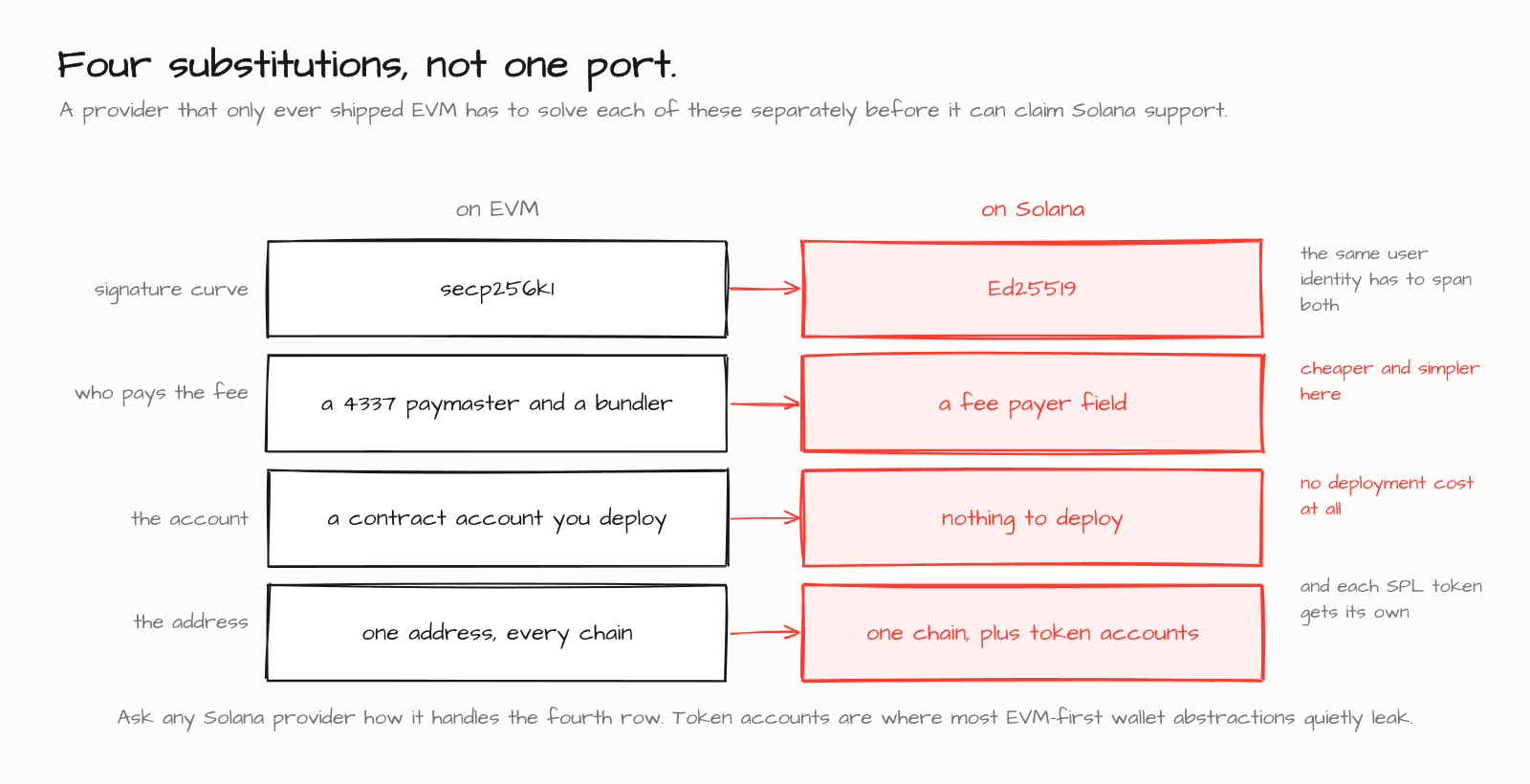
Solana keeps eating share of crypto activity — payments, memecoins, consumer apps, and a growing amount of agent-driven volume. For a developer shipping on Solana in 2026, the wallet layer is shaped differently from Ethereum: Ed25519 keys instead of Secp256k1, no ERC-4337, and a smaller but higher-performance infrastructure market. This guide compares the Solana wallet providers developers pick, across embedded wallets, signing infrastructure, SDKs, and compliance.
Quick Comparison
| Provider | Best For | Solana Support | Pricing Model | Key Strength | Key Limitation |
|---|---|---|---|---|---|
| Openfort | Multi-chain products shipping Solana + EVM | Wallet creation and signing; smart wallet features in progress | Free tier + usage-based | Open-source, self-hostable signer, same SDK covers Solana + EVM | Advanced Solana smart wallet features are still rolling out |
| Phantom | Consumer apps that want to reach existing Solana users | Native consumer wallet + MCP server | Free | Largest installed base of Solana users, MCP server for agents | Consumer wallet — limited programmatic controls |
| Turnkey | Treasury, high-frequency signing, agent infrastructure | Ed25519 native, TEE-isolated | Usage-based, $99/mo Pro, $0.0015/sig Enterprise | Hardware-isolated keys, full remote attestation, 100–150ms signing | Gasless/fee payer on custom plans only, Pro capped at 2,000 wallets |
| Privy | Consumer apps on Solana with Stripe-native payments | Embedded wallets on Solana | Free tier + $299/mo Core | Polished onboarding, Stripe ecosystem, cross-app wallet | EVM primary depth — Solana is a secondary chain; smart wallet via third-party |
| Dynamic | Multi-chain apps with wallet aggregation | Embedded + external Solana wallets | Free tier + usage-based | Multi-wallet auth UI, supports EVM + Solana + Cosmos | Agent support less developed; acquired by Fireblocks |
| Crossmint | Stablecoin products needing onramps and EU compliance | Smart contract wallets on Solana (+ EVM, Stellar) | 1,000 MAW free + usage | Native onramps/offramps, MiCA CASP license, dual-rail card + stablecoin | Proprietary stack; opinionated compliance tooling |
| Web3Auth | Apps that need social login on Solana at low per-MAU cost | MPC-based wallets on Solana | Free tier + $69/mo for 3K MAUs | Lowest per-MAU cost, familiar social login | MPC ceremony latency; no native smart wallet features |
Openfort
Openfort launched Solana support in 2025, bringing its open-source embedded wallet infrastructure to the Ed25519 world. The same SDK that covers EVM embedded wallets, smart accounts, and backend automations now provisions non-custodial Solana wallets, signs transactions, and handles message signing. Openfort is the only open-source and self-hostable option among embedded wallet providers on Solana.
Key features:
- Non-custodial Solana wallets with email and social login
- Simple, developer-friendly APIs for wallet creation and signing
- Same identity flow across Solana and EVM (derive both addresses from one login)
- Session keys and backend wallet automations for agent and server-side use
- Open-source signer (OpenSigner) — self-hostable for full custody control
- Multi-chain SDK covering JavaScript, React, React Native, Swift, Unity, and Node.js
- TEE-managed keys with self-hosting option for sovereignty
Pricing: Free tier includes 2,000 operations per month across Solana and EVM. Paid plans are usage-based — one operation is a wallet creation or a transaction, no separate per-signature fees.
Best for: Teams building products that span Solana and EVM, or Solana-first teams that want an open-source stack and the option to self-host the signer.
Limitations: Advanced smart wallet features on Solana (multi-sig flows, native gas sponsorship through fee-payer, and program-level account abstraction primitives) are still in active development. Today the Solana surface is the embedded wallet and signing layer — if you need a managed smart contract wallet on Solana with policy-engine-level guardrails built in today, Crossmint or Turnkey have more mature offerings. No native onramp or offramp (BYO).
Differentiator: Open-source and self-hostable. Openfort is the only embedded wallet provider on Solana where you can audit the signing code and run your own signer when regulatory or sovereignty requirements demand it.
Phantom
Phantom is the dominant consumer wallet on Solana — a browser extension, mobile app, and the default user experience for Solana applications. Phantom's developer surface includes wallet adapter integration and, more recently, an MCP server for AI agents.
Key features:
- Browser extension and mobile (iOS, Android) consumer wallet
- Wallet adapter standard integration (Solana standard for dApp connection)
- MCP server: AI agents can sign transactions, execute swaps, and transfer tokens
- Built-in swap UI and fiat onramp via partners
- Support for Solana, Ethereum, Base, and Polygon in a single app
Pricing: Free.
Best for: Products that target existing Solana users who already have Phantom installed, and agents that need to operate a user's Phantom wallet via MCP.
Limitations: Phantom is a consumer wallet, not a developer wallet infrastructure platform. You cannot provision Phantom wallets through your app, enforce spending limits programmatically, or manage them at the fleet level. The MCP integration adds agent access to a consumer wallet but does not add the policy controls a purpose-built agent wallet provides.
Differentiator: Reach. Most Solana users already have Phantom — integrating Phantom means meeting users where they are.
Turnkey
Turnkey operates at the cryptographic curve layer, signing Ed25519 (Solana) and Secp256k1 (EVM) inside the same AWS Nitro Enclave. This makes Turnkey chain-agnostic by design: Solana support is a first-class path from day one, not a retrofit. Turnkey is the strongest Solana option for treasury, high-frequency signing, and agent infrastructure.
Key features:
- TEE-based key management (AWS Nitro Enclaves)
- Ed25519 support at the curve layer — no waiting for chain-specific support
- Full remote attestation and reproducible builds
- 100–150ms signing latency — suitable for high-frequency trading and market-making
- Org-level policy engine enforced inside the TEE
- Key import and export
- Passkey, email, SMS (custom), OAuth, Telegram, and custom auth flows
- Multichain support across 50+ blockchains
Pricing: Free tier: 25 signatures per month, up to 100 wallets. Pay-as-you-go: $0.10 per signature, up to 1,000 wallets. Pro: $99/month, $0.05 per signature, up to 2,000 wallets. Enterprise: custom, as low as $0.0015 per signature.
Best for: Solana treasury operations, WaaS platforms, trading desks, market makers, and autonomous agents that require verifiable key custody and fast signing.
Limitations: Gasless / fee-payer transactions are on Enterprise and custom plans only. Custom JWT/OIDC authentication is not supported. Pro tier is capped at 2,000 wallets — not for high-volume consumer Solana apps. BYO stack: no built-in onramp, offramp, or consumer onboarding UI.
Differentiator: Curve-layer architecture plus attestation. For Solana teams that need hardware-isolated keys with independent cryptographic verifiability, Turnkey is the ceiling.
Privy
Privy (acquired by Stripe in June 2025) is the consumer-focused embedded wallet product, with Solana supported alongside EVM and Bitcoin. Solana is a secondary chain for Privy — the primary depth is on EVM — but the embedded wallet flow, server wallets, and agentic CLI all extend to Solana.
Key features:
- Embedded Solana wallets provisioned on user signup
- Email, phone, social, and passkey authentication
- JWT-based auth with Auth0, Firebase, or custom providers
- Cross-app "Global wallet" for portability within the Stripe ecosystem
- Server wallets with off-chain policy API
- Agentic CLI for AI-driven wallet operations
- Bridge (Stripe) stablecoin rails
Pricing: Free tier up to 499 MAUs. Core tier at $299/month for up to 2,500 MAUs. Apps over 10K MAUs, 50K signatures, or $1M monthly transaction volume move to usage-based billing.
Best for: Consumer apps on Solana that also touch EVM, or teams already on Stripe that want wallets plus fiat rails in one flow.
Limitations: Privy's depth is on EVM — Solana-specific features are narrower. Smart contract wallet programs on Solana are not native; you integrate at the signer level. Per-wallet policy scoping means a missed API call leaves a wallet without guardrails. Closed-source with no remote attestation of the TEE.
Differentiator: Stripe integration. For Solana consumer apps that also accept card and stablecoin payments, Privy plus Bridge is the shortest path from signup to a funded wallet with fiat settlement.
Dynamic
Dynamic (acquired by Fireblocks in 2025) provides multi-chain authentication and wallet connection with embedded wallets across EVM, Solana, and Cosmos. Dynamic's polished onboarding modal is the strongest pre-built consumer wallet UI on Solana that is not vertically locked to an ecosystem.
Key features:
- Embedded Solana wallets with social and email login
- Multi-wallet aggregation: users can link external Solana wallets (Phantom, Solflare) alongside an embedded wallet
- Branded auth UI with extensive customization
- Session management and JWT-based auth
- Sandbox environment for testing
- Configurable MPC or smart contract wallet architecture
Pricing: Free tier available. Usage-based pricing for growth and enterprise tiers.
Best for: Solana apps where users bring their own wallet (Phantom, Solflare) but you also want to offer an embedded option for users who do not have one.
Limitations: No native transaction orchestration, no fee-payer infrastructure, no smart wallet programs. Agent-specific capabilities are less developed than dedicated agent platforms. Strategic direction is in flux after the Fireblocks acquisition.
Differentiator: Wallet linking on Solana. If your product serves both crypto-native users (who want to connect Phantom) and new users (who need an embedded wallet), Dynamic is the only provider that handles both in a single polished flow.
Crossmint
Crossmint is an all-in-one stablecoin and wallet platform with smart contract wallets as the default on Solana, EVM, and Stellar. Crossmint bundles wallets, onramps, offramps, and compliance (MiCA CASP license across all 27 EU member states) into a single API — the broadest developer-facing Solana stack for regulated stablecoin products.
Key features:
- Smart contract wallets by default on Solana, EVM, and Stellar
- Custodial and non-custodial configurations per user
- Upgradeable wallet architecture — swap signer without migrating assets
- Native onramps (card, Apple Pay, Google Pay in 160+ countries)
- Native offramps in 100+ countries, including mobile money and cash agents
- Stablecoin orchestration across 50+ chains
- Built-in KYC/KYB (Persona), AML screening (Elliptic), Travel Rule (NotaBene)
- MiCA CASP licensed in the EU
- Gas sponsorship configurable
- Agent wallets with stablecoin + card rails via Lobster Cash
- Company/treasury wallets via AWS KMS, Azure Key Vault, GCP HSM
Pricing: 1,000 monthly active wallets free (includes wallets, payments, and compliance). Paid tiers usage-based.
Best for: Stablecoin products on Solana that need onramps, offramps, and EU compliance in one platform, or teams building consumer payment experiences that must clear regulatory bars from day one.
Limitations: Proprietary stack — not open-source and not self-hostable. Opinionated compliance tooling: you get Persona, Elliptic, and NotaBene whether you want them or not. Heavier platform footprint than a pure signing primitive.
Differentiator: Compliance plus onramps on Solana. Crossmint is the only provider on this list that ships wallets, fiat rails, and a MiCA license in the same product.
Web3Auth
Web3Auth (acquired by MetaMask/Consensys) supports Solana through its MPC-based social login model. Key shares are distributed across devices, server, and recovery, and recombined when a user signs. Web3Auth is the lowest per-MAU option for teams that primarily need social login on Solana.
Key features:
- MPC key management with Shamir Secret Sharing
- Solana support alongside EVM, Bitcoin, and others
- Social logins (Google, Apple, Discord, Facebook, custom)
- Wide ecosystem adoption and integrations
- SDKs for JavaScript, iOS, Android, Unity
Pricing: Free tier available. Paid plans start at $69/month for 3,000 MAUs.
Best for: Solana apps that want familiar social login at low per-MAU cost and do not need smart wallet features or agent-grade policy enforcement.
Limitations: MPC ceremony adds latency versus TEE-based signing, and keys are briefly reconstructed in memory. No native smart contract wallet support on Solana. Ownership by MetaMask/Consensys introduces strategic uncertainty.
Differentiator: Per-MAU cost. For Solana apps targeting a large user base with social login only, Web3Auth's pricing is the lowest on this list.
How to Choose a Solana Wallet Provider
The right Solana wallet depends on your product shape and your compliance surface.
If you are building a multi-chain product across Solana and EVM: Choose Openfort. One SDK covers both chains, with an open-source self-hostable signer for sovereignty and a unified identity flow across Ed25519 and Secp256k1.
If your users are already Solana-native and have Phantom: Integrate Phantom via wallet adapter, and add an embedded fallback through Dynamic or Privy for new users.
If you run a trading desk, treasury, or high-frequency signing workload: Choose Turnkey. Curve-layer TEE signing, full attestation, sub-150ms latency, and per-signature pricing that scales down at enterprise volume.
If you are building a consumer Solana app with Stripe payments: Choose Privy. Bridge stablecoin rails and fiat settlement in the same flow as wallet provisioning.
If your product is EVM-primary with Solana as a secondary chain and you need wallet connection UX: Choose Dynamic. Multi-wallet aggregation plus embedded fallback across both chains.
If you are shipping a stablecoin product in the EU or need onramps and offramps built in: Choose Crossmint. MiCA CASP license, native fiat rails, and compliance tooling in one platform.
If you need cheap social login on Solana at scale: Choose Web3Auth — provided you do not need smart wallet features.
Detailed Feature Comparison
| Feature | Openfort | Phantom | Turnkey | Privy | Dynamic | Crossmint | Web3Auth |
|---|---|---|---|---|---|---|---|
| Solana embedded wallets | Yes | N/A (consumer) | Yes | Yes | Yes | Yes | Yes |
| Ed25519 signing | Yes | Yes | Native curve-layer | Yes | Yes | Yes | Yes (MPC) |
| Provision wallets via SDK | Yes | No | Yes | Yes | Yes | Yes | Yes |
| Multi-chain (Solana + EVM) | Yes | Yes (consumer) | Yes | Yes | Yes | Yes | Yes |
| Smart contract wallets | Roadmap | No | Via program | Via integration | Configurable | Yes (default) | No |
| Gas sponsorship / fee payer | Roadmap | Partner-dependent | Custom plans | Paid tier | No | Yes | No |
| Native onramp / offramp | No | Partner | No | Via Bridge (Stripe) | No | Yes | No |
| Open-source | Yes | No | No | No | No | No | Partial |
| Self-hostable signer | Yes (OpenSigner) | No | No | No | No | No | No |
| Free tier | 2,000 ops/mo | Consumer free | 25 sigs/mo, 100 wallets | 499 MAUs | Yes | 1,000 MAW | Yes |
| MCP / agent support | Backend wallets | MCP server | Policy engine, agent-ready | Agentic CLI | Basic | Lobster Cash agent wallets | N/A |
Building on Solana in 2026
Solana's developer tooling matured quickly in 2025, and 2026 is the year the wallet layer caught up with the rest of the stack. The choice of wallet provider on Solana shapes your onboarding UX, your compliance posture if you handle fiat, and your ability to ship agent-driven or high-frequency products without assembling five vendors.
If you are building a Solana product — especially one that also touches EVM — and you want an open-source stack with the option to self-host the signer, Openfort supports Solana today. Read the Solana launch post or the docs to get started.