Fireblocks is the leading digital asset infrastructure platform for financial institutions. By its own count, it has secured 16 trillion USD in digital asset transactions across 200+ blockchains for customers including Worldpay, BNY, Galaxy, and Revolut. However, its enterprise-focused pricing and proprietary infrastructure don't suit every team. Many developers and organizations seek alternatives that offer better pricing transparency, open-source options, or specific features like native smart accounts.
What are the best Fireblocks alternatives?
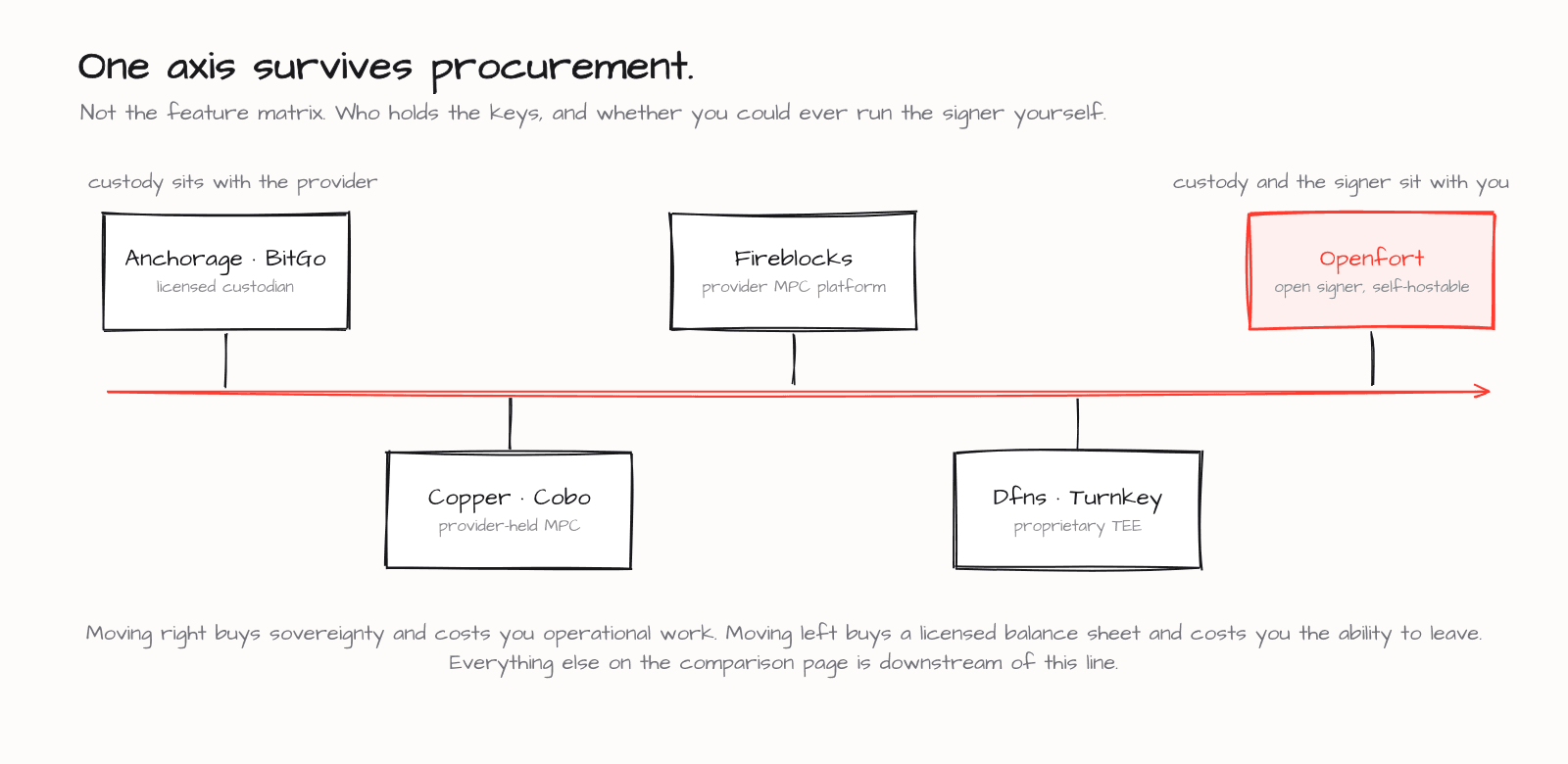
The best Fireblocks alternatives in 2026 are Openfort, Safe, BitGo, and Cobo. Openfort is the top choice for developers who need open-source infrastructure (OpenSigner), native smart account features like session keys and gas sponsorship, and a modular architecture that prevents vendor lock-in. Safe is the open-source choice for EVM treasuries that want every approval enforced and recorded onchain. BitGo (recently IPO'd on NYSE) is ideal for institutions requiring regulated, insured custody with multi-signature security. Cobo offers a versatile multi-wallet solution integrating MPC, custodial, and smart contract wallets. For U.S. institutions requiring federal bank charter, Anchorage Digital provides a unique regulatory position.
Fireblocks pricing
Fireblocks publishes two tiers on its pricing page:
| Plan | Price | Outbound volume | Overage | Embedded wallets |
|---|---|---|---|---|
| Essentials | 999 USD per month, for up to six months | 1,000,000 USD per quarter | 0.20% per transaction | 5,000 Dynamic embedded wallets |
| Pro, Enterprise, Enterprise+ | Custom annual plans, starting at 36,000 USD per year | Custom | Custom | Custom |
Two things decide what you actually pay. First, Essentials is an on-ramp to a custom contract, not a long-term plan: it runs for up to six months. Second, the volume cap is on outbound value, so a payments or treasury product that moves more than 1,000,000 USD a quarter pays the 0.20% overage on every dollar above it until it signs a custom plan. On 5,000,000 USD of quarterly outbound volume, that overage alone is 8,000 USD a quarter.
The alternatives price differently. Openfort and Turnkey publish usage-based pricing with free tiers. Safe's contracts are open source, so you pay gas to deploy and use a Safe but no license fee. BitGo, Anchorage, and Copper quote custom institutional contracts.
1. Openfort
Openfort (that's us) is an open-source wallet infrastructure solution that abstracts crypto complexity for both users and developers. Its platform allows developers to plug and play any signer (including Opensigner for embedded wallets) and contract they prefer, simplifying the whole vertical use case—from cross-app ecosystems and AI agents to fintech and DeFi.
Key Features
Openfort is designed for teams that are currently using Fireblocks and hitting limits around pricing opacity, need native smart account features (ERC-4337), want open-source self-hostable infrastructure, or need a solution that works for both consumer and enterprise use cases.
Opensigner for embedded wallets: Openfort's core signing infrastructure (Opensigner) is open-source and self-hostable, giving you complete sovereignty over your users' keys and data. Unlike Fireblocks' proprietary MPC, you can audit the code and self-host if needed. Opensigner powers Openfort's embedded wallet product, with onboarding via social login, email, or any OIDC provider. Learn more about how to avoid wallet vendor dependency.
TEE backend wallets for server-side key management: Openfort also provides backend wallets using Trusted Execution Environments (TEEs) for server-side private key storage. These are ideal for automating transactions, enforcing permissions, and running wallet automations without exposing keys to your application layer.
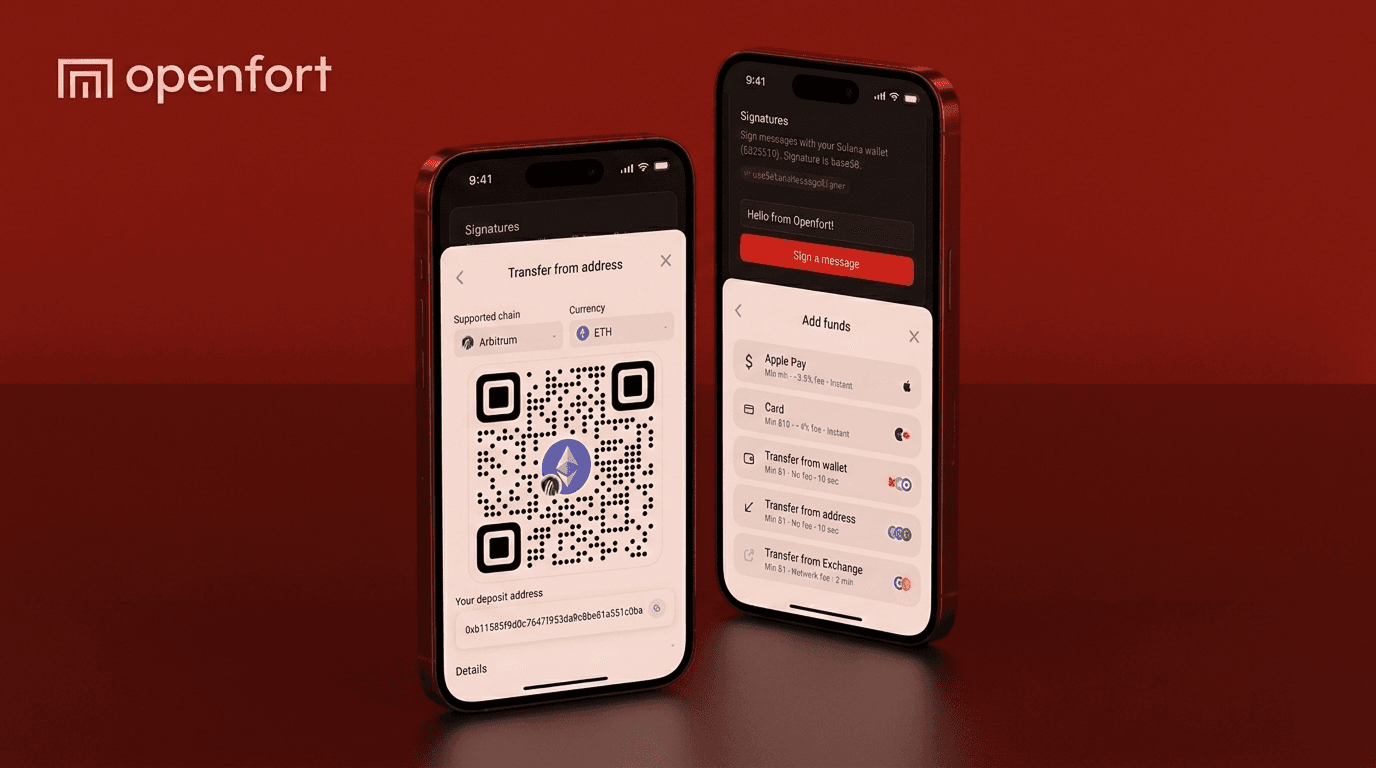
Built-in blockchain infrastructure: Unlike Fireblocks, which requires separate integrations for smart account features, Openfort includes native paymasters for gasless transactions, session keys, and a policy engine out of the box. For example, you can build a DeFi application with embedded wallets and smart accounts that sponsors gas for users—without needing third-party paymaster providers. Openfort also ships built-in funding for end users: cards, Apple Pay, and a universal deposit address that auto-swaps any token on any chain. Fireblocks focuses on institutional custody/transfers and leaves consumer funding to you.
Comparison Table: Openfort vs. Fireblocks
| Feature | Openfort | Fireblocks |
|---|---|---|
| Target Market | Startups to Enterprise | Large Enterprise |
| Open Source | ✅ (OpenSigner) | ❌ (Proprietary MPC) |
| Key Management | SSS (Self-hostable) | MPC (Proprietary) |
| Smart Wallets | ✅ Native (4337, 7702) | ⚠️ Separate offering |
| Blockchain Support | EVM + Solana | 200+ blockchains |
| Funding | ✅ Native + universal deposit address | ❌ No consumer onramp (institutional transfers only) |
| Pricing Model | Usage-based (Transparent) | Enterprise (Custom) |
| Vendor Lock-in | ❌ None (Exportable keys) | ⚠️ High (Proprietary) |
| Gas Sponsorship | ✅ Native Policy Engine | ⚠️ Separate integration |
| Session Keys | ✅ Granular Permissions | ❌ Not native |
| Compliance | In progress | SOC 2, ISO 27001 |
| Server Wallet | ✅ Backend Wallet | ✅ WaaS |
| Permission Model | On-chain (session keys) | Off-chain (enterprise policies) |
Scaling Considerations
Openfort uses usage-based pricing where an operation is creating a wallet or sending a transaction. You pay for what you use, with no per-seat or MAU-based fees. Transaction volume is unlimited and every feature ships on the free tier with no gating, so costs stay predictable from day one and scale with usage. Fireblocks uses an enterprise fixed-fee plus transaction-volume overage model that caps outbound volume with overage charges and gates features behind add-ons and tiers, requiring enterprise contracts with custom pricing. Openfort also provides native ERC-4337 and EIP-7702 support with policy engines for gas sponsorship, while Fireblocks offers embedded wallets but smart account features require additional integration work. On chain support, Fireblocks covers 200+ blockchains, while Openfort focuses on EVM chains and Solana with deep smart account and paymaster integration.
Why developers choose Openfort
Developers choose Openfort when they want enterprise-grade security through Opensigner and TEE backend wallets, but with open-source sovereignty, native smart account features including gasless transactions via built-in paymasters, and predictable usage-based pricing—all without the enterprise sales cycles and opaque contracts that Fireblocks typically requires.
2. Safe
Safe (formerly Gnosis Safe) is an open-source smart account with multisig at its core. You define a set of owners and a threshold, and a transaction executes only once enough owners have confirmed it. Owners can be EOAs, hardware wallets, passkeys, or other smart accounts (Safe docs). Safe's contracts have been in production since 2018 and are audited by firms including OpenZeppelin, Ackee Blockchain, and Certora (Safe security).
Safe vs. Fireblocks
The two answer the same question, "how many people must approve this transfer?", in different places. Fireblocks splits one key into MPC shares and enforces approvals in its off-chain policy engine; the chain sees a single ordinary signature. Safe keeps each signer's key separate and enforces the threshold in a smart contract, so the approval rule and every confirmation are visible onchain.
| Feature | Safe | Fireblocks |
|---|---|---|
| Approval model | Onchain m-of-n multisig | MPC key shares + off-chain policy engine |
| Open source | ✅ Contracts, interfaces, and core modules | ❌ Proprietary |
| Chains | EVM chains | 200+ blockchains, EVM and non-EVM |
| Pricing | No license fee; you pay gas per deployment and transaction | From 999 USD per month (Essentials) |
| Exchange connectivity | Via integrations | ✅ 30+ exchanges and 2,000+ network counterparties |
| Recovery | Owner rotation and guardian-based recovery modules | Key share backup and recovery through Fireblocks |
| Auditability | Every approval is an onchain record | Fireblocks console and audit logs |
Scaling considerations
Safe's costs scale with gas, not with volume: a 10,000,000 USD transfer costs the same to execute as a 10 USD one. The trade-offs are coverage and operations. Safe only covers EVM chains, every signer manages their own key, and multisig transactions cost more gas than single-signature ones because the contract checks each confirmation. There is no exchange network, so moving funds to a venue is an ordinary onchain transfer. If you need both, the two can split the work: Fireblocks for exchange and non-EVM flows, and a Safe for the EVM treasury.
Why developers choose Safe
Teams choose Safe when their assets live on EVM chains and they want approvals that no vendor can change or hide. DAOs, protocol treasuries, and crypto-native companies use it because the rules are in a contract anyone can read, and leaving Safe means changing a frontend, not migrating keys. For consumer wallets, gas sponsorship, or session keys, pair it with application-layer infrastructure such as Openfort.
3. BitGo
BitGo is a pioneer in crypto custody, offering multi-signature wallets and regulated trust services for institutions. BitGo went public on NYSE in January 2026, achieving a ~$2B market valuation. For how its charters compare with the rest of the market, see our guide to crypto custody providers.
Comparison Table: BitGo vs. Fireblocks
| Feature | BitGo | Fireblocks |
|---|---|---|
| Security | Multi-sig + MPC | MPC (Proprietary) |
| Custody Type | Qualified Custodian | Self-custody + Trust Co. |
| Insurance | ✅ Comprehensive | ✅ Available |
| Compliance | SOC 2, ISO 27001 | SOC 2, ISO 27001 |
| Exchange Integrations | Strong | ✅ 30+ exchanges |
| ETF Custody | ✅ (ARK 21Shares) | ✅ |
Scaling Considerations
BitGo offers institutional-grade custody with comprehensive insurance coverage that appeals to organizations with fiduciary responsibilities. As a qualified custodian, BitGo is suitable for funds and institutions that require regulatory compliance from the start. BitGo also serves as custodian for major Bitcoin ETFs alongside Coinbase and Anchorage, which speaks to the maturity of their infrastructure. However, BitGo does not provide native smart account features, gas sponsorship, or embedded wallet capabilities—teams needing these features would need to pair BitGo with a solution like Openfort.
Why developers choose BitGo
Teams choose BitGo when their primary requirement is regulated, insured institutional custody with a proven track record. Now a publicly traded company on NYSE, BitGo offers additional transparency into its operations and financial health. It is the strongest option for organizations where compliance and insurance are non-negotiable, though developers building consumer-facing applications may find its feature set insufficient for consumer wallet UX.
4. Cobo
Cobo provides a more advanced solution that integrates MPC Wallets, Custodial Wallets, Smart Contract Wallets, and Exchange Wallets, while Fireblocks focuses primarily on MPC wallets.
Comparison Table: Cobo vs. Fireblocks
| Feature | Cobo | Fireblocks |
|---|---|---|
| Wallet Types | MPC + Custodial + Smart Contract | MPC Primary |
| Blockchain Support | 80+ chains, 3,000+ tokens | 200+ blockchains |
| Target Market | Institutions + Developers | Large Enterprise |
| Pricing | Usage-based | Enterprise |
| Asia Focus | ✅ Strong | Global |
Scaling Considerations
Cobo's main advantage over Fireblocks is flexibility across wallet architectures in one platform. Organizations that need different security models for different use cases—hot wallets for frequent trading, cold storage for reserves, MPC for operational accounts—can manage all of them through Cobo's unified interface. Cobo also offers usage-based pricing that is more accessible than Fireblocks' enterprise contracts. That said, Cobo does not include native paymaster infrastructure for gasless transactions, so teams building consumer-facing applications would need to integrate additional infrastructure for gas abstraction.
Why developers choose Cobo
Teams choose Cobo when they need versatility across multiple wallet types and a strong presence in Asian markets. The unified platform approach simplifies operations for organizations managing diverse treasury and trading workflows, though it is more focused on institutional custody than on the developer-first embedded wallet experience that Openfort provides.
5. Anchorage Digital
Anchorage Digital is America's first federally chartered crypto bank, providing unique regulatory status for U.S. institutions.
Comparison Table: Anchorage vs. Fireblocks
| Feature | Anchorage Digital | Fireblocks |
|---|---|---|
| Regulatory Status | Federal Bank Charter (OCC) | State Trust Company |
| Custody Type | Qualified Custodian | Self-custody + Trust Co. |
| Security | HSM + Biometric | MPC (Proprietary) |
| Target | U.S. Institutions | Global Enterprise |
| Insurance | Comprehensive | Available |
Scaling Considerations
Anchorage's federal bank charter is its defining advantage, providing a level of regulatory clarity that no other crypto custodian can match in the United States. The company is planning a potential 2027 IPO backed by a $400M funding round, and as of December 2025, the OCC has granted conditional approval to Circle, Ripple, BitGo, Fidelity Digital Assets, and Paxos to operate as federally chartered national trust banks—increasing competitive pressure in this space. Anchorage does not offer developer-facing embedded wallet products, smart account infrastructure, or gasless transaction capabilities, so it is best suited for pure institutional custody rather than application development.
Why developers choose Anchorage Digital
U.S.-based institutions choose Anchorage when they need the highest level of regulatory compliance for digital asset custody. The federal bank charter and qualified custodian status make it the default choice for funds, asset managers, and financial institutions with strict fiduciary requirements. For teams building consumer-facing or developer-focused products, however, Anchorage's offering is complementary to—not a replacement for—application-layer wallet infrastructure like Openfort.
6. Copper
Copper provides institutional-grade crypto infrastructure including MPC custody, settlement, and prime brokerage services.
Comparison Table: Copper vs. Fireblocks
| Feature | Copper | Fireblocks |
|---|---|---|
| Security | MPC + Optical Air-gapping | MPC (Proprietary) |
| Services | Custody + Prime Brokerage | Custody + Settlement |
| Settlement | ClearLoop | Network |
| Target | Institutions | Enterprise |
| IPO Plans | In early talks (2026) | Private |
Scaling Considerations
Copper is in early talks for an IPO with Goldman Sachs, Citi, and Deutsche Bank as potential banks, which reflects the institutional credibility of their platform. Their ClearLoop settlement system integrates directly with exchanges, which is valuable for trading firms that need custody integrated with prime services. Like most institutional custody providers, Copper does not offer embedded wallet infrastructure, paymaster support for gasless transactions, or developer-focused SDKs for consumer applications.
Why developers choose Copper
Trading firms and institutions choose Copper when they need custody tightly integrated with prime brokerage and settlement services. The combination of MPC security with optical air-gapping provides strong protection for high-value assets, and ClearLoop enables off-exchange settlement that reduces counterparty risk. Copper is best suited for institutional trading operations rather than consumer application development.
7. Dfns
Dfns is a leading wallets-as-a-service platform used by startups, enterprises, and financial institutions. Dfns has helped ABN AMRO, Fidelity, Zodia Custody, FIFA, and others create over a million wallets.
Comparison Table: Dfns vs. Fireblocks
| Feature | Dfns | Fireblocks |
|---|---|---|
| Technology | Advanced MPC | MPC (Proprietary) |
| Target | Banks + Fintechs | Large Enterprise |
| Deployment | Cloud + On-prem | Cloud |
| API Focus | ✅ Developer-first | Enterprise SDK |
| Compliance | SOC 2, ISO | SOC 2, ISO |
Scaling Considerations
Dfns focuses squarely on regulated financial institutions with bank-grade compliance requirements. Their strong suit is offering both cloud and on-premise deployment options, which is critical for banks with strict data residency and security requirements. Dfns provides a developer-first API that makes integration more straightforward than Fireblocks' enterprise-oriented SDK, though it lacks native smart account features, gas sponsorship via paymasters, and embedded wallet onboarding that platforms like Openfort include out of the box.
Why developers choose Dfns
Banks and fintechs choose Dfns when they need institutional-grade MPC key management with flexible deployment options—particularly on-premise installations that satisfy regulatory mandates. Dfns has demonstrated real-world scale with clients like ABN AMRO and Fidelity, and its developer-first API approach reduces integration friction compared to Fireblocks. However, teams that also need consumer-facing wallet features like gasless transactions or social login would need to combine Dfns with additional infrastructure.
8. Turnkey
Turnkey (founded by the Coinbase Custody team) provides secure, programmable key management infrastructure using TEEs with 100–150 ms signing latency. Turnkey supports 7702 smart accounts and a full suite of auth methods (though custom JWT/OIDC is not supported, and custom email templates, custom domains, and SMS are only on custom tiers). Turnkey focuses on company and treasury-based wallets, with the Pro tier limited to 2,000 wallets. Gas sponsorship is available from the $99/month Pro tier upward, not on pay-as-you-go.
Comparison Table: Turnkey vs. Fireblocks
| Feature | Turnkey | Fireblocks |
|---|---|---|
| Technology | TEE (Enclaves) | MPC |
| Product Level | Infrastructure API | Full Platform |
| Performance | 100–150 ms signing | Standard |
| Pricing | Usage-based | Enterprise |
| Target | Developers | Enterprise |
Scaling Considerations
Turnkey offers developer-focused infrastructure with transparent usage-based pricing, making it accessible without enterprise sales cycles. Turnkey provides the TEE-based signing primitive, and you build the wallet experience on top. Teams get faster signing than traditional MPC solutions, but they also take on building their own embedded wallet UX, gas management, and paymaster integrations. Openfort, by contrast, includes all of these components natively alongside its signing infrastructure.
Why developers choose Turnkey
Developers choose Turnkey when they want the lowest-level key management infrastructure with excellent performance and are prepared to build the rest of the wallet stack themselves. It is the right choice for teams with strong engineering resources that want maximum control over the user-facing wallet experience. Teams that prefer a more complete solution with built-in paymasters for gasless transactions, embedded wallet onboarding, and smart account orchestration may find that Openfort requires less custom development.
Building In-House
Building your own custody solution is the ultimate alternative to Fireblocks.
Pros
- Total Control: Build the exact security model and features you need.
- No Vendor Dependency: Complete ownership of infrastructure.
Cons
- Complexity: HSM integration, key ceremony, disaster recovery, and compliance are extremely complex.
- Cost: Building and maintaining enterprise-grade custody requires significant investment.
- Liability: You own all security and compliance risk.
For a deeper dive into the trade-offs, check out our guide to crypto wallet infrastructure and our guide on building vs buying wallet infrastructure.
FAQ
1. Is Fireblocks only for large enterprises? No, but its pricing is built around enterprise contracts. The Essentials plan costs 999 USD per month for up to six months, includes 1,000,000 USD of quarterly outbound volume, and charges 0.20% per transaction above that. Custom plans start at 36,000 USD per year.
2. Can I use Openfort with Fireblocks? Yes! You can use Fireblocks for key management and layer Openfort's smart account infrastructure on top for gas sponsorship, session keys, and policy engines.
3. What's the difference between MPC and TEE? MPC (Multi-Party Computation) distributes key shares across multiple parties. TEE (Trusted Execution Environment) runs code in secure hardware enclaves. Both provide strong security with different trade-offs.
4. Does Fireblocks support smart accounts? Fireblocks offers embedded wallets for consumer applications, but native ERC-4337 smart account features like session keys and batching require additional integration.
5. Is there a wallet-as-a-service alternative that covers both consumer apps and institutional flows? Yes — Openfort's wallet-as-a-service platform is the only open-source option that pairs consumer-grade embedded wallets with TEE backend wallets for treasury and server-side automation. You ship a Fireblocks-style backend wallet workflow and a Privy-style consumer onboarding from the same SDK.
Conclusion
Fireblocks is an excellent choice for large enterprises that need institutional-grade custody with broad blockchain support and exchange integrations.
However, if you need open-source sovereignty through Opensigner, native smart account capabilities with built-in paymasters for gasless transactions, TEE backend wallets for server-side key management, or transparent usage-based pricing where you only pay per operation, Openfort provides the infrastructure you need without enterprise lock-in.
Explore Openfort's embedded wallet, the broader open-source wallet-as-a-service platform, wallet automations, or account abstraction infrastructure to learn more. See also: Privy alternatives, Turnkey alternatives, Web3Auth alternatives, Thirdweb alternatives, MetaMask alternatives.