TL;DR
This builder's guide walks through architecting a fintech app on Solana that uses embedded wallets and stablecoin payments from day one. It covers wallet onboarding (email/social/passkey), account setup, stablecoin flows (USDC, EURC), gas sponsorship, and ops considerations for a production deployment. You'll see how to glue the pieces together with the Openfort SDK, plus practices for KYC, compliance boundaries, and failure modes. It's aimed at teams who need to ship a working fintech MVP in weeks, not quarters. Use it as a template before building your own.
Stablecoins are now a working part of the fintech stack — particularly on Solana, where USDC settles in under a second at a fraction of a cent and runs 24/7 without correspondent banks. This guide is for builders shipping that stack in production: the architecture decisions, the layers you actually need, and how to wire them together from sign-up to payout. The examples use Openfort for the wallet layer and USDC on Solana for settlement, a combination already in production at a growing number of consumer fintech apps.
Why Builders Are Choosing Stablecoins Over Traditional Rails
The trade-offs are concrete enough to be worth listing.
Settlement speed. A bank transfer takes 1–3 business days. A card payment nets 2 days later. USDC on Solana settles in ~400 milliseconds, finalized. For gig economy platforms, marketplaces, and cross-border B2B payments, this difference compounds into a real product advantage — your users see money arrive instantly.
Global reach without per-country integrations. Stripe supports payouts in ~45 countries. USDC works anywhere with internet access. A contractor in Nigeria, a freelancer in Argentina, a supplier in Vietnam — they all receive the same USDC, at the same speed, with the same fees. For builders targeting emerging markets, this removes months of payment integration work.
Programmable money. Stablecoins let you build financial logic directly into your app — escrow, revenue splits, streaming payments, conditional releases — without relying on a payment processor's API limitations or building a compliance layer from scratch.
Lower fees at scale. Card processing runs 2–3%. ACH costs ~$0.25–$0.50/transaction. USDC on Solana costs ~$0.00025. If you're building a high-volume, low-margin fintech app (gig platforms, B2B invoice payments, remittances), the fee structure is fundamentally different.
The tradeoff: you need to handle wallet infrastructure, transaction signing, and key management. That's where embedded wallets come in — and why getting the architecture right matters.
Architecture: How a Stablecoin Fintech App Fits Together
A well-architected stablecoin fintech app on Solana has four layers. Each one abstracts complexity from the user while keeping the system non-custodial:
_10User (email/passkey auth)_10 │_10 ▼_10Embedded Wallet (Openfort — non-custodial, Ed25519 keypair)_10 │_10 ▼_10Gasless Transactions (Kora relayer via Openfort RPC — fee-sponsored)_10 │_10 ▼_10Solana → USDC transfers, payouts, escrow programs
Why this architecture matters for builders:
- Auth layer: Users authenticate with familiar credentials (email, Google, passkeys). No crypto knowledge required. Your onboarding funnel stays as clean as any traditional fintech app.
- Wallet layer: Wallets are provisioned as SVM (Solana Virtual Machine) accounts embedded in your app. Users never see a seed phrase, never install an extension — but they hold their own keys. This is the critical non-custodial property that affects your regulatory posture.
- Fee abstraction layer: The Kora relayer sponsors Solana transaction fees so users never need to hold SOL. From their perspective, they're moving dollars — not interacting with a blockchain.
- Settlement layer: All USDC transfers settle on-chain. Your backend stores transaction signatures as receipts, not balances. Solana is the source of truth.
Let's walk through how to build each layer.
Setting Up the Foundation
Start by installing the Openfort SDK and configuring your project:
_10npm install @openfort/openfort-js @solana/kit
_10import Openfort from "@openfort/openfort-js";_10_10const openfort = new Openfort({_10 publishableKey: process.env.NEXT_PUBLIC_OPENFORT_PUBLISHABLE_KEY!,_10});
In the Openfort dashboard, configure your project for Solana: select SVM as the chain type, choose EOA wallets (Ed25519 keypairs — Solana's native account model), and enable the Kora relayer for gasless transactions.
User Auth and Wallet Provisioning
The first design decision builders face: when to create a wallet for each user.
Eager provisioning creates a wallet the moment a user signs up. This is the right pattern for apps where every user will transact — payroll platforms, remittance apps, or expense management tools. There's no separate "wallet setup" step; it happens silently during onboarding.
Lazy provisioning defers wallet creation until the user's first transaction. This works well for marketplace apps where only a subset of users (sellers, contractors) need wallets.
With Openfort's React SDK, eager provisioning looks like this — wrap your app in the OpenfortProvider with your preferred recovery method, then call create() from the useSolanaEmbeddedWallet hook:
_15import { useSolanaEmbeddedWallet, RecoveryMethod } from "@openfort/react";_15_15function CreateSolanaWallet() {_15 const { create, isLoading } = useSolanaEmbeddedWallet();_15_15 const handleCreate = async (password: string) => {_15 const wallet = await create({_15 recoveryMethod: RecoveryMethod.PASSWORD,_15 password,_15 });_15 // wallet.address is the user's Solana address_15 };_15_15 // Render your onboarding UI here_15}
Openfort supports three recovery methods: PASSWORD (user-set, no backend required), AUTOMATIC (backend-managed, seamless UX), and PASSKEY (biometric WebAuthn). For most fintech apps targeting mainstream users, AUTOMATIC or PASSKEY provides the smoothest experience — users never think about wallet recovery because it's handled transparently.
Accepting Deposits: Getting Money In
For most fintech apps, users need to fund their wallets from a bank account or card. This is the fiat-to-USDC bridge, and several production-ready options exist:
- Coinbase Onramp — supports 100+ countries, integrates via a URL redirect or embedded widget. Generate a deposit URL with the user's Solana wallet address and USDC as the target asset.
- MoonPay / Transak — plug-and-play onramp widgets with broad geographic coverage. Good for consumer apps targeting international users.
- Circle Payments API — direct ACH/wire to USDC conversion, best suited for B2B fintech apps handling larger volumes.
The integration pattern is similar across all of them: your app generates a session URL with the user's wallet address, opens it in a webview or new tab, and the onramp provider handles KYC, payment collection, and USDC delivery to the wallet. No crypto UX touches your user — they see "Add Money," enter their bank details, and USDC arrives.
Fee Abstraction: Making Blockchain Invisible
This is a make-or-break layer for any fintech app built on a blockchain. Users of your app should never encounter the word "gas," never need to hold SOL, and never wonder why a $50 transfer requires a second token they've never heard of.
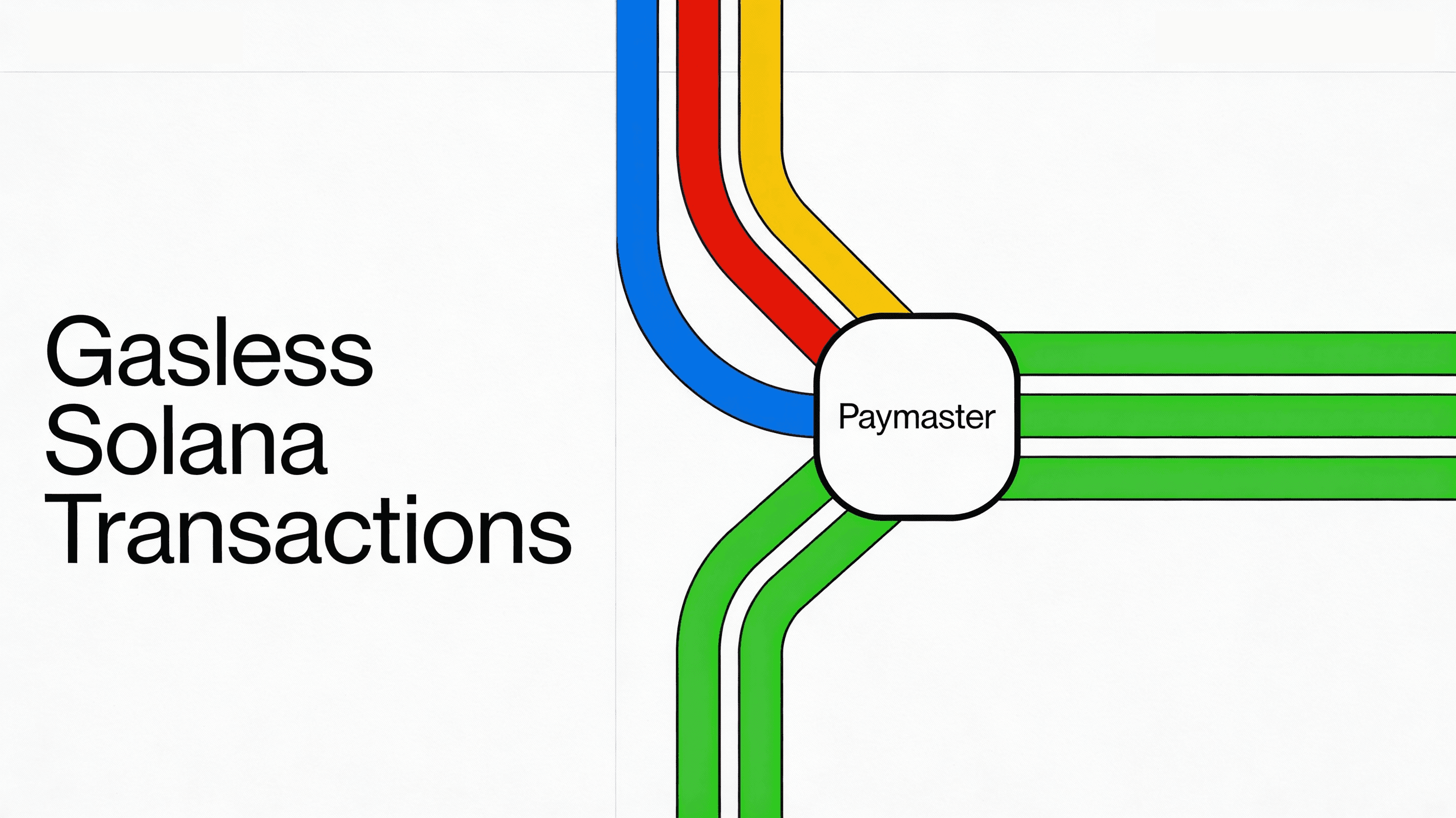
Solana transactions require SOL to pay for compute. With Openfort's Kora integration, a relayer co-signs each transaction and pays fees on behalf of your users. The setup is straightforward: configure Openfort's hosted RPC endpoint as your Solana RPC URL, and the relayer is invoked automatically when transactions are submitted through the embedded wallet.
From the user's perspective: they click "Send $50," confirm with their passkey or password, and it's done. No SOL involved, no fee selection screen, no "insufficient balance for gas" errors. Your fintech app feels like Venmo, not like a crypto wallet.
For builders, this means you call kora_getPayerSigner via the Openfort RPC to get a fee payer, then set it as the transaction's fee payer. The Kora relayer co-signs and covers the cost. Openfort's dashboard lets you set spending limits, allowlisted programs, and usage caps so you stay in control of sponsorship costs.
Sending Stablecoin Payments
The core of any fintech app: moving money between users. On Solana, USDC transfers are SPL token transfers to the USDC mint (EPjFWdd5AufqSSqeM2qN1xzybapC8G4wEGGkZwyTDt1v).
There are two patterns builders typically implement:
User-initiated transfers (peer-to-peer or payment to merchant): The user's embedded wallet signs the transaction client-side. You construct a TransferInstruction targeting the recipient's USDC token account, pipe it through a transaction message with the Kora fee payer, and sign with the embedded wallet's Ed25519 key via @solana/kit. The full flow is: build transaction → set fee payer (Kora) → set blockhash → append transfer instruction → sign → send and confirm.
_17// Simplified: the core of a USDC transfer_17const amountInUnits = BigInt(Math.floor(amountUSD * 10 ** 6)); // USDC has 6 decimals_17_17const transactionMessage = pipe(_17 createTransactionMessage({ version: 0 }),_17 (tx) => setTransactionMessageFeePayer(feePayer, tx),_17 (tx) => setTransactionMessageLifetimeUsingBlockhash(latestBlockhash, tx),_17 (tx) => appendTransactionMessageInstruction(_17 getTransferInstruction({_17 source: userSigner,_17 destination: address(recipientTokenAccount),_17 authority: userSigner,_17 amount: amountInUnits,_17 }),_17 tx,_17 ),_17);
Platform-initiated payouts (your backend pays a user): Your treasury wallet signs server-side. This is common for gig platforms paying contractors, cashback rewards, or refunds. The pattern is the same SPL token transfer, but signed by your backend keypair instead of the user's embedded wallet.
In both cases, the transaction settles on Solana in under a second. Your app stores the transaction signature as a receipt and can verify settlement status via RPC at any time.
Reading Balances and Transaction History
Displaying a user's USDC balance is a single RPC call: look up their associated token account for the USDC mint, read the amount field, and divide by 10^6 (USDC has 6 decimals). If the token account doesn't exist yet, the balance is zero.
For transaction history, query getSignaturesForAddress to get recent transaction signatures, then getParsedTransactions for the details. Filter by the USDC mint to show only stablecoin activity. Most builders wrap this in a server-side API route that caches results and polls for updates, so the UI stays responsive.
These are standard Solana RPC patterns — no Openfort-specific integration needed. Any Solana RPC provider (Helius, QuickNode, or Openfort's hosted endpoint) works.
Offramp: Getting Money Out
The last mile of any fintech app: letting users withdraw USDC to their bank account.
For consumer apps, Coinbase Offramp and MoonPay Offramp are the simplest to integrate — you generate a URL with the user's wallet address, and the provider handles the USDC-to-fiat conversion and bank deposit. The user clicks "Withdraw," enters their bank details in the provider's flow, and receives USD in 1–3 business days.
For B2B fintech apps handling programmatic payouts, Circle's Payouts API lets you convert USDC to USD and wire it directly to a bank account via API. This is the right tool for platforms that need to pay out hundreds or thousands of recipients automatically — payroll apps, marketplace settlement engines, or invoice factoring platforms.
Compliance: What Builders Need to Know
Building a fintech app with stablecoins doesn't exempt you from financial regulations — but the architecture choices you make significantly affect your compliance burden.
Non-custodial architecture reduces licensing requirements. By using embedded wallets where users hold their own keys, you avoid being classified as a custodian. Openfort's architecture is non-custodial by design: the platform never holds user keys. This doesn't eliminate compliance obligations entirely, but it changes the regulatory category you fall into — typically a much lighter one.
KYC/AML is still required for meaningful volumes. If users are moving significant amounts, you need identity verification. Persona, Stripe Identity, and Jumio all offer APIs you can wire into your onboarding flow. Most builders set a threshold (e.g., $1,000 lifetime volume) before requiring full KYC.
Transaction monitoring for production apps. Chainalysis, TRM Labs, and Sardine can screen wallet addresses and transactions for sanctions exposure and fraud signals. Adding one of these to your payout flow is a best practice for any fintech app handling real money.
USDC is a regulated stablecoin. Circle is a licensed money services business. Using USDC (rather than building or choosing an unregulated stablecoin) puts your app in a stronger compliance posture from day one.
Putting It All Together
Here's how the full flow works for a gig economy platform paying contractors in USDC:
_16Contractor signs up → email/passkey auth_16 │_16 ▼_16Embedded wallet provisioned automatically (Openfort + Solana)_16 │_16 ▼_16Platform completes milestone → triggers USDC payout from treasury_16 │_16 ▼_16USDC sent to contractor's wallet (gasless via Kora relayer)_16 │_16 ▼_16Contractor sees balance in app → taps "Withdraw"_16 │_16 ▼_16Offramp provider converts USDC → USD hits bank account
End-to-end: the USDC transfer settles in under a second. The bank offramp takes 1–3 business days (same as ACH). Everything in between — the actual payment to the contractor — is instant, global, and costs a fraction of a cent.
What to Build Next
Once your core payment flow is working, the stablecoin stack on Solana opens up features that are difficult or impossible with traditional payment rails:
Streaming payments. Pay contractors per minute worked, not per invoice cycle. Protocols like Streamflow implement token streaming natively on Solana — your app just needs to create and manage streams.
On-chain escrow. Hold milestone payments in a Solana program that releases automatically when conditions are met, with a configurable dispute window. No intermediary, no manual reconciliation.
Multi-party splits. Split a payment between a platform fee, a contractor, and a referrer in a single atomic transaction. The money moves simultaneously — no partial-state risk, no batched reconciliation.
Spending limits and policies. Build employee expense accounts with per-transaction or daily limits using delegated authority patterns on Solana. Policy enforcement happens at the protocol level, not in your backend.
Cross-chain payouts. Accept deposits on one chain, pay out on another. Bridges like Wormhole and Allbridge move USDC between Solana, Base, and Arbitrum — all abstracted from your users.
The stablecoin payment stack in 2026 is production-ready for fintech applications. Embedded wallets, fee relayers, regulated stablecoins, and fiat on/off-ramps have all been tested at scale. The infrastructure layer is solved — what's left is building great products on top of it.
If you're a builder ready to ship a fintech app with stablecoin payments, explore Openfort's documentation or talk to the team on the chat. We've helped dozens of teams go from prototype to production on this stack.