TL;DR
MoonPay is the default fiat-to-crypto onramp for many wallets and apps, but teams look for alternatives when card fees, country gaps, or first-attempt declines start to cost them users. The main alternatives fall into three groups. Standalone onramps (Transak, Ramp Network, Banxa) compete with MoonPay on coverage and payment methods. Platform onramps (Coinbase Onramp, Stripe) fit teams already on those platforms, and Coinbase offers zero-fee USDC to select apps. Routing layers (Onramper, Openfort Funding) put several providers behind one integration so a buyer gets whichever method works in their country. Pick by the countries and methods your users need, then price the same test transaction across your shortlist.
MoonPay is the fiat-to-crypto onramp many wallets and apps reach for first. It is available in 160+ countries and used by 300+ wallets, websites, and apps. This guide is for developers choosing an onramp to put inside their own product, and for teams already on MoonPay who need a second option.
Why developers look for MoonPay alternatives
- Card fees. MoonPay lists transaction fees as low as 1% for bank transfers and 4.5% for Visa cards. Most of your buyers pay by card, so the card number is the one that reaches them.
- Country gaps. MoonPay's unsupported countries list includes India, Japan, Pakistan, and Malaysia. If your users are there, they can't fund through MoonPay at all.
- First-attempt declines. Card onramps for crypto sit in a high-risk category, and every provider declines a share of legitimate buyers. With one provider, a declined buyer has nowhere else to go.
- A separate integration. A standalone onramp is its own SDK, its own webhooks, and its own status model, which you reconcile against your wallet state.
What to look for in a MoonPay alternative
| Criteria | Why it matters |
|---|---|
| Country and method coverage | Coverage is per country and per method. A provider that serves a country may not offer bank transfer there. |
| Fee breakdown | Processor fee, spread, and network fee are three separate numbers. Ask for all three on a real quote. |
| KYC model | Who collects identity data, who stores it, and who is merchant of record, per region. |
| Integration surface | Hosted widget, embedded checkout, or headless API, and how its status model maps onto your wallet. |
| Fallback | What happens when a buyer is declined or their country isn't covered. |
1. Openfort Funding
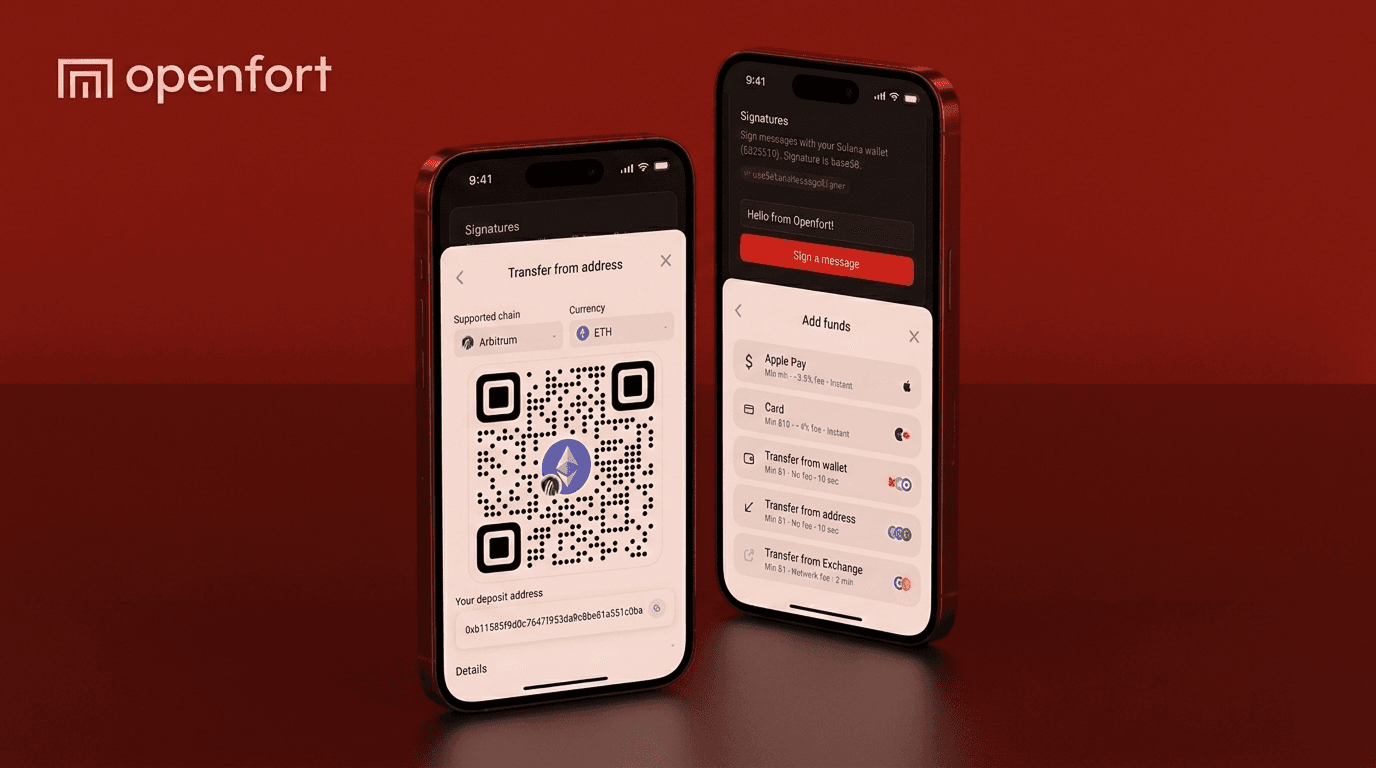
Openfort Funding (that's us) is a wallet funding layer, not a single onramp. One funding session covers every way money reaches a wallet:
- Card, Apple Pay, Google Pay, and bank transfer (ACH, SEPA, and local rails) through built-in onramp providers.
- Transfers from another wallet, with prefilled send links for apps like MetaMask, Coinbase Wallet, Phantom, and Trust.
- Guided withdrawals from exchanges, with prefilled pay links for Coinbase and Binance where available.
- A universal deposit address that accepts any supported token on any supported chain and swaps it into the token your app expects, for example USDC on Base.
Method resolution happens server-side for each buyer, by region and destination, so a buyer only sees methods that work for them. Every method moves through the same status model, requires_payment_method → waiting_payment → processing → succeeded, ending at bounced or expired on failure. KYC happens at the provider and identity data never passes through Openfort. It ships as a React and React Native Deposit modal, a hosted page, or a headless API for backends and agents.
Why choose Openfort over MoonPay
- If a share of your buyers can't fund with a card, they can fund from another wallet, an exchange, or a deposit address in the same flow.
- If you already use Openfort wallets, funding lands in the same wallet with no second SDK to reconcile.
- If you serve several regions, provider selection happens per buyer instead of per integration.
Fiat methods are off by default and mainnet-only. The crypto onramp guide covers the setup in detail.
2. Transak
Transak offers onramps and offramps as a drop-in widget or a white-label API, so you can build the checkout in your own UI. It lists 136+ assets across 45+ networks, with cards, bank transfer, SEPA, and Apple Pay as payment methods, and registered entities in the US, the UK, Canada, Australia, and Hong Kong.
Transak's quoted rate is the CoinGecko market rate plus a spread of 0% to 2.5% depending on volatility, with fees on top that vary by payment method.
Choose Transak if you want a white-label checkout inside your own UI rather than a hosted widget.
3. Ramp Network
Ramp Network lists 150+ countries and territories, 40+ fiat currencies, and 120+ crypto assets. In the EU it is authorized as a crypto-asset service provider under MiCA through Ramp Swaps (Ireland) Ltd, which covers all 27 member states. Buyers pay with cards, Apple Pay, Google Pay, bank transfer, and local methods. Its pricing policy splits each quote into a network fee and a processing fee.
Choose Ramp Network if EU regulatory status matters to your compliance review.
4. Banxa
Banxa provides crypto services in 180+ countries, the widest country list in this comparison. Its hosted checkout handles KYC, payments, and compliance, and integrates as a URL redirect, an API, or React Native, iOS, and Android SDKs. Payment methods include cards, bank transfer, Apple Pay, Google Pay, and local methods.
Choose Banxa if country coverage is your main gap and a hosted checkout is acceptable.
5. Coinbase Onramp
Coinbase Onramp is part of the Coinbase Developer Platform. Buyers pay with debit cards, credit cards outside the US, Apple Pay, Google Pay, ACH in the US, or an existing Coinbase balance. It runs as a Coinbase-hosted flow or headless with embedded Apple Pay and Google Pay.
The headline difference is price: Coinbase offers zero-fee USDC onramping and offramping to select apps. It is region-limited and needs Coinbase's approval, so confirm eligibility first.
Choose Coinbase Onramp if you deliver USDC and your app qualifies for the zero-fee program.
6. Stripe crypto onramp
Stripe's crypto onramp embeds a fiat-to-crypto purchase into your app, with cards, Apple Pay, and instant ACH among its methods. Coverage is narrower than the dedicated onramps: check Stripe's crypto availability by region before you plan around it.
Choose Stripe if you already process payments on Stripe and your users are in the regions it serves.
7. Onramper
Onramper is an aggregator. It puts 25+ onramps behind one integration and recommends a provider per buyer based on country, payment method, price, and KYC friction. Its coverage page lists supported ramps and payment methods by country.
Choose Onramper if you want many onramps behind one widget and are fine with the aggregator choosing the provider.
How to choose
- List the countries and methods your users actually need. Pull this from your signup or traffic data, not from the provider's headline country count.
- Shortlist two providers that cover them, so a declined buyer has a fallback.
- Price the same test transaction across the shortlist. Published rates move, and the spread is often where the cost sits.
- Decide where funding lives. A standalone onramp is the right call if you serve one market with one method. If you serve several regions, or users also fund from wallets and exchanges, a funding layer saves you maintaining a status model per provider.
The onramp selection checklist has the full list of questions to ask each vendor.
Conclusion
MoonPay remains a strong default with broad country coverage. Its alternatives win on specific gaps: Banxa on country count, Ramp Network on EU regulatory status, Transak on white-label checkout, Coinbase on zero-fee USDC for eligible apps, and Onramper on breadth behind one widget.
If your users fund from cards, banks, wallets, and exchanges, and you want every deposit to land in the same wallet with one status model, Openfort Funding covers all of those in one session. See also: crypto onramp guide, Privy alternatives, best wallet-as-a-service providers.