TL;DR
A stablecoin wallet controls keys and signs transactions. A stablecoin account adds customer balances, transaction histories, and statements. Shipping the second means assembling four layers: wallet and key management, ledger and sub-accounting, compliance, and issuing or licensing. No vendor on this list covers all four. Openfort covers the wallet and policy layer natively and requires partners for the other three. Crossmint bundles the most layers under one contract. Circle covers wallets and its own assets but exposes no end-customer sub-ledger. Bridge and Stripe cover balances and rails without self-custodial wallet infrastructure. Choose based on the layers you still need, not on whether a vendor says wallet or account.
Teams shopping for "stablecoin accounts" usually discover halfway through procurement that they were shopping for four products, not one. A vendor that manages keys beautifully may have no customer ledger. A vendor that shows balances may not let you hold your own keys. Neither issues a regulated account.
This post separates the four layers, marks which ones each vendor actually covers, and is explicit about where Openfort stops. For the historical shift that made this stack possible, see neobanks: from banking licenses to stablecoin rails. For the build sequence, see how to build a neobank.
Wallet vs. account: the distinction that decides your vendor shortlist
A stablecoin wallet authorizes transactions, while a stablecoin account records what each customer owns. The wallet manages cryptographic keys, signs transfers, and enforces controls such as spending limits or approval rules. The account layer calculates balances, organizes transaction history, and generates customer-facing statements. Secure key management alone does not provide those account functions.
Traditional neobanks show why the distinction matters. Customer funds often sit in one pooled For Benefit Of account, commonly called an FBO account. A sub-ledger assigns portions of that pool to individual customers. The bank holds the pooled money, while the sub-ledger records each customer's claim and produces the balance shown in the app.
Public blockchains record stablecoin ownership on-chain, but they do not replace the customer ledger needed for an account product. Per-user wallets can make ownership easier to trace, but many products still pool funds or combine activity across wallets, networks, and stablecoins. A separate ledger must map that activity to customers and convert transactions into usable balances and statements.
The 2024 Synapse bankruptcy and the resulting dispute involving Evolve showed the consequences of unresolved differences between pooled funds and customer records. Some customers lost access to funds while Synapse, Evolve, and other involved parties disputed ledger records and account balances. A key holder may authorize asset movements, but signing authority cannot establish each customer's entitlement when the ledger of record is incomplete or disputed. Buyers should therefore ask who holds the keys and who maintains the authoritative customer ledger as separate questions.
Building a stablecoin account product requires four distinct infrastructure layers.
-
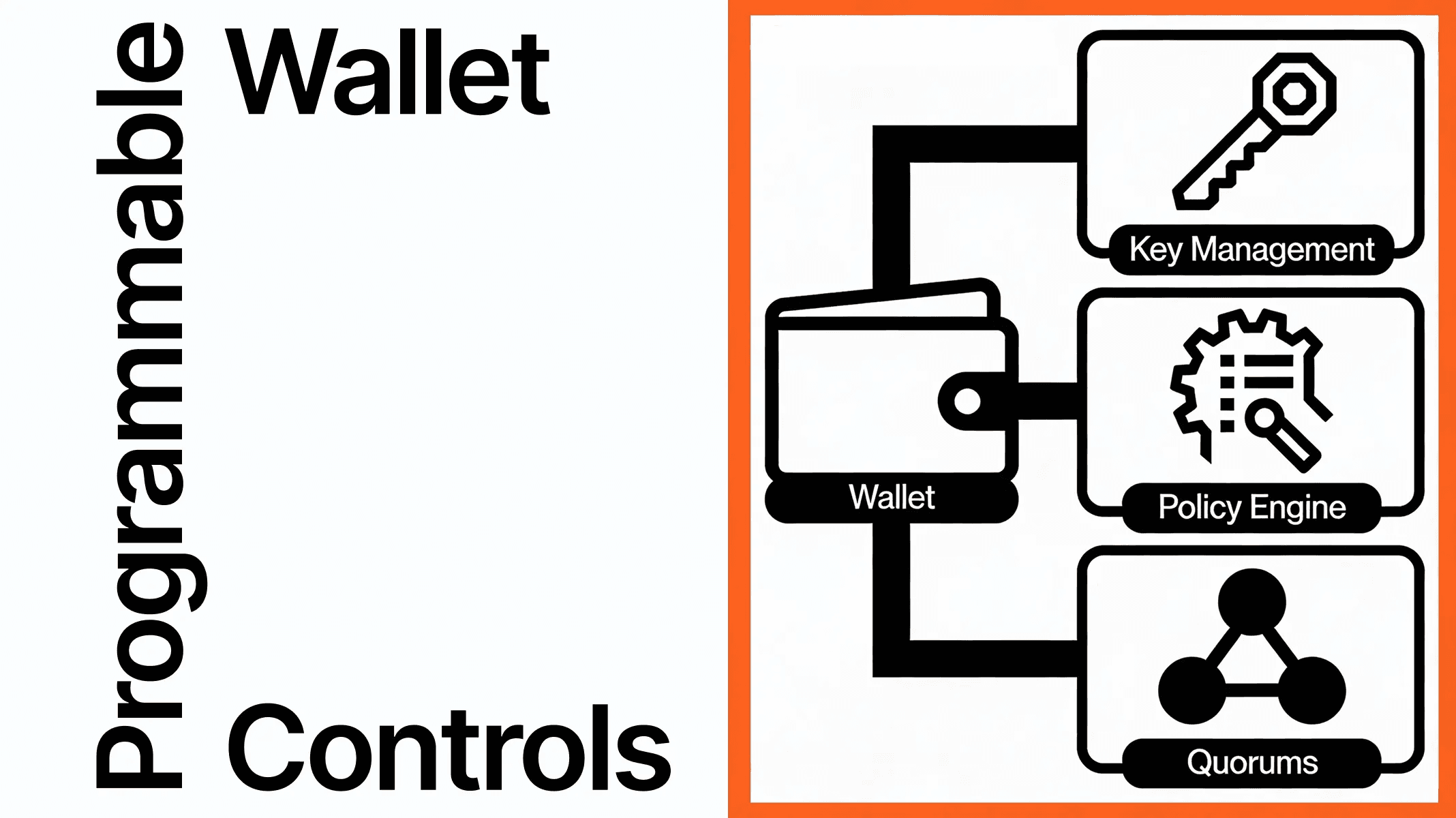
Wallet and key management. This layer creates wallets, secures keys, signs transactions, and applies policies such as limits, allowlists, and approval requirements. Openfort provides this layer with self-custodial key management and programmable transaction controls.
-
Ledger and sub-accounting. This layer assigns balances to customers, reconciles internal records with on-chain activity, and produces transaction histories or statements. Openfort does not provide native multi-tenant ledgering or account statements.
-
Compliance. This layer handles identity verification, sanctions screening, transaction monitoring, and Travel Rule workflows. Wallet policies can act on signals from specialized compliance providers, but they do not replace those providers. See stablecoin KYC for builders for what this layer involves.
-
Issuing and licensing. This layer supplies the regulated entity, fiat payment rails, and account issuance permissions required for the intended market. A fintech using Openfort must source this coverage separately when its product requires it.
How each vendor covers the four layers
Vendor labels can hide which infrastructure layers a product actually provides. The table compares the capabilities each vendor publicly describes for a branded end-customer account program. "Partner" means you must connect another provider, while "absent" means the reviewed product does not expose that capability.
| Vendor | Wallet / key management | Ledger / sub-account | Compliance | Issuing / licensing |
|---|---|---|---|---|
| Openfort | Native. Self-custodial wallets, signing policies, limits, and allowlists | Partner. No native multi-tenant ledger or statements | Partner. External KYC, monitoring, sanctions screening, and Travel Rule tools required | Partner. Licensed issuer or banking partner required |
| Crossmint | Native. Programmable smart-contract wallets | Native. Customer balances and account-like services | Partner, bundled. Integrates providers including Elliptic and NotaBene | Native and partner. Crossmint holds licenses in several markets and uses partners for card rails |
| Circle | Native. Circle Wallets supports user-controlled and developer-controlled wallets | Absent. Circle does not expose an end-customer sub-ledger or statement product | Partner. End-user compliance remains outside the wallet product | Native for Circle assets. A partner remains necessary for branded account issuance |
| Bridge | Absent. Reviewed account products do not expose self-custodial key management | Native. Account balances and stablecoin orchestration | Not documented. Product materials do not clearly separate native and partner coverage | Partner and product dependent. Card issuing uses Visa, while licensing coverage varies |
| Stripe | Absent. Stablecoin financial accounts do not expose embedded wallet signing | Native via Bridge. Businesses receive stablecoin-denominated account balances | Bundled or Bridge-supported. Detailed responsibility boundaries are not public | Partner. Stripe relies on Bridge infrastructure and Visa for card issuing |
Crossmint is the closest fit in this group for buyers seeking several neobank infrastructure layers through one vendor. Crossmint combines wallet infrastructure and account services with compliance integrations, payment rails, and access to licensed entities through its product and partner network.
Circle takes a split-stack approach. Circle Mint gives approved businesses direct mint and redemption access, while Circle Wallets provides key management and transaction signing. A neobank using Circle still needs an end-customer ledger, statements, compliance coverage, and account-issuing support.
Openfort concentrates on the wallet and policy layer. Our self-custodial key management and programmable transaction controls support embedded account experiences, but you must add partners for ledgering, compliance, and licensing.
Stripe's stablecoin financial accounts cover business balances and payment rails through Bridge rather than self-custodial wallet infrastructure. Bridge remains a separate infrastructure layer within Stripe, and its conditional federal trust approval does not by itself establish full licensing coverage for every customer program.
Issuing a branded stablecoin account with Openfort
Openfort can power a branded stablecoin account experience while your product retains control of the interface and customer relationship. Your app displays balances, transfer controls, transaction history, and account branding. We provide the embedded stablecoin wallet and signing layer beneath that product interface.
You create a wallet for each customer through the API and connect wallet access to your existing authentication flow. The wallet holds the customer's stablecoins on-chain, while Openfort applies signing policies whenever the customer sends or spends funds. Gas sponsorship can cover network fees so customers do not need to acquire a network's native token before transacting.
Policy controls let you shape wallet activity around account rules. You can set transaction limits and restrict transfers to approved addresses or other defined conditions. External compliance signals can also inform whether Openfort approves, blocks, or sends a transaction for review.
An on-chain balance can support the balance shown in your app, but it does not replace a financial ledger. We do not natively provide the multi-tenant subledger described in layer 2. You still need a ledger provider or an internal ledger to track pending funds, account-level adjustments, and reconciliation across customers. Openfort also does not generate formal account statements, so your ledger or reporting service must produce them.
A full stablecoin account also requires the issuing and licensing capabilities covered by layer 4. Openfort does not provide a banking charter, money transmission coverage, or a regulated account program. You must pair the wallet with an appropriate issuing or banking partner based on the markets and services your product supports. A separate compliance provider typically handles identity checks, sanctions screening, transaction monitoring, and Travel Rule workflows.
Customers can use the resulting product as an account interface, while each provider remains responsible for a defined infrastructure layer. Openfort controls wallet creation, signing, and programmable transaction policies. Your ledger records customer obligations and produces statements, while regulated partners support compliant account issuance.
Where compliance and issuing partners fit
Openfort and specialist compliance providers cover separate controls in a composable architecture. Openfort's wallet layer manages self-custodial key infrastructure and transaction signing. Its policies can enforce transaction limits, destination allowlists, programmable spending rules, and wallet-level audit trails.
Specialist providers assess identities, addresses, and transactions, then your application can use their findings when applying wallet policies. Sumsub provides identity-verification and KYC/AML tools. TRM Labs and Chainalysis provide blockchain risk analysis and transaction-monitoring tools. A separate specialist may handle sanctions screening or Travel Rule workflows, depending on your jurisdictions and transaction types. For a side-by-side of these, see best compliance and security controls for stablecoin wallet infrastructure.
For example, your application can send a proposed transfer and destination address to a monitoring provider before requesting a signature. If the provider flags the destination as a potential sanctions match, your application can pass that result into the approval logic. An Openfort policy can then block the signing request or route the transaction for manual review. Openfort enforces the wallet decision, while the compliance provider produces the underlying risk assessment.
Compliance coverage does not remove the need for an issuing or banking partner. A full stablecoin account product may require a licensed partner to provide the regulated account relationship, safeguarding structure, and relevant payment access. You may also need separate ledger infrastructure for sub-account balances and statements. Buyers should verify each partner's licensed scope in every market where the product will operate.
Best fit by buyer type
-
Neobanks usually need an auditable ledger of record, customer statements, compliance coverage, and licensed fiat rails. Openfort covers layer 1 through self-custodial wallets, signing controls, transaction limits, and programmable spend rules. A neobank must source layers 2 through 4 separately, so Openfort alone does not provide a complete account product. Buyers that want native ledgering and statements under a bundled contract should assess Crossmint's offering and verify that its statement format meets their requirements.
-
Payroll platforms need reliable wallet provisioning and controlled payouts at scale. Openfort can create wallets for workers, restrict supported assets or destinations, and apply approval rules before signing a payment. A payroll provider that already operates its own ledger, compliance program, and licensed payment relationships may use Openfort for layer 1 without replacing those systems. Otherwise, the provider still needs partners for worker verification, transaction monitoring, ledgering, and regulated fiat movement.
-
Embedded-finance products should identify which layers their existing provider already supplies. If your licensed platform already has customer ledgers and compliance systems, Openfort can add embedded wallets and policy controls without replacing those systems. External compliance signals can feed into Openfort's transaction policies when a transfer requires approval or blocking. A product starting without account infrastructure will need separate ledger, compliance, and issuing partners, or it should consider a vendor that bundles those capabilities.
Frequently asked questions
Is a stablecoin wallet the same as a bank account?
A stablecoin wallet manages keys and authorizes transactions, while a bank account provides a recorded balance, transaction history, and statements. Openfort supplies self-custodial wallet and policy infrastructure rather than a bank account. You can pair Openfort with ledger and banking partners to create an account-like product.
Do I need a money transmitter license to issue stablecoin accounts?
Money-transmission requirements vary by jurisdiction and by whether your product holds, exchanges, or transmits customer funds. Openfort does not provide money transmitter licensing, so you may need a licensed issuing or banking partner. Qualified legal counsel can determine which licenses and partners your product requires.
Can Openfort generate account statements?
Account statements convert ledger records into customer-facing balances and transaction histories for a defined period. Openfort provides wallet-level activity records but does not natively generate account statements or maintain a multi-tenant sub-ledger. A separate ledger provider can turn Openfort wallet activity into statements.
What is the difference between wallet-as-a-service and account infrastructure?
Wallet-as-a-service manages keys, signing, and transaction policies, while account infrastructure adds customer balances, ledgering, and statements. Openfort covers the wallet and policy layer, including limits, allowlists, and programmable spend rules. You can add ledger, compliance, and issuing partners when your product needs full account functionality.
Get started with Openfort
You can use Openfort's free tier to test the API, embedded wallets, and policy controls before selecting the rest of your account infrastructure.
Choose infrastructure based on the layers you still need rather than whether a vendor uses the word "wallet" or "account." Openfort covers wallet key management and transaction policy. Pair it with a ledger provider for sub-accounts and statements. Add compliance providers for identity checks and transaction monitoring, plus a licensed issuing partner when your product requires regulated account issuance.