TL;DR
Stablecoin compliance is three separate control layers, and no vendor on this list is strong at all three. Fireblocks fits enterprises that want MPC custody with configurable approval policies. Chainalysis fits investigation-heavy programs that need entity attribution. TRM Labs fits API-based wallet screening and sanctions checks. Sumsub fits embedded onboarding with identity, biometric, and AML checks. Cobo bundles MPC wallets with custody operations. Openfort fits products that need self-custodial key management with policy-based transaction controls. Expect to connect a compliance provider to wallet infrastructure, and expect the seams between them to be your own work.
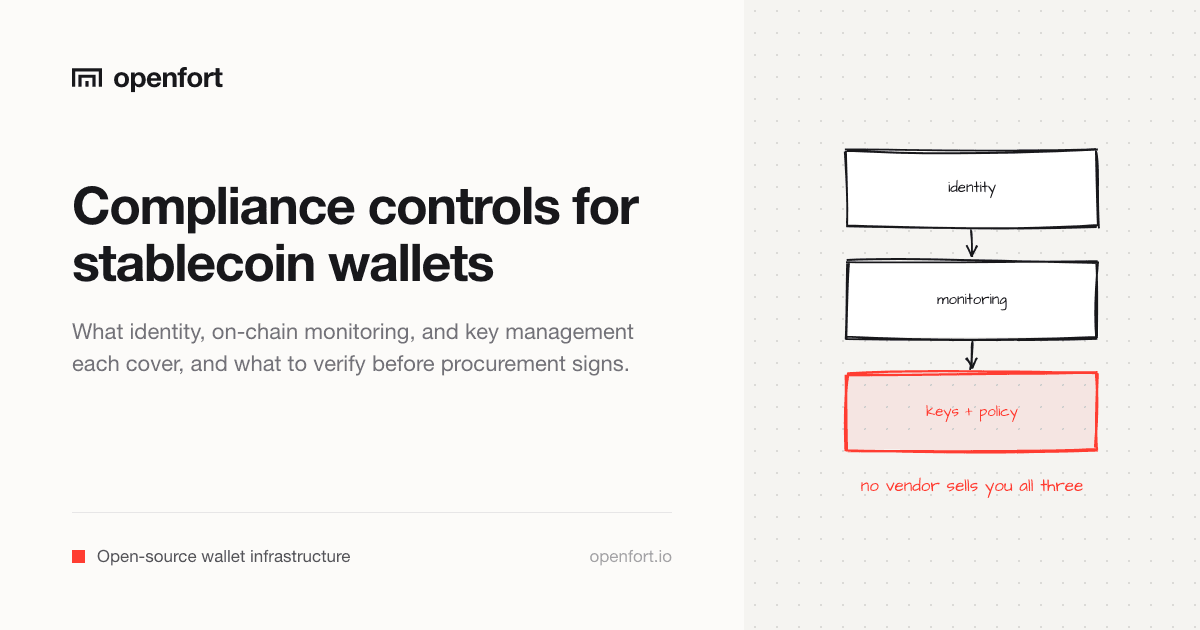
Buyers shopping for "compliant stablecoin wallet infrastructure" usually find three different products wearing the same label: an identity vendor, a blockchain intelligence vendor, and a key-management vendor. Each covers one layer. None covers all three.
This post compares six of them on the controls a procurement review actually tests, and marks the claims that need primary evidence before you sign anything. For the custody and licensing question underneath it, see crypto custody providers and stablecoin KYC for builders. For the wallet layer itself, see the payments solution page and stablecoin payment infrastructure.
Comparison table: best-fit vendor by compliance function
Each vendor covers a different part of stablecoin compliance, so buyers often combine identity, monitoring, and wallet products. Certification and audit claims marked unverified require direct confirmation before procurement.
| Vendor | KYC and AML | Real-time monitoring | Audit trails | SOC 2 and certifications | Key management | Best for |
|---|---|---|---|---|---|---|
| Fireblocks | Chainalysis and Elliptic integrations | Automated screening with policy actions | Transaction and admin logs | SOC 2 Type 2 and three ISO certifications | MPC with hardware isolation | Institutional custody and governance |
| Chainalysis | Blockchain AML intelligence, not identity KYC | Wallet exposure and sanctions monitoring | Investigative reporting | Unverified | None | Forensics and entity attribution |
| TRM Labs | Wallet, entity, and VASP screening | Risk-based transaction monitoring | Investigation and compliance reporting | Unverified | None | API-oriented sanctions and scam monitoring |
| Sumsub | Identity, biometric, address, and AML checks | Ongoing wallet monitoring not established by the cited source | Timestamped verification records | Unverified | None | Embedded customer verification |
| Cobo | Screening listed, details unverified | Unverified | Reports listed, details unverified | SOC 2 Type II and ISO 27001 claims require verification | Provider-held MPC and custodial options | Bundled custody and wallet operations |
| Openfort | Requires integration | Requires compliance integration | Wallet control evidence depends on implementation | Five-audit claim not substantiated by the cited source. OpenSigner lists a Quantstamp audit as ongoing | Self-custodial threshold shares | Portable, self-custodial embedded wallets |
What "compliant wallet infrastructure" actually requires
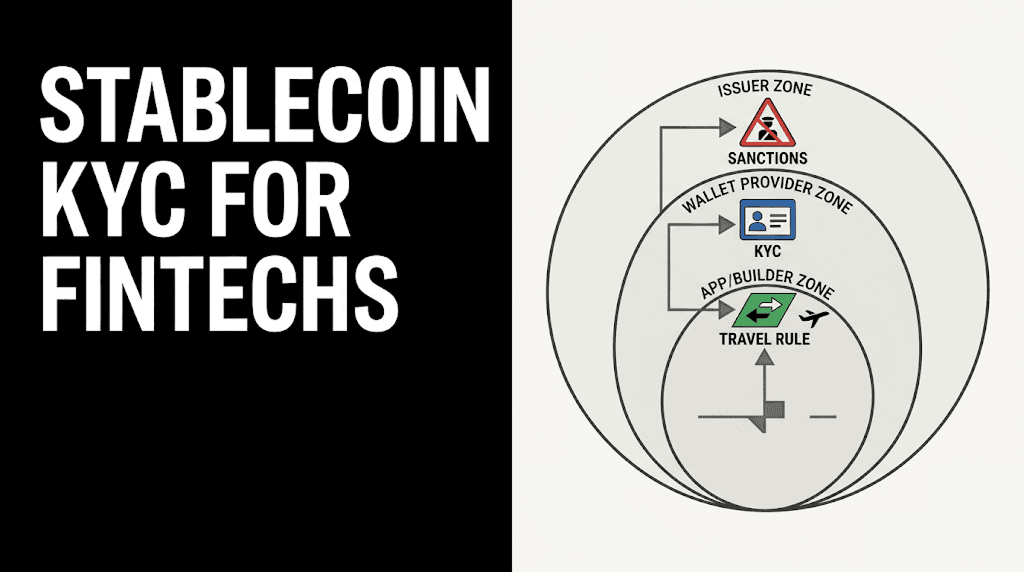
Compliant wallet infrastructure combines three separate control layers. Identity verification establishes who the customer is and checks sanctions, eligibility, and risk. On-chain monitoring screens wallet addresses and transactions for illicit exposure. Custody and key security govern who can sign, recover, or change access to assets. Vendors often specialize in one layer, so buyers commonly integrate several products.
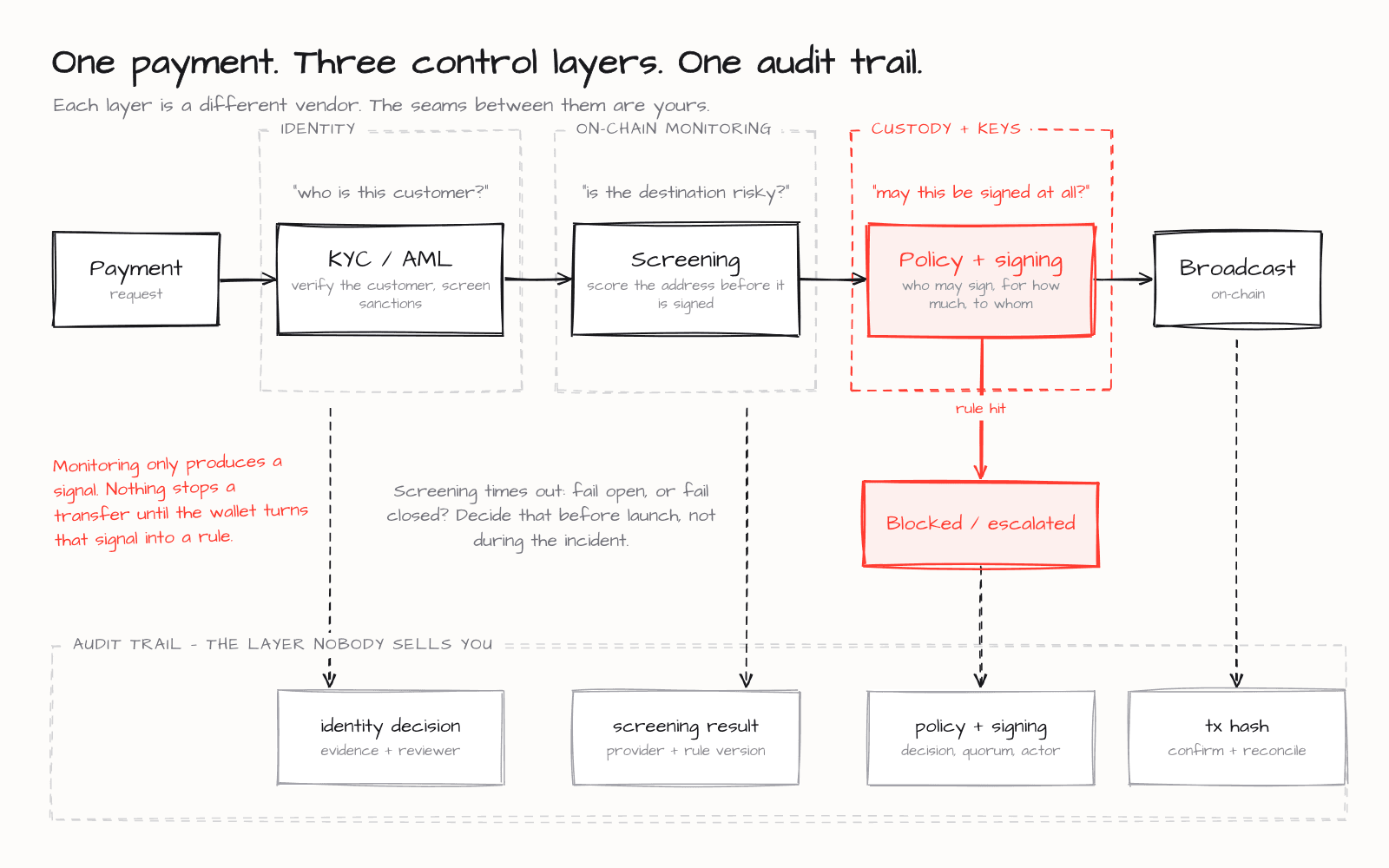
KYC and AML controls must preserve identity evidence, screening results, risk decisions, and review records. Transaction monitoring must record the rules applied, alerts generated, and actions taken before or after a transfer. Ongoing-screening requirements vary by jurisdiction, product, and risk program, so buyers should confirm the applicable rules rather than relying on a one-time onboarding check.
Audit trails must connect each payment request to screening, approval, signing, blockchain confirmation, and ledger reconciliation. A useful evidence package includes timestamps, approval decisions, signing quorum records, transaction hashes, and exceptions, as described in this stablecoin controls guidance.
SOC 2 Type II reports show whether an independent auditor tested specified security controls over a defined period. They do not certify regulatory compliance. Key-management reviews separately examine access permissions, key storage or splitting, approval policies, recovery procedures, revocation, and incident records.
Multi-jurisdiction compliance: monitoring and forensics at scale
Chainalysis fits operators that need investigation and attribution across several regulatory regimes. Its investigation-first approach connects wallets, entities, and transaction histories across multiple blockchain networks. Analysts can use those relationships for exposure analysis, sanctions monitoring, and investigative reporting. A third-party comparison of Chainalysis and Elliptic identifies blockchain investigations and law enforcement collaboration as relative strengths, but buyers should confirm those capabilities with primary product documentation.
Buyers should still verify claims about Chainalysis Prevent, Monitor, and Respond before relying on that architecture for regulatory defensibility. The available source does not document those product layers, continuous screening mechanics, sanctions update frequency, or independently validated attribution accuracy. Ask Chainalysis for product documentation, jurisdictional coverage, attribution methodology, validation results, and records showing how analysts reached each attribution.
A multi-jurisdiction deployment also needs rules outside the blockchain intelligence layer. Your wallet must translate a risk signal into a jurisdiction-specific action, such as blocking a transfer, requesting additional review, or opening a case. The monitoring provider must then preserve the address data, rule version, analyst decision, and timestamps needed for an audit.
TRM Labs presents an alternative for sanctions and scam-focused monitoring. A CryptoSlate profile of TRM Labs lists wallet screening, transaction monitoring, fund tracing, and VASP risk assessment among its products. Buyers should confirm this product coverage with TRM Labs documentation. Available sourcing does not establish attribution accuracy, certification status, sanctions update cadence, or monitoring latency. Buyers should treat those capabilities as vendor claims pending technical testing and documentary review.
Low-friction verification for embedded finance
Structured identity decisions can reduce manual review during consumer wallet onboarding. Sumsub can deliver document data, biometric and liveness results, AML screening outputs, and user-submitted evidence through API webhooks. Buyers can use those outputs to approve users or route exceptions within the wallet experience.
Sumsub also records each verification step with timestamps, which supports later compliance review. Its verification records can include document images, selfies, questionnaire responses, screening results, and downloadable reports. The available evidence does not substantiate specific verification-speed or pass-rate figures, so buyers should test both measures with their expected countries, document types, and user devices.
Buyers should also verify Sumsub's Unhosted Wallet Verification and Travel Rule capabilities directly before treating them as selection criteria. The supplied source documents identity verification and onboarding-time screening, but it does not establish custody, key management, or continuous wallet monitoring capabilities. A consumer wallet using Sumsub for verification still needs wallet infrastructure or a digital asset custody layer to manage signing controls and key security. That layer must also enforce any transaction decisions produced by the compliance program.
Real-time AML monitoring wired into wallet APIs
Wallet-integrated AML must convert a risk signal into a signing decision before funds move. The wallet API should submit the destination and transaction details for screening, receive a risk response, and apply a rule that approves, blocks, or escalates the request.
Chainalysis fits an external intelligence pattern. Continuous re-screening can surface risk when an address receives a new attribution or sanctions designation after onboarding. However, independent coverage places blockchain intelligence within a broader stack that also includes wallet systems, case management, and regulatory reporting, so you must connect alerts to those components yourself, according to a WalletInvestor comparison of Chainalysis and Elliptic. Available sourcing does not verify Chainalysis response times or specific re-screening mechanics, so buyers should confirm both during testing.
Fireblocks puts enforcement closer to the signing layer. Its policy engine can approve, block, or require additional signers, while Chainalysis and Elliptic integrations support screening and risk scoring within the transaction process, according to the Fireblocks listing on Microsoft Marketplace. The listing also describes pending-transaction controls and audit logs. You still depend on an analytics provider for risk intelligence, but Fireblocks handles the resulting action inside its wallet controls.
Before choosing either pattern, test screening latency under load and define how the wallet behaves when the monitoring API times out. A fail-open rule keeps transfers available when screening fails, but it may allow an unscreened transaction to proceed. A fail-closed rule prevents that transaction from proceeding but may delay legitimate transfers.
Custody and key-management controls and performance evidence
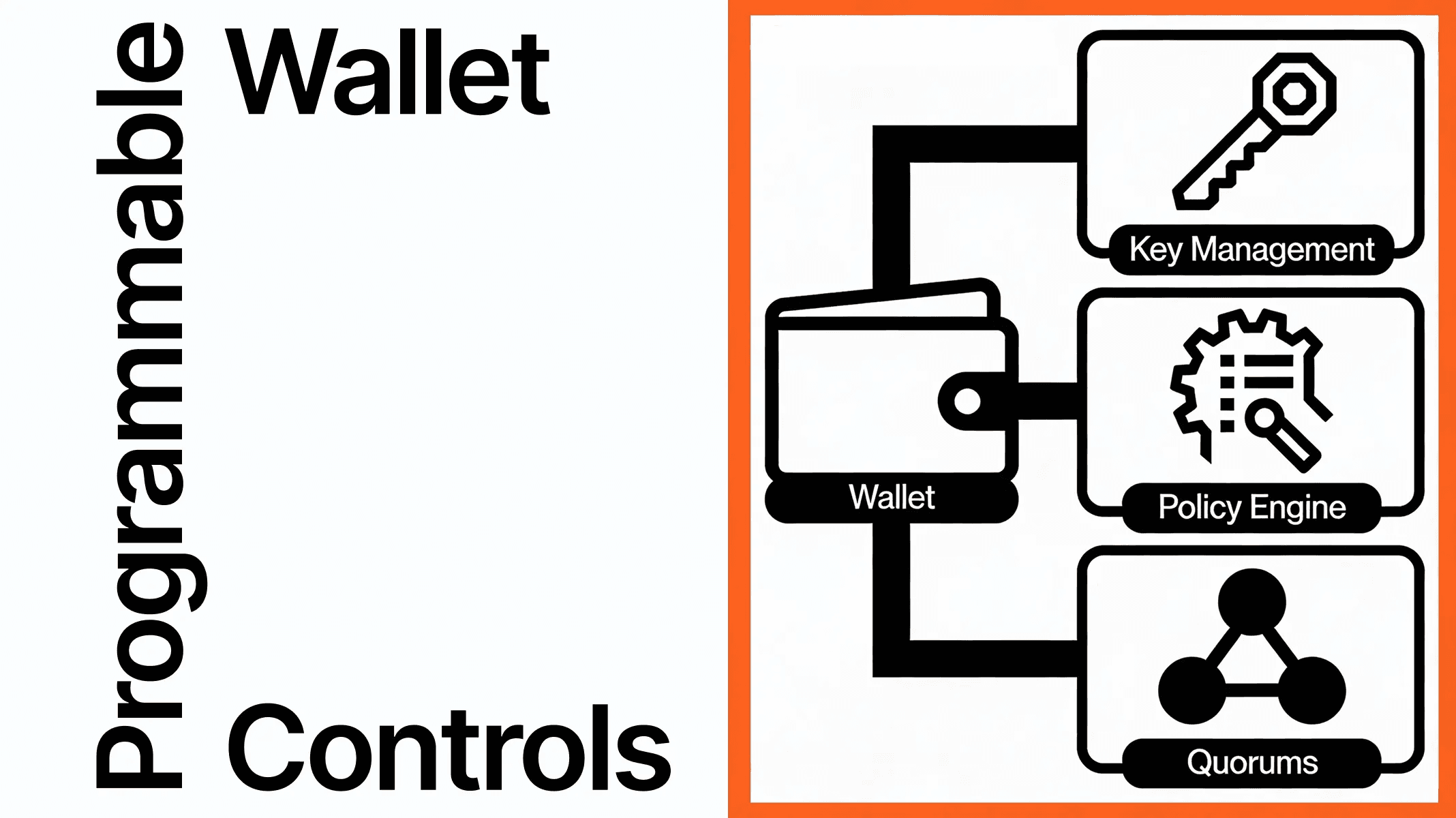
Fireblocks targets institutional wallet security and transaction governance. Its MPC-CMP model distributes key operations across isolated environments, while its policy engine can block transfers or require additional signers based on customer rules. Fireblocks reports SOC 2 Type II and three ISO certifications in its Microsoft Marketplace listing. Procurement reviewers should inspect the reports, certification scope, and covered services before relying on them. However, the available Fireblocks documentation does not provide a signing latency benchmark.
Cobo offers MPC, smart contract, and custodial wallet options through one platform. A Fystack comparison of its product with Cobo states that Cobo controls the key infrastructure and reserves custodial wallets for its Enterprise tier. Because the source compares Fystack with Cobo, buyers should verify those details in current Cobo documentation. Cobo may suit buyers seeking managed custody, but the supplied sources do not document enough about policy evaluation or signing speed for a direct performance comparison.
Openfort fits embedded wallet products that want to retain control over custody design. OpenSigner splits each key into shares, reconstructs it temporarily in device memory for signing, and supports self-hosting. Openfort reports five independent security audits and sub-200ms signing for its policy-based transaction controls. The supplied primary material confirms only an ongoing Quantstamp audit and does not substantiate the policy controls or latency measurement, so buyers should request the audit reports and benchmark methodology.
Buyers seeking institution-oriented custody infrastructure can evaluate Fireblocks or Cobo, while confirming which entity holds the assets and keys in each deployment. Buyers seeking portable, self-custodial key management can review Openfort and verify its audit evidence, policy controls, and performance methodology.
Audit trails and SOC 2 certification: what buyers should actually verify
Treat certification badges and audit counts as claims until you inspect the supporting evidence.
- Request the complete SOC 2 Type II report. Confirm the auditor, review period, covered services, control exceptions, subservice providers, and any bridge letter issued after the period ended.
- Check licenses and registrations in the relevant regulator's registry. A security audit or SOC 2 report does not establish permission to offer custody in every jurisdiction.
- Test whether audit logs connect screening, approval, signing, blockchain confirmation, and ledger reconciliation. Auditors may also request timestamps, signing quorum evidence, transaction hashes, and exception records, as this stablecoin controls guide explains.
- Distinguish public evidence from vendor statements. Fireblocks' SOC 2 Type II and named-auditor details come from its Microsoft Marketplace listing. Sumsub's timestamped audit-trail description comes from its own blog.
- Ask Openfort for reports supporting its stated five independent security audits. The supplied OpenSigner repository names only an ongoing Quantstamp audit, so buyers should confirm the other audits directly.
Choosing a stack, not a single vendor
Stablecoin compliance usually requires separate identity, transaction monitoring, and wallet control layers. An identity provider verifies users, a monitoring vendor screens blockchain activity, and wallet infrastructure manages keys and signing rules.
Build around the controls you already operate. If your KYC program works, add monitoring and wallet infrastructure rather than replacing it. Connect each layer with shared transaction identifiers and timestamps so auditors can trace screening, approval, signing, and confirmation.
If your product needs self-custodial wallet infrastructure, review Openfort and test the integration against your signing policies and monitoring provider. Confirm that the resulting records meet your audit requirements. Openfort's OpenSigner architecture splits key material and reconstructs complete keys only in memory during signing. Buyers should verify policy controls and independent audit evidence directly during procurement.
Choose each provider by control layer, then test the connections among identity decisions, transaction screening, signing enforcement, and audit records. For Openfort deployments, procurement should verify policy behavior, audit evidence, and monitoring integrations before launch.
FAQs
Is SOC 2 Type II required for stablecoin wallet providers?
SOC 2 Type II is an independent assessment of how security controls operated over a defined period, but most jurisdictions do not mandate it for wallet providers. Openfort buyers should request any current SOC 2 report, review its scope, and examine noted exceptions rather than assuming a report is available. These materials help your security reviewers assess controls instead of relying on a certification badge.
Can KYC/AML and custody be handled by one vendor?
KYC/AML and custody cover separate functions, although some custody platforms integrate external screening tools. Openfort provides self-custodial wallet infrastructure, so you generally connect a separate identity and blockchain monitoring provider. Separate components let you choose coverage for your jurisdictions and risk model.
Does self-custodial key management still meet compliance requirements?
Self-custodial key management can meet compliance requirements when access, approvals, signing events, and recovery actions produce reviewable records. Openfort's OpenSigner splits key material into shares and reconstructs the key temporarily during signing. Auditors can then examine the technical custody model alongside your operating controls.
How does policy-based transaction control differ from transaction monitoring?
Policy controls approve, reject, or escalate transactions before signing, while monitoring tools assess on-chain risk and suspicious activity. Openfort buyers should verify which policy rules and evidence exports their deployment supports. Connecting monitoring results to policy controls can block transactions that meet defined prohibition rules and preserve the associated screening evidence for later review.