TL;DR
Mass payouts pay contractors, creators, and marketplace sellers. Payroll pays employees and carries tax withholding, benefits, and labour-law obligations that a stablecoin does not remove. Worker status decides which one you are buying, not payment frequency, and most buyers end up sourcing employment compliance and payment delivery separately. Openfort fits teams building their own self-custodial payout or payroll product. Triple-A fits businesses that want licensed stablecoin and local-currency payout rails. NOWPayments fits smaller businesses sending crypto straight to wallets or email addresses. BVNK fits fintechs embedding fiat and stablecoin balances with automatic conversion. Stripe fits existing Stripe users who want stablecoin settlement inside the payments stack they already run.
Search for a stablecoin payout platform and the results mix two different products: payment rails that move money, and employment platforms that carry tax and labour obligations. Buying the wrong one surfaces at the worst possible moment, which is usually an audit.
This post compares five providers on the criteria a procurement review actually tests, and marks the claims that need primary evidence before you sign. For the flows underneath, see the global payouts and stablecoin payroll use cases, the stablecoin payroll guide, and stablecoin payment infrastructure.
Mass payouts vs. global payroll: why the distinction matters before you compare vendors
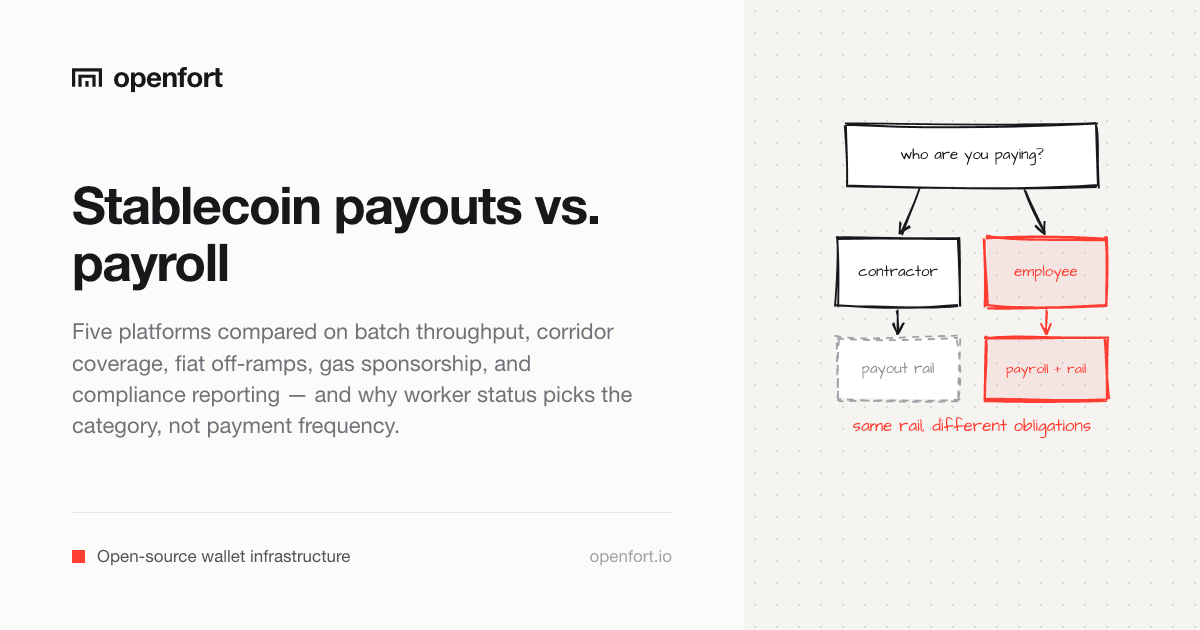
Payroll applies when you pay employees. A global payroll platform calculates tax withholding, administers required benefits, and supports compliance with local labour law. Paying wages in stablecoins changes the settlement rail, but it does not remove those employer obligations.
Mass payouts usually serve non-employees such as contractors, creators, or marketplace sellers. The platform distributes funds and may produce transaction records or tax reports, while recipients generally manage their own income taxes. Triple-A uses this distinction to separate employee payroll from high-volume payments to independent recipients.
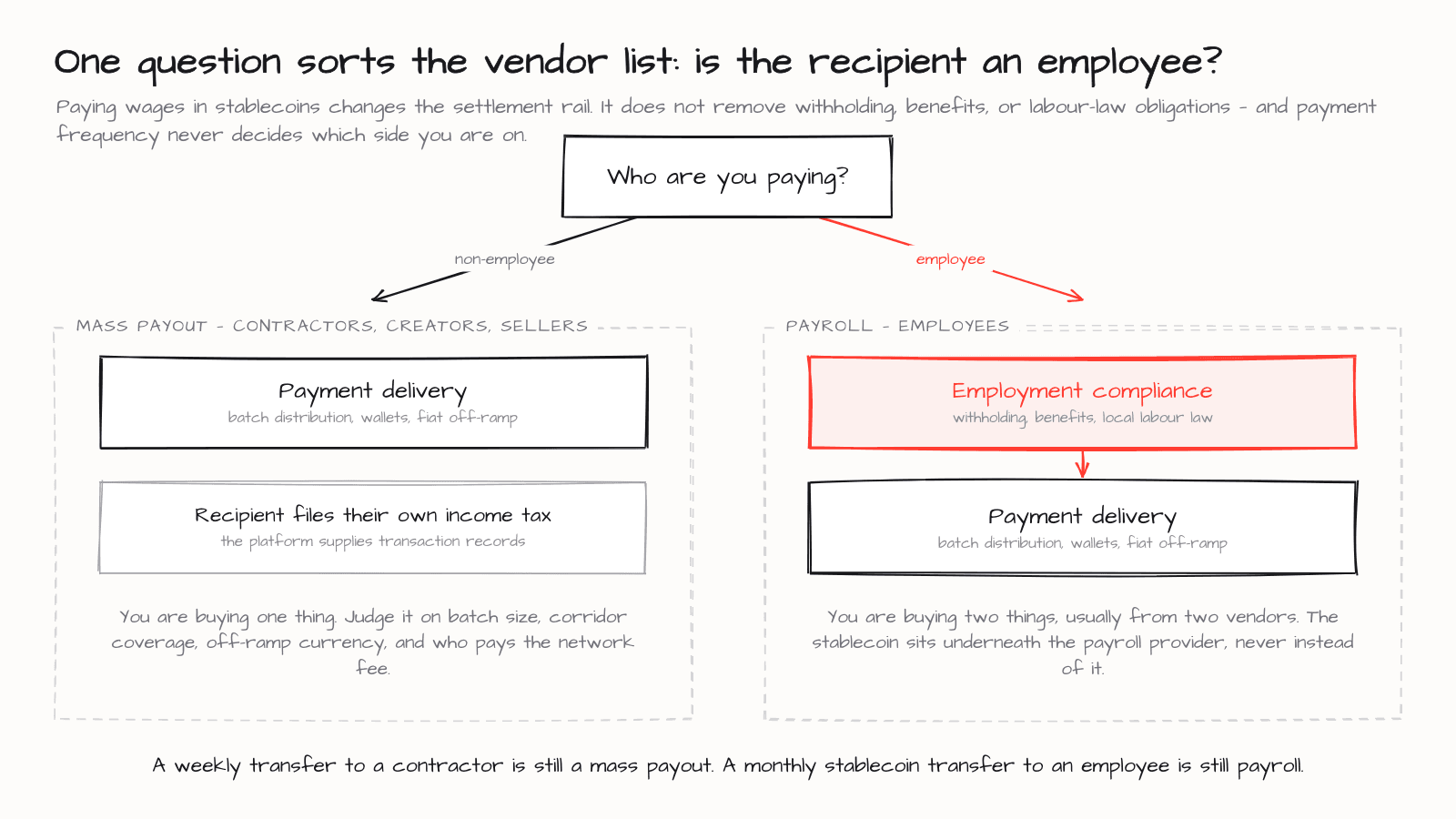
Worker status determines which category applies. Payment frequency does not. A weekly transfer to a contractor can remain a mass payout, while a monthly stablecoin transfer to an employee still requires payroll treatment under the relevant jurisdiction.
Most buyers need separate coverage for employment compliance and payment delivery. A payroll provider can manage worker classification, withholding, and local employment rules but may offer limited stablecoin support. A mass payout platform can handle batch distribution, wallets, and fiat off-ramps but may leave employment compliance to you. The comparison that follows therefore judges each vendor by its buyer fit rather than treating every platform as a complete substitute for the others.
How to evaluate a stablecoin payout or payroll platform
Five measures determine whether a provider fits your payout volume, recipient locations, and compliance duties.
- Batch throughput. Check supported batch sizes, processing rates, retry handling, webhooks, and reconciliation exports. A provider should publish limits or test them during evaluation.
- Multi-country and currency support. Verify coverage by corridor rather than relying on a global country count. Confirm which locations support stablecoins, local currency, and employee wages.
- Fiat off-ramp. Ask whether recipients can withdraw through local bank rails, which currencies they receive, and who pays conversion and withdrawal fees.
- Gas-sponsored cost. Confirm whether the provider pays blockchain network fees on the recipient's behalf. Compare the full cost per successful payout, including platform fees, network fees, foreign exchange spreads, and recipient charges.
- Compliance reporting. Require payer KYB, recipient KYC, transaction-level sanctions and AML screening, jurisdiction-specific records, and exportable audit trails. Also verify licenses for every market where the provider handles funds.
Traditional rails provide the cost baseline. Cross-border SWIFT transfers commonly cost $25 to $50 before foreign exchange markup and take two to five business days. IMF figures place average cross-border costs near 1.5 percent for retail B2B transactions and above 6 percent for remittances, with smaller payments carrying higher percentage costs.
Stablecoin pricing should be compared against that full traditional cost, not the wire fee alone. Employee payroll also requires local tax withholding and labour-law compliance, even when a stablecoin carries the payment.
Best-for comparison table
These providers serve different layers of a stablecoin payroll or mass payout stack. Compare each platform against your custody, compliance, and recipient requirements.
| Platform | Batch throughput | Country and currency support | Fiat off-ramp | Gas-sponsored cost | Compliance reporting | Best for |
|---|---|---|---|---|---|---|
| Openfort | No published batch cap | Multi-chain USDC infrastructure | Integration dependent | Gas sponsorship supported. Pricing unpublished | Policy controls and webhooks. You manage KYC and reporting | Building a self-custodial payout product |
| Triple-A | Limit unpublished | 30+ currencies across 70+ countries | Local bank payouts | Stablecoin payouts typically cost under 1%. Gas detail unpublished | Licensed provider with wallet screening and transaction monitoring | Outsourced stablecoin and local-currency payout rails |
| NOWPayments | API limit unpublished. Email product supports up to 100,000 recipients | 300+ crypto assets. Fiat payroll coverage unconfirmed | Fiat withdrawals available. Local coverage unconfirmed | Email payouts claim zero fees. API payout pricing unpublished | AML and KYC policy available. Licensing detail unpublished | Crypto payouts to wallets or email addresses |
| BVNK | No published limit | USD, GBP, EUR, stablecoins, and multiple chains | Automatic fiat and stablecoin conversion | Pricing and gas treatment unpublished | BVNK handles KYC, KYB, and transaction flows. License detail unavailable | Embedded fiat and stablecoin balances |
| Stripe | No verified batch limit | Reported broad coverage, but country counts conflict | Fiat conversion through Bridge | Pricing and gas treatment unverified | Primary compliance documentation unavailable in supplied research | Existing Stripe users adding stablecoin settlement |
Openfort: self-custodial wallet infrastructure for teams building their own payout product
Openfort does not suit buyers seeking a turnkey global payroll or accounts-payable platform. It does not replace worker classification, tax withholding, employment-law support, or licensed money movement. You must provide those functions internally or integrate separate compliance and payment providers.
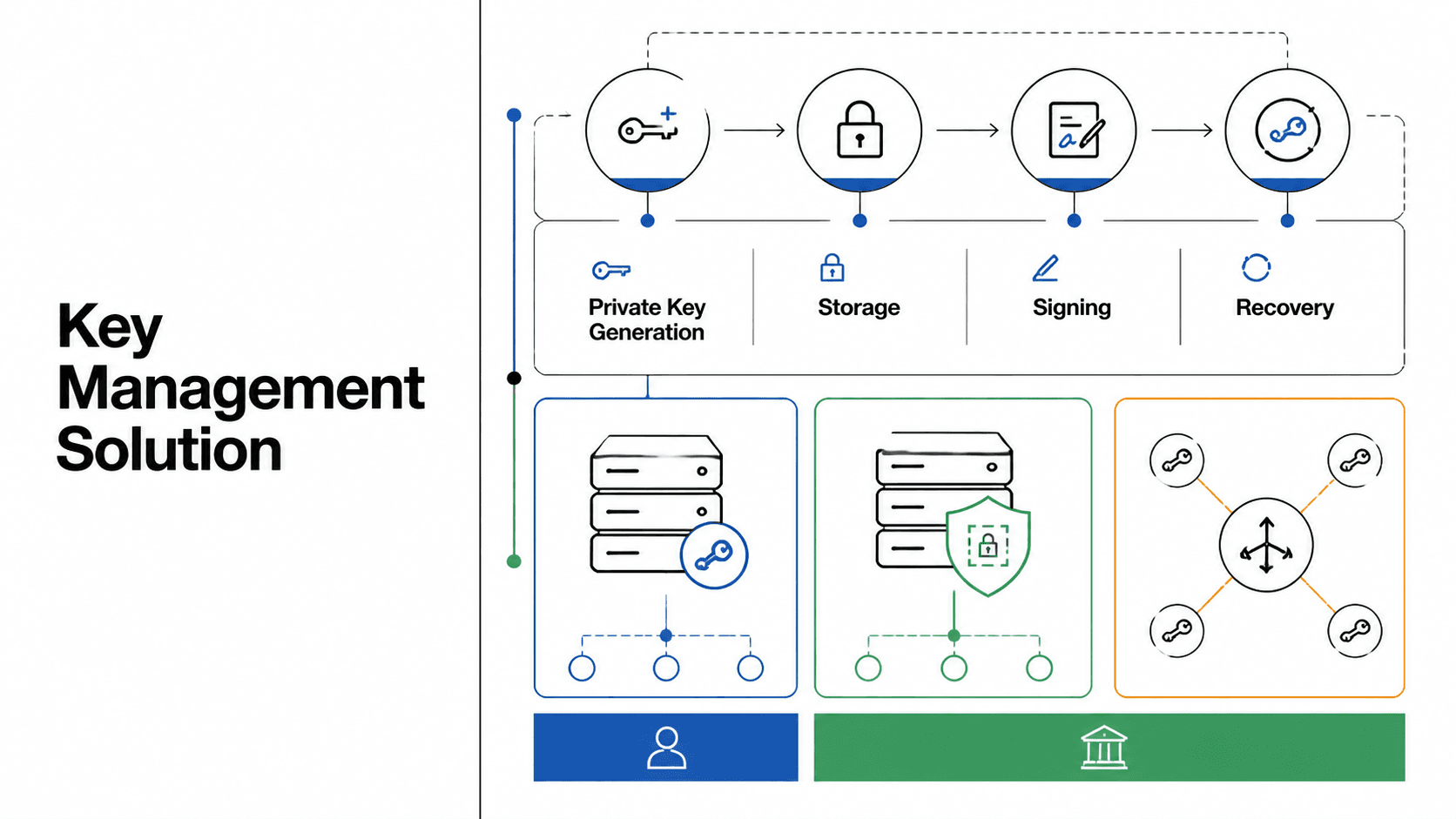
Openfort fits companies building a proprietary stablecoin payroll or mass payout product. Its unified API covers authentication, wallet creation, gas sponsorship, and funding. Self-custodial key management lets you control the signing model without Openfort taking custody of user keys, while the open-source OpenSigner stack can run in your own environment.
Openfort grounds its security position in five independent audits and policy-based transaction controls. You can define spending limits, approved contracts, and other transaction rules before a wallet signs a payment. Built-in recovery and multiple wallets per user can support products that separate payroll, expenses, or treasury balances.
Sub-200ms signing can reduce delay during transaction authorization, but signing speed does not establish batch payout throughput or final settlement time. Network capacity, contract design, and the chosen blockchain still affect payout performance. Gas sponsorship lets your product pay network fees on behalf of recipients, though Openfort does not publish a standard per-transaction gas cost.
Buyers must separately validate fiat off-ramps, corridor coverage, payroll reporting, and regulatory responsibilities. Openfort works best as the wallet and transaction layer underneath a payout product whose operator already has those functions or plans to source them elsewhere.
Triple-A: licensed payout rails for stablecoin and local-currency disbursement
Triple-A suits businesses that want regulated payout rails without operating their own digital asset compliance stack. The company functions as a payment institution rather than a wallet or exchange, and it handles wallet screening and transaction monitoring. Businesses can fund stablecoin or local-currency disbursements without holding digital currency on their balance sheets.
Triple-A operates under a Singapore Major Payment Institution license and an EU Payment Institution license. It also holds EU crypto-asset service provider registration and US FinCEN registration. Those credentials distinguish Triple-A from infrastructure providers that leave licensing and compliance controls to the customer.
For recipient coverage, Triple-A supports more than 30 local currencies across over 70 countries. Its stablecoin service supports USDC, USDT, and PYUSD at any time, including weekends. Triple-A reports that stablecoin payouts usually settle within minutes and cost under 1 percent, though actual cost depends on the corridor and conversion requirements.
Triple-A provides the payment leg rather than full global payroll administration. You still need another provider for employment contracts, tax withholding, benefits, and labour-law compliance. Its own mass payout comparison focuses on accounts-payable and treasury platforms such as Tipalti, Airwallex, and Wise. Buyers comparing stablecoin-native providers should also assess Triple-A against Openfort, BVNK, NOWPayments, and Stripe.
NOWPayments: lightweight crypto payouts for SMB and creator use cases
NOWPayments fits businesses that need self-serve, crypto-denominated payouts for creators, affiliates, contractors, or rewards recipients. Its products send crypto to wallet or email addresses, but the available documentation does not confirm local-fiat payroll delivery, tax withholding, or employment compliance across multiple countries.
The Mass Payouts API serves developers building payouts into an application. NOWPayments says one API call can initiate thousands of transactions to different wallet addresses. However, NOWPayments does not publish a maximum batch size, mass-payout-specific pricing, or a confirmed throughput rate.
The separate Zero-Fee Mass Payouts product targets lighter operational needs. A business can upload a CSV, enter payments manually, or use an API to send funds to as many as 100,000 email recipients. Recipients claim their crypto through the ChangeNOW ecosystem, which removes the need to collect wallet addresses before sending. The zero-fee claim applies to this consumer product and should not be treated as pricing for the Mass Payouts API.
NOWPayments works best when recipients want crypto and can manage it themselves. Buyers that require bank-account delivery in local currency should compare providers such as Triple-A or BVNK, which focus more directly on fiat off-ramps. NOWPayments references an AML/KYC policy, but its published product pages do not provide a licensing list or payroll compliance coverage by jurisdiction.
BVNK: embedded wallet unifying fiat and stablecoin balances
BVNK's embedded wallet connects bank and blockchain rails through one API. Bank connections include Swift and ACH, while blockchain support includes networks such as Ethereum, Solana, and Tron. Customers can maintain stablecoin balances alongside USD, GBP, and EUR, with automatic or on-demand conversion available around the clock through the embedded wallet.
BVNK best fits fintechs and payroll platforms that want to offer both fiat and stablecoin payments without holding crypto on their own balance sheets. The platform can convert incoming stablecoins into fiat or convert fiat into stablecoins when a payment occurs. A business would otherwise need separate banking, wallet, custody, and exchange integrations to support the same payment flow.
BVNK also states that it manages custody, fund flows, and customer verification requirements for integrating businesses, and advertises a licence count without naming the underlying entities. Request the licensing documentation for every relevant country, because neither the press coverage nor the marketing pages identify which entity holds what. The same sources provide no pricing or batch-throughput limits. They also leave gas sponsorship and per-transaction blockchain costs unclear, which makes a direct cost comparison difficult without a proposal from BVNK.
Stripe: stablecoin settlement folded into an existing payments stack
Stripe best fits existing Stripe users who want stablecoins to operate behind their current payments stack. Stripe's acquisition of Bridge added infrastructure for stablecoin balances, conversion, cards, and on-chain settlement to its broader product suite. Existing merchants can therefore add stablecoin functions with less onboarding work than a separate provider would usually require.
Buyers should treat Stripe's geographic coverage as unconfirmed. Secondary reports cite either 101 or more than 150 countries for stablecoin financial accounts, while claiming payouts to 160 countries. Those conflicting figures lack supporting primary documentation from Stripe. Available sources also do not verify transaction pricing, gas sponsorship, compliance reporting, or corridor-level availability.
Stripe keeps blockchain activity largely out of the merchant experience. By comparison, Triple-A and BVNK expose stablecoin conversion and payout functions more directly, while Openfort gives builders direct control over wallets, keys, gas, and funding. Choose Stripe when you already rely on its payments products and prefer stablecoins as a settlement rail. Choose a crypto-native provider when you need clearer control over wallet behaviour, blockchain execution, or payout routing.
A buyer's checklist for choosing a provider
Choose providers by corridor and recipient needs rather than relying on a global average.
- Where are recipients located, and how do they want to receive funds? Map your main corridors and preferred currencies before comparing coverage.
- Does the provider hold the required licenses? Verify authorisation in every market where it handles funds or conversion.
- What does each payout cost all-in? Include transaction charges, FX spreads, network fees, and recipient withdrawal costs.
- How quickly does money arrive in each corridor? Test weekend availability and fiat off-ramp timing rather than accepting one advertised speed.
- Can the platform fit your existing software? Check its API, batch upload, webhooks, reconciliation exports, and gas sponsorship controls.
- How does the provider handle failed payments? Review validation, retry rules, status reporting, refunds, and support escalation.
A hybrid architecture often makes the most practical choice. Use local bank rails where they already offer cheap, fast settlement, and use stablecoins where correspondent banking adds cost or delay. Budget separately for employment compliance and payment delivery. As Triple-A explains, payroll covers employees and associated obligations, while mass payouts usually serve contractors, sellers, and creators. One provider may not cover both functions.
For the compliance layer underneath either flow, see stablecoin KYC for fintechs, stablecoin regulation and licensing, and the compliance and security controls comparison.
FAQs
What is the difference between mass payouts and payroll?
Mass payouts send funds to contractors, sellers, creators, and other non-employees. Payroll covers employees and incorporates tax withholding, benefits, and employment compliance. Businesses serving both groups may need separate providers.
How much do stablecoin payouts cost compared with traditional wires?
Stablecoin payouts typically cost under 1 percent, while international wires often cost $25 to $50 plus foreign exchange markup. Traditional cross-border costs can reach 3 to 7 percent after currency conversion. Actual costs depend on the network, corridor, off-ramp, and recipient fees.
Is stablecoin payroll legal for employees and contractors?
Businesses can generally pay contractors in stablecoins when local law permits and both parties agree. Employee wages must follow local labour, tax, and minimum wage rules, which may restrict payment methods. A stablecoin payroll platform does not replace local employment compliance.
What licenses should a stablecoin payout provider hold?
A provider should hold the licenses required in every market where it operates. Relevant credentials may include US money transmitter licenses, FinCEN registration, EU Payment Institution or CASP authorisation, and Singapore Major Payment Institution status. Buyers should also verify recipient screening, sanctions controls, and audit reporting.
Can one provider cover both mass payouts and global payroll?
Rarely. A payroll provider manages worker classification, withholding, and local employment rules but often has limited stablecoin support. A mass payout platform handles batch distribution, wallets, and fiat off-ramps but usually leaves employment compliance to you. Budget for both, and check which vendor owns each obligation in writing.
Closing takeaway
No single provider offers the best economics and recipient coverage while meeting every corridor's compliance requirements. A practical stack often uses a licensed payout provider or embedded wallet for regulated fund flows and fiat conversion, while separate payroll software handles employee taxes and labour obligations.
If you are building a proprietary wallet or payout experience, Openfort can provide self-custodial key management and policy-based transaction controls through its wallet infrastructure. You still need compliant payment rails and employment providers for each market. Evaluate the combined stack corridor by corridor.