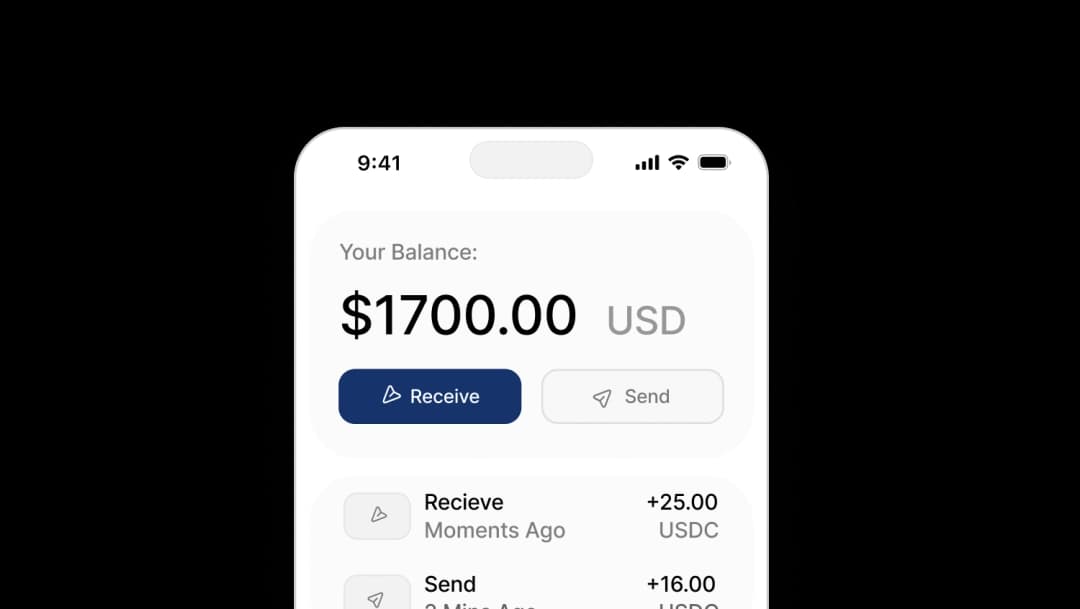
You are a product manager. You have identified a market that needs better financial services — maybe cross-border freelancers, maybe creator economy workers, maybe small businesses in emerging markets. You want to build a neobank, and your job is to scope the project, align stakeholders, and prepare your team to execute.
Five years ago, scoping a neobank meant preparing for $10M+ in fundraising, a 30-person hiring plan, and an 18-month integration timeline across sponsor banks, card networks, and compliance vendors — before a single user could open an account.
Today, the stack has fundamentally changed. Stablecoins and embedded wallets have collapsed the infrastructure requirements to the point where a focused team can ship a production financial product in weeks.
This guide is your scoping companion. It covers every decision you need to make, every stakeholder you need to align, and every trade-off you need to evaluate — so you can walk into your kickoff meeting with a clear plan.
Before You Start: The Key Questions
Before diving into architecture and vendors, answer these questions. They will shape every downstream decision:
- Who is your target user? Cross-border workers? Crypto-native teams? Emerging market savers? Creators? The answer drives feature priority, compliance needs, and go-to-market.
- What geographies will you serve? Each region has different regulatory requirements. US, EU, and LatAm have very different licensing paths.
- What is your MVP? Stablecoin wallets with transfers? Or do you need cards and fiat on/off ramps from day one?
- What is your custody posture? Will you hold user funds (custodial) or will users hold their own keys (non-custodial)? This has massive regulatory implications.
- What is your revenue model? Interchange? Subscription? Yield? FX spread? This determines which infrastructure you need.
PM Tip: Write a one-page brief answering these five questions before you start technical scoping. Share it with engineering, legal, and design leads for alignment. Every decision in this guide flows from these answers.
Understanding the Architecture: The Four Layers
A modern stablecoin neobank has four layers. As a PM, you need to understand what each layer does, who owns it, and where the build-vs-buy decisions live.
_21┌──────────────────────────────────────────────────────────┐_21│ LAYER 4: APPLICATION │_21│ Owner: Product + Design + Frontend Engineering │_21│ Mobile app (React Native), Web dashboard (Next.js) │_21│ User onboarding, KYC flows, transaction UI │_21├──────────────────────────────────────────────────────────┤_21│ LAYER 3: BUSINESS LOGIC │_21│ Owner: Backend Engineering │_21│ API server (Node.js/Go), Database (PostgreSQL) │_21│ User management, transaction routing, notifications │_21├──────────────────────────────────────────────────────────┤_21│ LAYER 2: FINANCIAL INFRASTRUCTURE │_21│ Owner: Engineering + PM (vendor evaluation) │_21│ Wallet SDK, On/off ramps, Card issuance, Compliance │_21│ (Openfort, Bridge, KYC providers, card programs) │_21├──────────────────────────────────────────────────────────┤_21│ LAYER 1: SETTLEMENT │_21│ Owner: Engineering (selection) + PM (cost/speed reqs) │_21│ Blockchain networks (Base, Arbitrum, Ethereum) │_21│ Stablecoins (USDC, USDT), Smart contracts │_21└──────────────────────────────────────────────────────────┘
The key insight for PMs: Layers 1 and 2 are mostly buy decisions. Layer 3 is where your engineering team builds differentiation. Layer 4 is where product and design create the user experience. Your scoping work should focus on evaluating vendors for Layers 1-2 and defining requirements for Layers 3-4.
Layer 1: Settlement — The Blockchain Choice
Your engineering team will make this call, but you need to understand the trade-offs because they affect cost, speed, and ecosystem.
| Network | Transaction Cost | Finality | USDC Liquidity | Ecosystem |
|---|---|---|---|---|
| Base | < $0.01 | ~2 seconds | $4.8B+ | Coinbase ecosystem, largest L2 by stablecoin value |
| Arbitrum | < $0.01 | ~1 second | $3B+ | Mature DeFi ecosystem |
| Polygon | < $0.01 | ~2 seconds | $1.5B+ | Wide adoption, especially in gaming/consumer |
| Ethereum L1 | $1-10 | ~12 seconds | $25B+ | Highest security, highest cost |
PM decision input: For most neobank use cases, Base is the pragmatic choice — deepest stablecoin liquidity among L2s, Coinbase ecosystem integration, and sub-cent transaction costs. Ask your engineering lead: "Is there a technical reason we should not default to Base?"
Layer 2: Financial Infrastructure — Your Biggest Vendor Decisions
This is where most of your scoping and evaluation work lives. There are four sub-components, and each requires a vendor decision:
1. Wallet infrastructure — Handles wallet creation, key management, transaction signing, and gas sponsorship. This is the most technically complex component.
2. On/off ramps — Converts between fiat and stablecoins. Building your own requires money transmitter licenses.
3. Card issuance — Lets users spend stablecoins at traditional merchants. Requires Visa/Mastercard partnerships.
4. Compliance — KYC verification, transaction monitoring, sanctions screening.
PM Action Item: Create a vendor evaluation matrix for each of these four areas. See the "Vendor Evaluation" section below for criteria.
Layer 3: Business Logic — Your Team Builds This
This is your core product logic — the differentiated code your engineering team writes:
- User management and authentication
- Transaction routing and fee logic
- Notification systems
- Analytics and reporting
- Internal admin tools
What to scope: Define the API contract between your business logic and the vendor services in Layer 2. Work with your engineering lead to estimate the data model and key integrations.
Layer 4: Application — Where Product Differentiation Lives
Your mobile app and web interfaces. This is where design and product create the experience:
- Onboarding flow and KYC UX
- Transaction and transfer experience
- Card management
- Settings and support
What to scope: User flows, wireframes, and the interaction model between the app and backend APIs. This is standard product work — the blockchain is invisible to users.
The Wallet Decision: Your Most Important Technical Trade-Off
The wallet architecture is the single most important technical decision. It determines your security model, custody classification, user experience, and regulatory posture. As a PM, you need to understand the options well enough to make an informed recommendation.
The Three Models
| Model | How It Works | Regulatory Impact | UX Impact | Build Complexity |
|---|---|---|---|---|
| Custodial | You hold private keys on behalf of users | Requires custody licensing (trust charter, banking license, or MTL) | Simplest for users | Medium — but high regulatory burden |
| Non-Custodial (Embedded) | Users own their keys, but wallet is invisible in your app | Lower regulatory burden — you are not a custodian | Seamless — users authenticate with passkeys/biometrics | Low with managed service, high from scratch |
| Hybrid | Different models for different tiers (e.g., non-custodial for spending, custodial for large deposits) | Complex — multiple regulatory frameworks | Flexible | Highest |
PM recommendation for most teams: Non-custodial embedded wallets. Users authenticate with familiar methods (email, passkeys, Face ID) and never see blockchain complexity. You avoid custody liability and the associated licensing burden.
Key Management: What to Ask Engineering
Your engineering team will evaluate key management approaches. Here is what you need to know to ask the right questions:
- Passkeys (WebAuthn): Keys bound to biometrics (Face ID, Touch ID). Best UX, hardware-backed security, no centralized key storage. Ask: "Do our target devices support passkeys?"
- MPC (Multi-Party Computation): Key split into shares across multiple parties. No single point of failure. Ask: "Who holds the key shares? What happens if one party is unavailable?"
- HSM (Hardware Security Modules): Keys in tamper-resistant hardware. Used for backend/treasury wallets. Ask: "What is the HSM provider's SLA and disaster recovery?"
Smart Accounts: Why They Matter for Your Product
Standard crypto wallets are just keypairs — they cannot enforce business rules. Smart accounts built on ERC-4337 account abstraction unlock product features that are impossible otherwise:
| Capability | What It Means for Your Product | PM Priority |
|---|---|---|
| Gas Sponsorship | Users never pay or see transaction fees | Must-have — any gas fee exposure kills conversion |
| Spending Policies | Per-user limits, merchant restrictions, approval workflows | Important for compliance and parental/corporate use cases |
| Transaction Batching | Multiple operations in one step — better UX, lower costs | Nice-to-have for MVP, important at scale |
| Social Recovery | Users recover access via trusted contacts — no seed phrases | Important for consumer products |
| Session Keys | Temporary permissions for specific actions | Advanced — useful for integrations |
PM Checklist — Wallet Decision:
- Aligned with legal on custody model (custodial vs. non-custodial)?
- Confirmed key management approach with engineering?
- Gas sponsorship budgeted as operating expense?
- Smart account features prioritized for MVP vs. later phases?
- Evaluated build vs. buy for wallet infrastructure?
Build vs. Buy: Wallet Infrastructure
This is a critical decision. Here is the framework:
| Factor | Build In-House | Use Managed Service (e.g., Openfort) |
|---|---|---|
| Time to production | 6-12 months | 1-2 weeks |
| Engineering investment | 3-5 dedicated wallet engineers | Integration work only |
| Maintenance burden | Ongoing — key management, security patches, audits | Provider handles it |
| Customization | Full control | API-level customization |
| Best for | Wallets are your core differentiator | Wallets enable your product (not the product itself) |
PM recommendation: Unless wallet technology is your company's core differentiator, use a managed service. The 6-12 month build timeline is rarely worth it. See build vs. buy analysis for a deeper breakdown.
Backend Wallets: Server-Side Operations
Your product will also need server-side wallets for operations that run without user interaction:
- Treasury management: Holding operational funds, automated sweeps
- Payroll/disbursement: Automated multi-recipient transfers
- Gas funding: Funding paymasters that sponsor user transactions
- Liquidity management: Moving funds between chains or protocols
What to scope: Work with engineering to define which backend wallet operations are needed at launch vs. later. Treasury management and gas funding are day-one requirements.
Stablecoin Integration: What to Know and Decide
For a deeper look at the infrastructure evolution behind this shift, see our companion article on neobank wallet infrastructure.
Choosing Your Stablecoin
This decision affects compliance posture, liquidity, and partner compatibility:
| Stablecoin | Issuer | Circulation | Compliance Posture | Best For |
|---|---|---|---|---|
| USDC | Circle | $50B+ | SOC 2, regulated, reserves audited | US/EU fintechs, institutional use — recommended default |
| USDT | Tether | $130B+ | Largest by volume | Emerging markets, high liquidity needs |
| PYUSD | PayPal | $500M+ | PayPal-regulated | PayPal ecosystem integration |
| EURC | Circle | Growing | MiCA-compliant | Euro-denominated products |
PM decision: Default to USDC unless your target market strongly favors USDT (common in emerging markets). For multi-currency products, plan to support both USDC and EURC with on-chain swaps.
Questions to ask legal: "Given our target geography and user base, which stablecoins can we support from a compliance perspective? Are there restrictions on USDT in our operating jurisdictions?"
On-Ramps and Off-Ramps: Connecting Fiat and Crypto
Users need to move between fiat and stablecoins. This is where you connect the blockchain world to the banking world.
On-ramp (fiat → stablecoin): User deposits USD from their bank account and receives USDC in their wallet.
Off-ramp (stablecoin → fiat): User converts USDC to USD and withdraws to their bank account.
| Provider | Strengths | Coverage | PM Evaluation Notes |
|---|---|---|---|
| Bridge (Stripe) | Deepest Stripe integration, Visa cards, stablecoin accounts in 101 countries | Global | Best if you are already in the Stripe ecosystem or need card issuance |
| MoonPay | Consumer-friendly widget, broad crypto support | 160+ countries | Good drop-in solution, higher fees |
| Transak | Developer-focused APIs, wide payment methods | 170+ countries | Good for markets needing local payment methods |
| Ramp Network | European focus, strong compliance | EU focus | Best for EU-first products |
Bridge (acquired by Stripe) is becoming the infrastructure default. Key capabilities to evaluate:
- Orchestration API for programmatic stablecoin movement
- Virtual accounts with unique routing numbers
- Automatic fiat-to-USDC conversion
- Stablecoin financial accounts in 101 countries
- Visa card issuance backed by stablecoin balances
Real-world validation: Airtm processes $1.2B in stablecoin volume using Bridge APIs to serve 2.5M+ users across Latin America and emerging markets.
PM Action Item: Request pricing, coverage maps, and integration timelines from at least two on/off ramp providers. Key evaluation criteria: supported geographies, payment methods in your target market, settlement times, fee structure, and KYC requirements.
Cross-Border Payments: Your Competitive Moat
If your target users transact across borders, this is your strongest value proposition:
| Traditional Cross-Border | Stablecoin Transfer | |
|---|---|---|
| Cost | 5-7% of transfer amount | < $0.01 |
| Time | 3-5 business days | Seconds |
| Intermediaries | 3-5 banks | Zero |
| Visibility | Limited tracking | Full on-chain transparency |
What this means for your product: A freelancer in Mexico receiving $5,000 from a US client saves $250-350 per transfer. This cost difference is a tangible, quantifiable value proposition you can use in positioning and GTM.
Card Programs: Scoping Physical Spend
Users will want to spend their stablecoin balance at traditional merchants. Card programs make this possible, but they add complexity and vendor dependencies.
How Stablecoin Cards Work
_10User taps card at merchant → Card network (Visa) authorizes →_10 Your backend receives authorization → Deducts USDC from user's wallet →_10 Settlement occurs in fiat to the merchant
The user's balance stays in USDC until the moment of purchase. Conversion happens at point of sale.
Card Issuance: Vendor Options
| Option | Provider Examples | Pros | Cons | Best For |
|---|---|---|---|---|
| Full-stack issuer | Rain, Reap | Direct Visa/Mastercard membership, proven scale (Rain: $3B+ annualized volume) | Less flexibility, their compliance requirements | Teams wanting fastest path to cards |
| Platform-based | Bridge/Stripe Issuing, Gnosis Pay | Integrated with stablecoin infrastructure, white-label options | Platform dependency | Teams already using Bridge/Stripe for on/off ramps |
| Card-as-a-service | Marqeta, Lithic | Maximum customization, proven infrastructure | More integration work, higher minimum volumes | Teams with strong engineering capacity and specific card requirements |
Card Economics
Crypto card volume has grown from ~$100M monthly in early 2023 to over $1.5B monthly by late 2025 — a 106% CAGR. Annualized volume now exceeds $18B.
| Revenue Stream | Typical Margin | PM Notes |
|---|---|---|
| Interchange fees | 1-3% of spend volume | Primary card revenue — negotiate BIN sponsor rates carefully |
| FX spread | Variable on cross-currency transactions | Significant for cross-border user bases |
| Card issuance fees | $5-20 per physical card | Consider virtual-first to reduce costs |
| Premium card tiers | $5-20/month subscription | Metal cards, higher limits — strong for retention |
PM Decision: Cards in MVP? Cards are a powerful feature but not the core product. Consider launching without cards (Phase 1-2) and adding them in Phase 3. The core value proposition is stablecoin accounts with instant transfers. Cards expand utility but add 4-8 weeks to the timeline and a major vendor dependency. Discuss with your team whether cards are a day-one requirement or a fast-follow.
Regulatory Planning: What Legal and Compliance Need from You
Regulation is not optional, and stablecoins do not eliminate regulatory requirements — they change which regulations apply. For a comprehensive overview, see our stablecoin regulation and licensing guide.
As a PM, your job is to ensure legal and compliance are looped in early and that their requirements are factored into the product plan.
United States
- Money Transmitter Licenses (MTLs): Required in most states if you transmit stablecoins on behalf of users. Full licensing across all states takes 12-18 months and $500K-2M. Alternative: partner with a licensed entity (much faster).
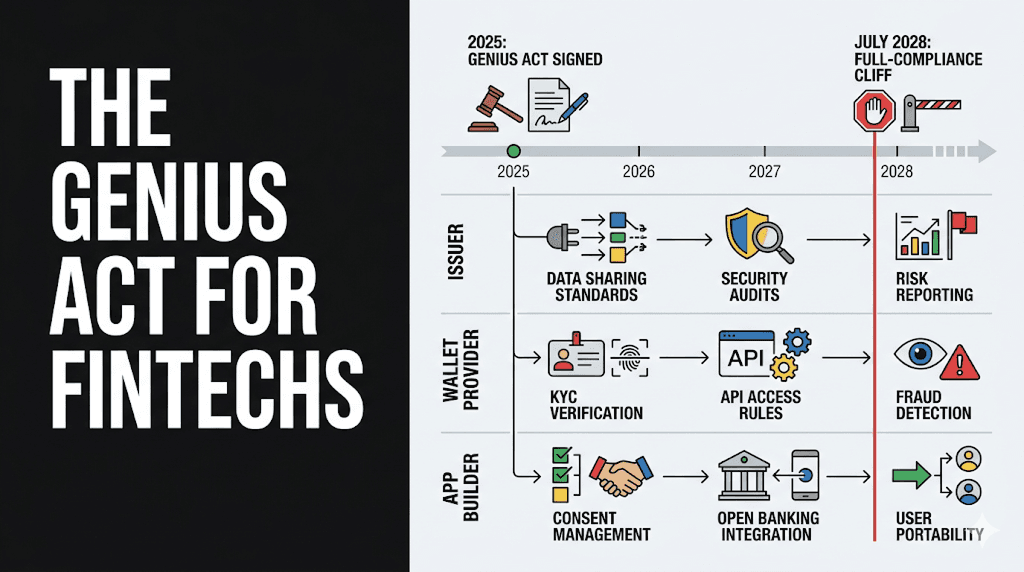
- GENIUS Act (2025): Federal framework for payment stablecoins. Restricts issuance to regulated entities. Issuers must maintain full reserves and provide monthly disclosures.
- FinCEN / BSA: Anti-money laundering obligations apply. You must implement a compliance program, file SARs, and maintain transaction records.
European Union
- MiCA (Markets in Crypto-Assets): Fully applicable since January 2025. Clear framework for stablecoin operations, including e-money token (EMT) and asset-referenced token (ART) categories.
- E-Money License: May be required depending on your stablecoin activities.
- PSD2/PSD3: Payment services regulations that may apply to fiat on/off ramp operations.
The Practical Path for Most Startups
| Phase | Regulatory Approach | Timeline |
|---|---|---|
| Phase 1: Launch | Partner with licensed providers for all regulated activities (on/off ramps via Bridge/Stripe, card issuance via licensed issuer, KYC via compliance vendor) | Weeks to months |
| Phase 2: Growth | Obtain your own MTLs or e-money license as volume grows | 12-18 months |
| Phase 3: Scale | Consider banking charter or specialized fintech charter for full-service offering | 2+ years |
PM Checklist — Regulatory:
- Engaged legal counsel with fintech/crypto experience?
- Identified required licenses for target jurisdictions?
- Mapped which activities will be handled by licensed partners vs. in-house?
- Budgeted for compliance costs ($50-150K/year for stablecoin stack)?
- Defined KYC requirements with legal (document types, liveness check, enhanced due diligence thresholds)?
- Confirmed sanctions screening approach with compliance?
KYC/AML Implementation: Vendor Landscape
| Function | Provider Options | What to Evaluate |
|---|---|---|
| Identity verification | Jumio, Onfido, Persona, Sumsub | Pass rates in your target market, document coverage, liveness detection quality |
| Sanctions screening | Built into most KYC providers | Real-time vs. batch, list coverage (OFAC, EU, UN) |
| On-chain monitoring | Chainalysis, Elliptic, TRM Labs | Address risk scoring, real-time alerts, regulatory reporting |
| SAR filing | Compliance team + tooling | Workflow for escalation and filing |
Questions to ask KYC vendors: "What are your pass rates for [target country] documents? What is your average verification time? Do you support [specific document types] needed in our market? What is your pricing model at our projected volume?"
Security Architecture: What PMs Need to Understand
Financial products demand defense-in-depth security. You do not need to architect this, but you need to ensure it is scoped, budgeted, and prioritized correctly.
Key Areas to Scope with Engineering
Key Management — The most critical security concern:
- User keys: Passkey-based authentication (keys never leave the device)
- Server keys: HSMs or TEEs for backend wallets
- Access controls: Multi-party approval for treasury operations
Smart Contract Security (if deploying custom contracts):
- Third-party audits before deployment ($50-200K per audit)
- Formal verification for critical financial logic
- Emergency pause functionality
Application Security — Standard fintech practices:
- Multi-factor authentication with step-up for high-value operations
- Rate limiting and API security
- Data encryption (at rest and in transit)
- Real-time monitoring and alerting
Fraud Prevention — Stablecoin-specific considerations:
- Velocity checks (limits on transaction count/volume per time window)
- Address screening against sanctions lists
- Behavioral analysis for account takeover detection
- Optional user-configured trusted addresses for large transfers
PM Checklist — Security:
- Discussed key management approach with engineering lead?
- Budgeted for smart contract audits (if deploying custom contracts)?
- Defined fraud prevention rules with engineering and compliance?
- Planned for incident response runbook?
- If using managed wallet service — reviewed provider's security certifications and audit reports?
User Experience: Scoping the Product
The entire point of embedded wallet infrastructure is to make blockchain invisible. Your UX should feel like a traditional banking app.
Onboarding Flow
Target: Under 5 minutes from download to funded account.
_101. Download app_102. Enter email / phone → verify with OTP_103. KYC: scan ID + selfie liveness check (2-3 minutes)_104. Passkey enrollment (Face ID / Touch ID prompt)_10 → Wallet created invisibly in background_105. Fund account (bank transfer, card, or receive stablecoins)_106. Ready to use
The wallet creation at step 4 is invisible. The user enrolls a passkey for security and convenience. Behind the scenes, an embedded wallet and smart account are provisioned.
PM Scoping Questions for Design:
- What is the minimum KYC flow for our target market? Can we do tiered KYC (basic for small amounts, enhanced for larger)?
- What recovery flow do users get if they lose their device?
- What does the empty state look like after onboarding — how do we drive first deposit?
- What notifications does the user receive (and through which channels)?
Third-Party Services Map
Use this as your vendor landscape overview when scoping integrations:
| Function | Recommended Providers | Integration Effort |
|---|---|---|
| Wallet infrastructure | Openfort (embedded wallets, smart accounts, gas sponsorship, backend wallets) | 1-2 weeks |
| On/off ramp | Bridge (Stripe) or MoonPay | 2-4 weeks |
| KYC | Persona or Sumsub | 1-2 weeks |
| Card issuance | Rain, Bridge Visa, or Gnosis Pay | 4-8 weeks |
| On-chain monitoring | Chainalysis or TRM Labs | 1-2 weeks |
| Notifications | Firebase Cloud Messaging + email (SendGrid/Resend) | 1 week |
Cost Planning: Budgets and Unit Economics
Launch Costs (MVP to Production)
| Category | Stablecoin Stack | Traditional Stack | PM Notes |
|---|---|---|---|
| Engineering team (3-6 months) | $150-400K | $1-3M | 5-8 engineers for stablecoin stack vs. 15-30 for traditional |
| Wallet infrastructure | Usage-based (near zero at start) | $500K-1M (build) or $200K/year (buy) | Managed service scales with usage |
| On/off ramp integration | Revenue share model | ACH/wire setup: $50-200K | Revenue share means low upfront cost |
| Card program | Per-card pricing | $100K+ setup + per-card | Defer to Phase 3 if possible |
| KYC/compliance | $20-100K/year | $300K-1M/year | Volume-dependent pricing |
| Legal/licensing | $50-150K | $500K-2M | Partner path vs. direct licensing |
| Total to launch | $300K-800K | $5-15M | 10-15x cost reduction |
Operating Costs (Annual at 10K Users)
| Category | Stablecoin Stack | Traditional Stack |
|---|---|---|
| Infrastructure (cloud, services) | $50-150K | $200-500K |
| Wallet/blockchain services | $20-100K | N/A |
| BaaS / Sponsor bank fees | N/A | $500K-2M |
| Compliance | $50-150K | $300K-1M |
| Card program | Per-transaction | Per-transaction + minimums |
| Support | $50-150K | $100-300K |
| Total annual | $200-600K | $1.5-4M |
Revenue Model
| Revenue Stream | Typical Margin | When It Activates |
|---|---|---|
| Card interchange | 1-3% of spend volume | Phase 3 (card launch) |
| On/off ramp spread | 0.5-2% of volume | Phase 2 (fiat rails) |
| FX spread (cross-border) | 0.5-1.5% | Phase 1 (stablecoin transfers) |
| Premium subscriptions | $5-20/month per user | Phase 4 (growth features) |
| Yield on deposits (DeFi treasury) | Variable | Phase 4 |
Unit economics example: At 10K active users with $1K average monthly spend, a stablecoin neobank can generate $120K-360K annual interchange revenue alone — potentially reaching cash-flow positive much earlier than traditional neobanks that require millions of users to cover their infrastructure costs.
PM Action Item: Build a financial model with your finance lead. Key inputs: projected user growth, average account balance, monthly transaction volume, interchange rate, and on/off ramp spread. Model the path to unit economics breakeven.
Go-to-Market: Choosing Your Niche
Because infrastructure costs are 10-100x lower with stablecoins, you do not need millions of users to sustain the business. This enables deep specialization — and as a PM, picking the right niche is your most important strategic decision.
| Target Segment | Pain Points | Stablecoin Solution | Market Validation |
|---|---|---|---|
| Cross-border workers & freelancers | 5-7% transfer fees, 3-5 day settlement, banking access issues | Instant near-free transfers + local off-ramp | Airtm: $1.2B+ volume, 2.5M users in LatAm |
| Creator economy / gig workers | Payment delays (Net 30-90), deplatforming risk, high fees | Instant stablecoin payouts + debit card | KAST: 150+ countries, zero-fee spending |
| Crypto-native teams & DAOs | Stablecoin treasury but need fiat spend, corporate cards, payroll | Treasury management + corporate card program | Tria: $12M raised for self-custodial neobank infrastructure |
| Emerging market savers | Currency devaluation, limited banking, high remittance costs | Dollar-denominated accounts + local off-ramps | RedotPay: 6M users across 100+ countries |
| SMBs with international operations | SWIFT costs, FX markups, slow settlement, locked working capital | Stablecoin treasury + instant settlement + card spend | Growing segment |
PM Decision Framework for Niche Selection:
- Do we have domain expertise or network in this segment?
- Is the pain point quantifiable and frequent (not occasional)?
- Can we reach this audience through targeted channels (not mass marketing)?
- Is the regulatory path tractable for this segment and geography?
- Does the revenue model work at 5K-10K users (not just at millions)?
Implementation Timeline: Phased Roadmap
Here is a realistic phased approach. Use this as a starting point for your sprint planning:
Phase 1: Core Product (Weeks 1-6)
Goal: Users can create an account, hold stablecoins, and transfer to other users.
| Work Stream | Tasks | Owner | Dependencies |
|---|---|---|---|
| Wallet integration | Integrate embedded wallet SDK (passkey auth, smart accounts) | Engineering | Vendor contract signed |
| Onboarding | Build onboarding flow with KYC integration | Engineering + Design | KYC vendor selected |
| Core features | Stablecoin balance display and P2P transfers | Engineering | Wallet integration complete |
| Infrastructure | Gas sponsorship setup, backend API, database | Engineering | Wallet vendor supports paymasters |
| Compliance | Sanctions screening, transaction monitoring setup | Engineering + Compliance | Monitoring vendor selected |
Exit criteria: Users can sign up, pass KYC, receive stablecoins, and send to other users — with zero blockchain complexity visible.
Phase 2: Fiat Rails (Weeks 4-10)
Goal: Users can deposit and withdraw fiat currency.
| Work Stream | Tasks | Owner | Dependencies |
|---|---|---|---|
| On/off ramp | Integrate fiat deposit and withdrawal provider | Engineering | On/off ramp vendor contract |
| Compliance | Enhanced monitoring, SAR workflow | Compliance + Engineering | Phase 1 monitoring in place |
| Operations | Admin dashboard, transaction notifications | Engineering | Phase 1 backend complete |
Exit criteria: Users can fund their account from a bank account and withdraw to a bank account.
Phase 3: Card Program (Weeks 8-14)
Goal: Users can spend stablecoins at any merchant via virtual and physical cards.
| Work Stream | Tasks | Owner | Dependencies |
|---|---|---|---|
| Card issuance | Integrate card provider, build card management UI | Engineering + Design | Card vendor contract (start early — longest lead time) |
| Mobile pay | Apple Pay / Google Pay enrollment | Engineering | Card integration complete |
| Revenue | Interchange tracking, revenue reporting | Engineering + Finance | Card program live |
Exit criteria: Users can issue a virtual card, add to Apple/Google Pay, and spend at merchants.
Phase 4: Growth Features (Weeks 12-20)
Goal: Retention and expansion features.
| Work Stream | Tasks | Owner |
|---|---|---|
| Multi-currency | Support additional stablecoins and currencies | Engineering |
| Automation | Scheduled/recurring transfers | Engineering + Design |
| Yield | Yield on idle balances | Engineering + Compliance + Legal |
| Growth | Referral program, spending insights | Product + Engineering + Design |
Important note: These phases overlap. A focused team of 5-8 engineers can have Phase 1 in production by week 6 and a full-featured product by week 16-20.
PM Checklist — Timeline Planning:
- Card vendor discussions started in Week 1 (longest procurement lead time)?
- Legal counsel engaged before Phase 1 starts?
- KYC vendor selected and contract signed before engineering starts onboarding flow?
- Design started 2-4 weeks ahead of engineering on each phase?
- QA and security review planned before each phase launch?
Team Requirements: Who You Need
Minimum Viable Team (5-8 people)
| Role | Count | Responsibilities |
|---|---|---|
| Product Manager | 1 | Scoping, prioritization, vendor management, stakeholder alignment |
| Backend Engineer | 2-3 | API server, database, vendor integrations, transaction logic |
| Mobile/Frontend Engineer | 1-2 | React Native app, web dashboard, onboarding flows |
| Designer | 1 | UX/UI design, user research, brand |
| Compliance/Legal | 0.5-1 (can be external) | Regulatory strategy, KYC requirements, licensing |
Stakeholder Map
As a PM, you are the hub connecting these stakeholders. Here is what each needs from you:
| Stakeholder | What They Need | When to Engage |
|---|---|---|
| Engineering | Clear requirements, prioritized backlog, vendor API docs, defined integration contracts | From sprint 0 — involve in vendor evaluation |
| Legal/Compliance | Target geographies, custody model decision, stablecoin selection, user flow for KYC | Before any engineering starts — their inputs constrain your architecture |
| Design | User personas, competitive analysis, feature requirements, KYC/onboarding constraints | 2-4 weeks ahead of engineering on each phase |
| Finance | Cost projections, revenue model, vendor pricing, runway analysis | During scoping — they validate your financial model |
| Operations | Support workflows, escalation paths, admin tool requirements | Before Phase 1 launch |
| Leadership | Progress updates, key decisions, risks, timeline | Weekly or bi-weekly |
Vendor Evaluation Framework
Use this framework when evaluating any infrastructure vendor for your neobank:
Evaluation Criteria
| Criteria | Questions to Ask | Weight |
|---|---|---|
| Coverage | Does it support our target geographies and currencies? | High |
| Compliance | What licenses does the vendor hold? What compliance burden shifts to us? | High |
| Integration effort | How long to integrate? What is the API quality? Is there SDK support? | High |
| Pricing | What is the fee structure? Per-transaction, subscription, or hybrid? At our projected volume? | High |
| Scalability | Can it handle our growth projections? What are throughput limits? | Medium |
| Support | What is the SLA? Is there dedicated support? What is the incident response process? | Medium |
| Lock-in risk | How portable is our integration? Can we switch providers later? | Medium |
| Track record | Who else uses this? What is their volume? Any public incidents? | Medium |
PM Action Item: Create a vendor evaluation scorecard using these criteria. Score each vendor 1-5 on each criterion. Weight by importance. Review with engineering and legal before making final selections.
Lessons from Teams That Ship Successfully
At Openfort, we have worked with dozens of fintechs building stablecoin products. Here are the patterns we see in teams that ship successfully — framed as principles for PMs:
Start with wallets, not cards. The core value proposition is stablecoin accounts with instant transfers. Scope cards as Phase 3, not Phase 1. Cards add vendor complexity and procurement lead time that can delay your entire launch.
Sponsor all gas from day one. Any mention of gas fees in the user experience is a conversion killer. Budget for gas sponsorship as a cost of doing business, like Stripe processing fees. Work with finance to model this as a per-user operating cost.
Use passkeys for authentication. Passkeys (Face ID/Touch ID) deliver the best combination of security and UX. No passwords to forget, no seed phrases to lose. This is a non-negotiable UX decision.
Build for a specific community. The teams with the strongest traction serve a defined audience deeply rather than competing with Revolut for the mass market. Your niche selection is your most important product decision.
Compliance is not optional. Even in the stablecoin world, KYC/AML is required. Integrate it from day one, not as an afterthought. Loop in legal counsel before your first sprint.
Vendor contracts take longer than you think. Start procurement conversations in Week 1, especially for card issuance. A signed vendor contract is a dependency for engineering work, and enterprise sales cycles can delay your timeline.
Your Next Steps: The PM Kickoff Checklist
Use this checklist to prepare for your neobank build. Each item should be completed or in progress before engineering starts:
Week 1-2: Strategic Foundations
- Write the one-page brief (target user, geography, MVP scope, custody model, revenue model)
- Engage legal counsel with fintech/crypto expertise
- Begin vendor outreach for wallet infrastructure, on/off ramps, KYC, and card issuance
- Align leadership on budget range ($300K-800K for stablecoin stack)
Week 2-3: Technical Scoping
- Define custody model with legal input (recommend: non-custodial embedded wallets)
- Select blockchain network with engineering (recommend: Base for most use cases)
- Select stablecoin(s) with legal input (recommend: USDC as default)
- Evaluate and shortlist wallet infrastructure provider
- Evaluate and shortlist on/off ramp provider
- Evaluate and shortlist KYC provider
Week 3-4: Product Definition
- Define user personas and key user flows with design
- Create phased feature roadmap (Phase 1-4 as outlined above)
- Define KYC requirements and tiers with legal and compliance
- Scope admin dashboard requirements with operations
- Build financial model with finance
Week 4-5: Execution Setup
- Sign vendor contracts (wallet, KYC — minimum for Phase 1)
- Set up project tracking and sprint cadence
- Define success metrics for each phase (sign-up conversion, time to first transaction, etc.)
- Plan security review and audit process
- Begin Phase 1 engineering
Building a neobank is more accessible than it has ever been. The infrastructure primitives exist. The regulatory frameworks are emerging. The market opportunity is real.
The question is not whether stablecoin-powered neobanks will exist — companies like Airtm, KAST, and RedotPay are already proving the model with millions of users. The question is which specific communities will get the best-designed financial products built for their needs.
Your job as a PM is to answer that question — to identify the right market, scope the right product, choose the right partners, and get your team executing.
If you are building a stablecoin fintech and need wallet infrastructure — embedded wallets, smart accounts, gas sponsorship, backend wallets — let's talk.