Privy and Turnkey both let you give users a wallet without a seed phrase, and that is where the similarity ends. Privy is a bundled product you drop in. Turnkey is a signing primitive you build on. Picking wrongly costs you either six months of building auth you did not want to build, or a migration when the bundle stops fitting.
Here is the short version, then the detail.
Quick answer
Pick Privy if you want wallets, login, and fiat onramps from one SDK, you are happy inside Stripe's ecosystem, and your users transact often enough that per-user pricing works out. Pick Turnkey if you are assembling your own stack, you need per-signature economics because most of your wallets sit idle, or you need key-quorum approvals and a policy engine.
Side by side
| Privy | Turnkey | |
|---|---|---|
| What it is | Bundled wallets, auth, and onramps | Key management and signing infrastructure |
| Owner | Stripe (acquired June 2025) | Independent |
| Key management | Shamir's Secret Sharing plus TEE, proprietary | AWS Nitro Enclaves with verifiable attestation |
| Signing latency | 100–130 ms median after 2026 multi-region work | 100–150 ms |
| Pricing unit | Monthly active user | Signature |
| Entry pricing | Free to 499 MAU, then 299 USD/month | Free to 100 wallets and 25 signatures, then 0.10 USD/signature |
| Volume pricing | 499 USD/month to 9,999 MAU, then enterprise | 99 USD/month Pro at 0.05 USD/signature, enterprise from 0.0015 USD |
| Wallet cap | None, priced on active users | 100 free, 1,000 PAYG, 2,000 Pro, unlimited enterprise |
| Custom OIDC / JWT | Supported | Not supported |
| Smart accounts | Via Alchemy, ZeroDev, and similar | EIP-7702 supported directly, 38 EVM networks |
| Gas sponsorship | Available | From the 99 USD/month Pro tier up |
| Policy engine | Off-chain policy API | Policy engine with key-quorum approvals |
| Compliance | Inherits Stripe's posture | SOC 2 Type II, pen tests by Cure53, Disttrust, Trail of Bits |
| Fiat onramp | Native, Bridge and Stripe onramp, 100+ countries | Not included |
The pricing model is the real fork
Both companies publish their pricing, which is rarer than it should be in this category. The numbers matter less than the unit.
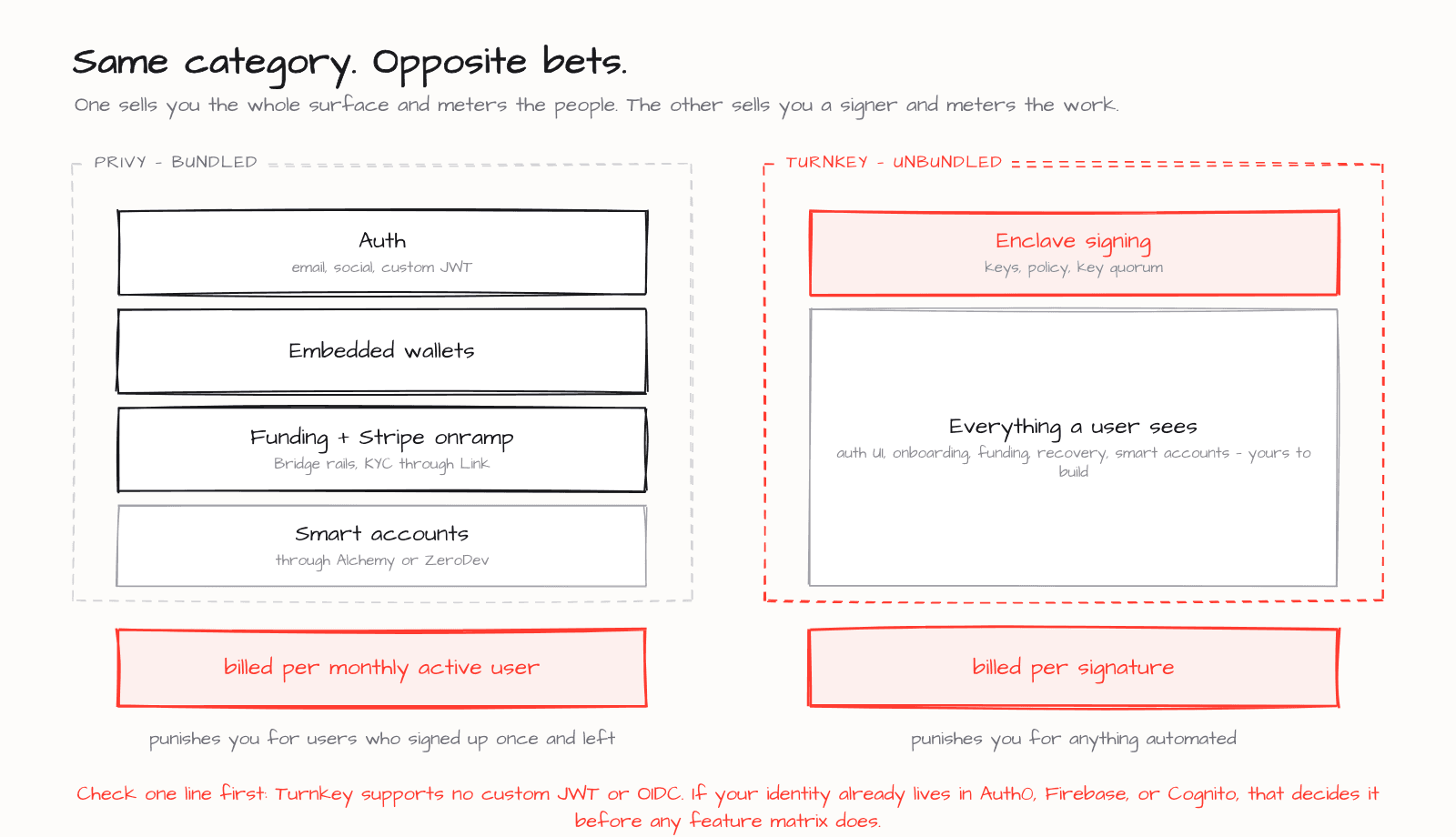
Privy charges for users who show up. Turnkey charges for signatures produced. Model your own numbers before you pick, because the same application can be three times cheaper on either one:
- A consumer app with 50,000 registered wallets where 2,000 people log in monthly and each signs twice: Privy's Scale tier at 499 USD/month covers it. On Turnkey PAYG that is 4,000 signatures at 0.10 USD, so 400 USD, but you have blown through the 1,000-wallet cap and need Pro or enterprise.
- A trading or agent workload with 500 wallets signing 200 times each per month: 100,000 signatures. On Turnkey Pro that is 99 USD plus 5,000 USD. On Privy those 500 users sit inside the 299 USD Core tier.
- A game with 200,000 mostly dormant wallets: Privy's MAU count stays low, but so does Turnkey's signature count. Compare the wallet cap, not the headline price.
The trap in both directions is the same. MAU pricing punishes you for users who registered and left. Per-signature pricing punishes you for automation. Know which shape your app is before you sign anything.
Architecture: bundled versus unbundled
Privy ships auth, embedded wallets, and funding as one integrated surface. Since the Stripe acquisition it has added Bridge integration and, in July 2026, the Stripe crypto onramp across 100+ countries with Stripe handling KYC through Link. For a fintech that wants fiat in and stablecoins out, that is a lot of work you do not have to do.
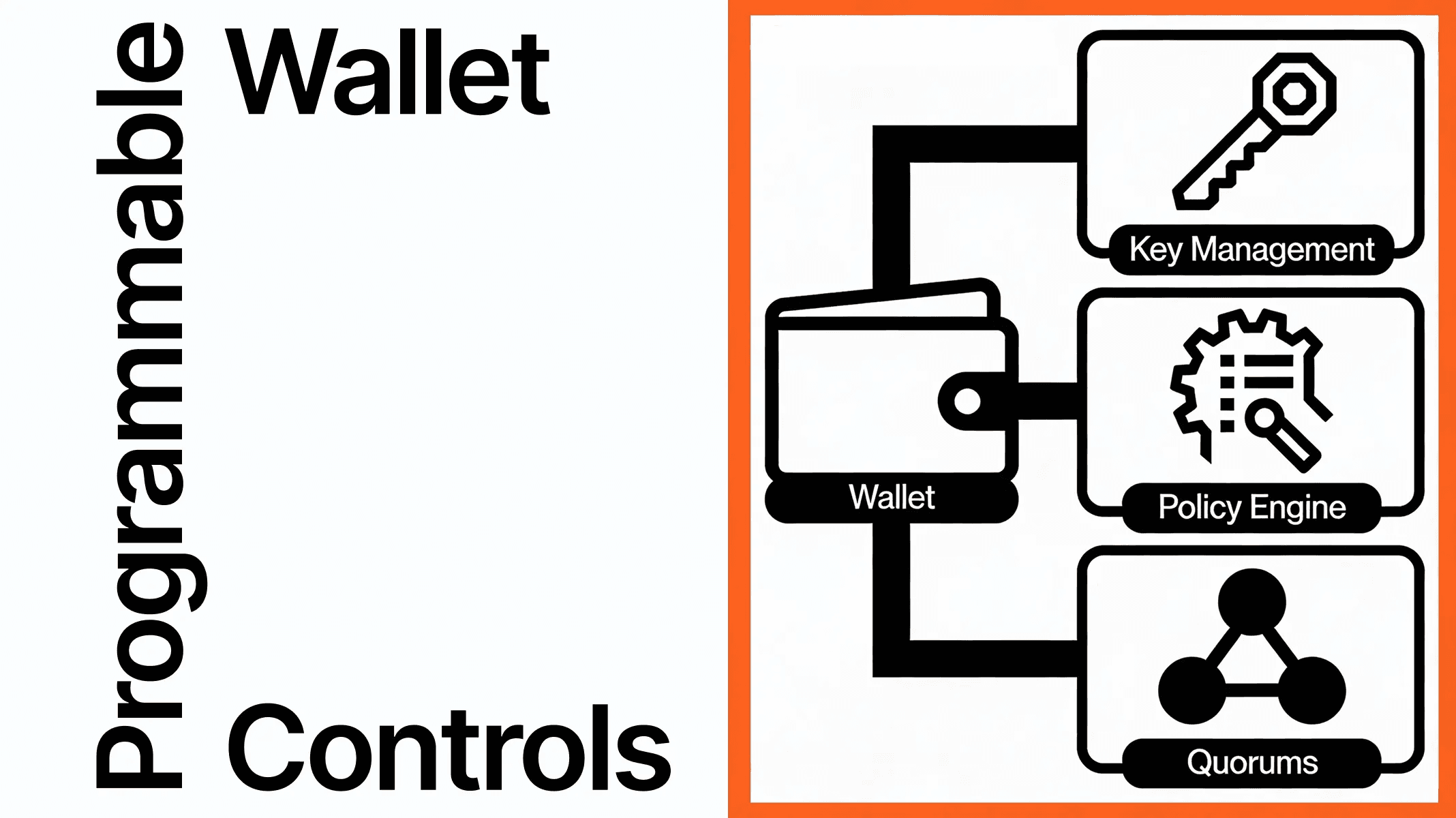
Turnkey deliberately does less. Private key generation, signing, authentication, and policy enforcement run inside hardware-isolated secure enclaves with reproducible builds and verifiable attestation. The founding team built Coinbase Custody. What you get is a signing primitive with a policy engine and key-quorum approvals on top, and what you build is everything a user actually sees.
Turnkey raised a 12.5M USD strategic investment in May 2026, taking total funding past 65M USD, and remains independent. Whether that matters depends on whether you regard Stripe ownership as distribution or as dependency.
Auth is where most decisions get made
Turnkey does not support custom JWT or OIDC. If your identity already lives in Auth0, Firebase, Cognito, or your own service, you cannot point Turnkey at it. Custom email templates, custom domains, and SMS auth sit on enterprise tiers.
Privy supports custom JWT-based auth, so an existing identity provider can stay where it is.
This single line eliminates one of the two options for a lot of teams before anything else gets evaluated. Check it first.
Smart accounts
Turnkey supports EIP-7702 and has published integration documentation across 38 EVM networks. Privy handles ERC-4337 smart accounts through third-party integrations such as Alchemy and ZeroDev, which works but means a second vendor in the path and a second thing to keep current.
If gas sponsorship, session keys, and batched transactions are core to your product rather than a nice-to-have, count how many vendors end up in that chain before you commit.
Who each one fits
Privy fits consumer apps and fintechs that want to ship in days, teams that want fiat onramps without a separate integration, and anyone already committed to Stripe.
Turnkey fits teams building custom wallet UX, workloads with heavy programmatic signing such as agents and trading, and organisations that need key-quorum approvals for internal controls.
Neither fits well if you want native smart account features and self-hostable key management in the same system. Privy's TEE infrastructure is proprietary. Turnkey's runs in AWS Nitro Enclaves you do not control.
Where Openfort fits
That last gap is the one we built for, so treat this section as interested rather than neutral. Openfort pairs OpenSigner, an open-source and self-hostable signer, with native ERC-4337 and EIP-7702 smart accounts, built-in paymasters, and any OIDC provider you already use. Pricing is per operation, where an operation is creating a wallet or sending a transaction.
If open-source key management and exportable keys are on your requirements list, we are worth a look. If they are not, the comparison above stands on its own.
Before you decide
Run three checks in this order, because each one can end the evaluation early:
- Auth. Do you have an identity provider you intend to keep? If yes, Turnkey is out.
- Economics. Take last month's real numbers, active users and signatures, and price both. Do not use the headline tier.
- Exit. Ask each vendor in writing what key export looks like and how long it takes. The answer is more informative than any feature table.
For a wider view of the category, see our embedded wallet comparison, or the individual breakdowns of Privy alternatives and Turnkey alternatives.