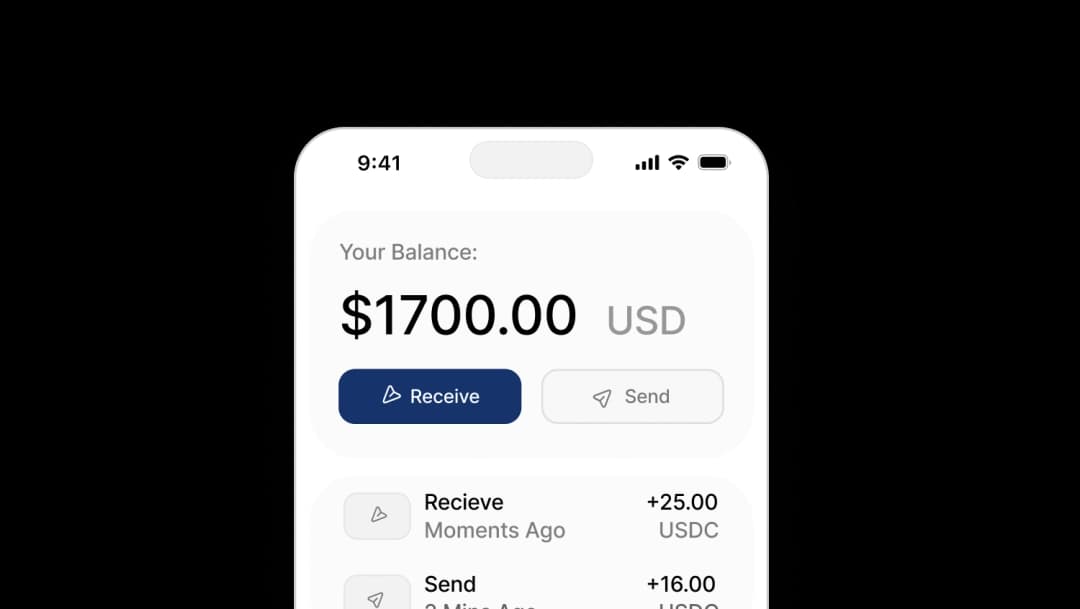
A working list of the consumer privacy apps worth knowing in 2026: products people actually use to send a payment without leaking their balance, hold value off the public ledger, or transact without an exchange in the loop. Each entry is a short spotlight on what makes it distinctive, not a head-to-head comparison.
The lineup
| App | What's distinctive | Platforms |
|---|---|---|
| Canigo | Self-custody crypto neobank with passkey-based keys | iOS, Android |
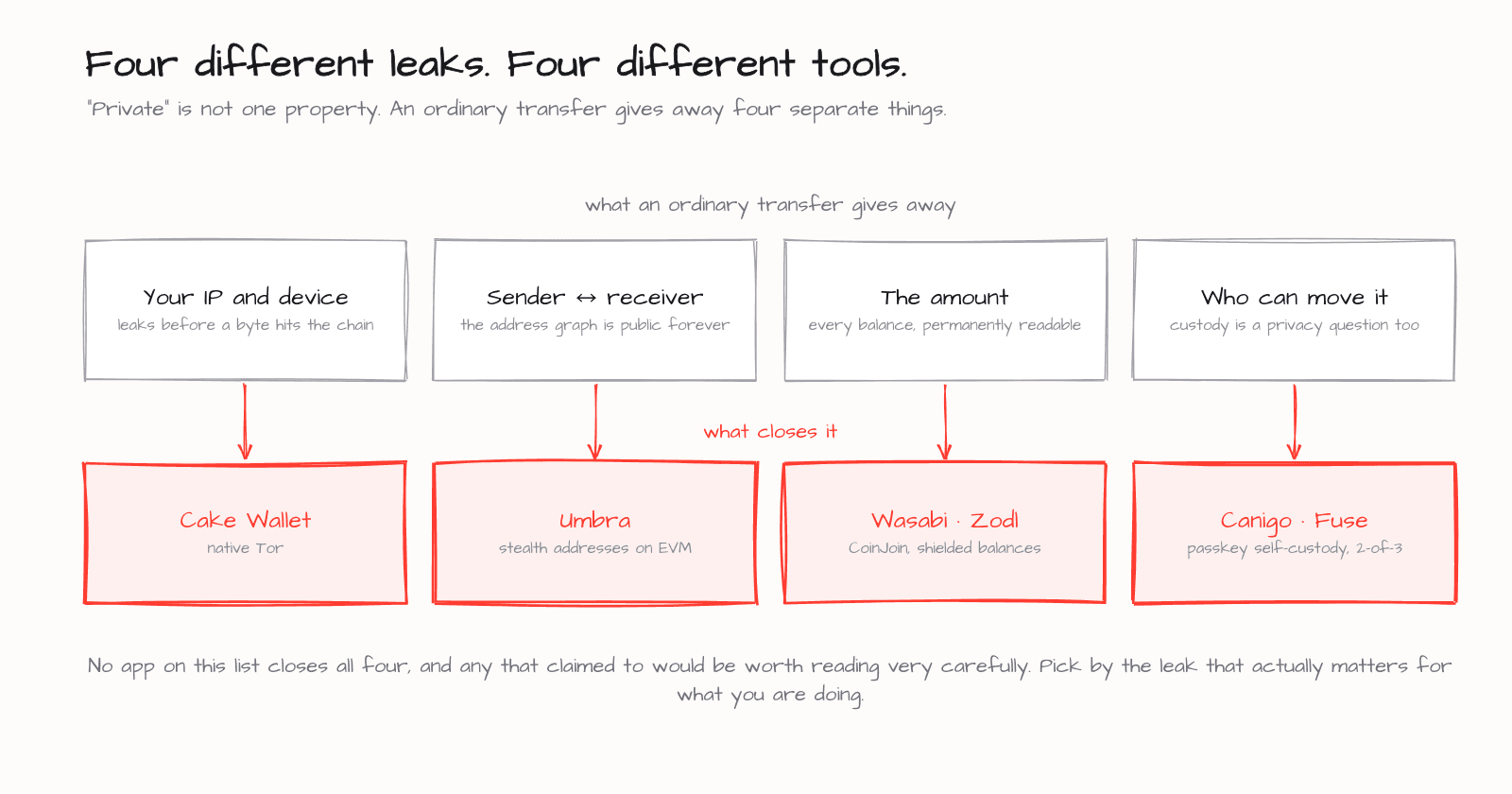
| Umbra | Stealth-address payments on EVM networks | Web app |
| Fuse | Solana smart wallet with 2-of-3 multi-key approval | iOS |
| Cake Wallet | Open-source multi-coin wallet with native Tor | iOS, Android, desktop, browser |
| Stack Wallet | Multi-coin wallet with privacy features on by default | iOS, Android, desktop |
| Wasabi Wallet | Bitcoin desktop wallet with built-in CoinJoin | Windows, macOS, Linux |
| Zodl | Official Zcash mobile wallet with shielded balances | iOS, Android |
Canigo
Canigo is a self-custodial crypto neobank where the wallet itself is the privacy story. A passkey-secured wallet means there is no third party holding the user's keys, no bank running KYC on every transaction, and no email-based account that can be reset by a support agent.
- Passkey-based key management — no seed phrase to leak
- Stablecoin earn routed automatically to lending protocols like Aave and Morpho
- Easiest way to manage global stablecoins from the digital Eur, Yen, Can, Gbp, etc.
- Privacy by default, using stealth addresses for receiving and sending amounts paired with Zama shielded transactions.
- Bluetooth peer-to-peer transfers — like AirDrop, but for money
- Integrated with Bitrefill to support purchase of giftcards with stablecoins and no-KYC.
Available on: iOS, Android.
Umbra
Umbra is a stealth-address protocol for EVM networks. A sender pays to a fresh address controlled by the recipient, and only the sender and recipient know the link — onchain observers see a payment to an address that has never been seen before.
- Stealth payments on Ethereum and other EVM chains using two key pairs (spending + viewing)
- Open and grant-funded — Umbra has processed 85,000+ transactions since 2021
- A receive-side privacy primitive that works alongside any standard wallet
Available on: web app at app.umbra.cash. Umbra is primarily a web product, not a mobile app — worth knowing if you plan to use it from a phone.
Fuse
Fuse is a Solana smart wallet that replaces single-key seed-phrase wallets with smart accounts. Each Fuse wallet requires approval from 2 of 3 keys for every transaction, removing the single point of failure that traditional crypto wallets have.
- 2-of-3 multi-key approval on every transaction, with the option to rotate keys or set up social recovery
- Spending limits per token and timeframe — small operations skip the multifactor step
- Gas abstraction — Fuse pays network fees so the user does not have to keep SOL on hand
Available on: iOS at the time of writing.
Cake Wallet
Cake Wallet is an open-source, non-custodial multi-coin wallet covering Monero, Bitcoin, Ethereum, Litecoin, Bitcoin Cash and a long list of others. Privacy features sit alongside everyday functionality like a built-in exchange and fiat onramp.
- Bitcoin Silent Payments and Payjoin alongside Monero as a first-class chain
- Native Tor integration for network-level privacy
- Built-in exchange and fiat onramp inside the same wallet
Available on: iOS, Android, macOS, Windows, Linux, plus Chrome / Firefox / Edge browser extensions.
Stack Wallet
Stack Wallet is an open-source multi-coin wallet from Cypher Stack. It supports Monero, Bitcoin, Litecoin, Firo, Epic Cash, Wownero and others, with privacy technologies turned on by default for the coins that have them.
- Privacy features on by default for supported coins — no toggles to forget
- Tor integration and no data collection from the developer
- Open-source codebase that ships on iOS, Android and all major desktop platforms
Available on: iOS, Android, Windows, macOS, Linux.
Wasabi Wallet
Wasabi Wallet is an open-source, non-custodial Bitcoin wallet built for desktop. The signature feature is built-in CoinJoin — a Bitcoin transaction where many participants combine their inputs and outputs so observers cannot match who paid whom.
- Built-in WabiSabi CoinJoin protocol with an automatic coinjoin "robot" that runs on a schedule
- All traffic routed through Tor by default, with custom Tor circuits per request
- Hardware-wallet support for Trezor, Ledger, ColdCard, BitBox02 and Blockstream Jade
Available on: Windows, macOS, Linux. Wasabi is desktop-only by design — it is not a mobile app.
Zodl
Zold is the self-custody Zcash mobile wallet built and supported by Electric Coin Co., the team that launched Zcash in 2016. Best-in-class shielded privacy is the default rather than an opt-in.
- Shielded Zcash balances by default — only the user can see, access and manage their funds
- Built-in swaps to convert any supported cryptocurrency into Zcash
- Pay with Zcash at participating retailers like GameStop, Sheetz and Chipotle
Available on: iOS, Android. The app is mid-rebrand from Zashi to Zodl — same wallet, same team.
A note for developers building consumer privacy apps
Privacy is a UX problem, not only a chain feature. The user signs in, sees their balance, and never wants to think about which chain or which proof.
Openfort gives you the wallet primitives that privacy apps need:
- Embedded wallets with passkey, social or email login. Users sign up once and get a non-custodial identity that can hold private balances or derive stealth-address meta-addresses from the same login.
- ERC-4337 and EIP-7702 smart accounts for selective-disclosure flows — prove balance, jurisdiction or membership in a set without revealing the underlying data.
- Session keys scoped to a privacy primitive (e.g. shielded transfers under 100 USDC). Users approve a session at login; subsequent shielded payments do not require popups.
- Open-source signer (OpenSigner) — self-hostable. Critical for privacy products: if your stack depends on a closed-source signing service, the privacy guarantees end at the SDK boundary.
- Backend wallets for compliance providers and Association Set Providers that need to issue attestations or revocation flags.
- Cross-chain identity so a user's accounts on different privacy systems all derive from the same login.
For deeper context, see Smart wallet security best practices and the orchestration platform. Read the Openfort docs to wire this up, or talk to the team if your privacy product needs help with a specific integration.