TL;DR
Stablecoin payment orchestration coordinates transactions across blockchains, cards, bank transfers, and conversion providers, and some platforms also pick the route based on cost, availability, and destination. Openfort fits developers who want self-custodial wallets, several funding methods, and policy controls through one integration. Fireblocks suits institutional treasury and payment operations that need governance and an established provider network. Circle suits USDC-native businesses that prefer issuer-backed infrastructure. Crossmint suits businesses that want wallets, checkout, onramps, and offramps bundled behind a managed API. Choose by the flow that carries most of your volume, then verify corridor coverage before you commit.
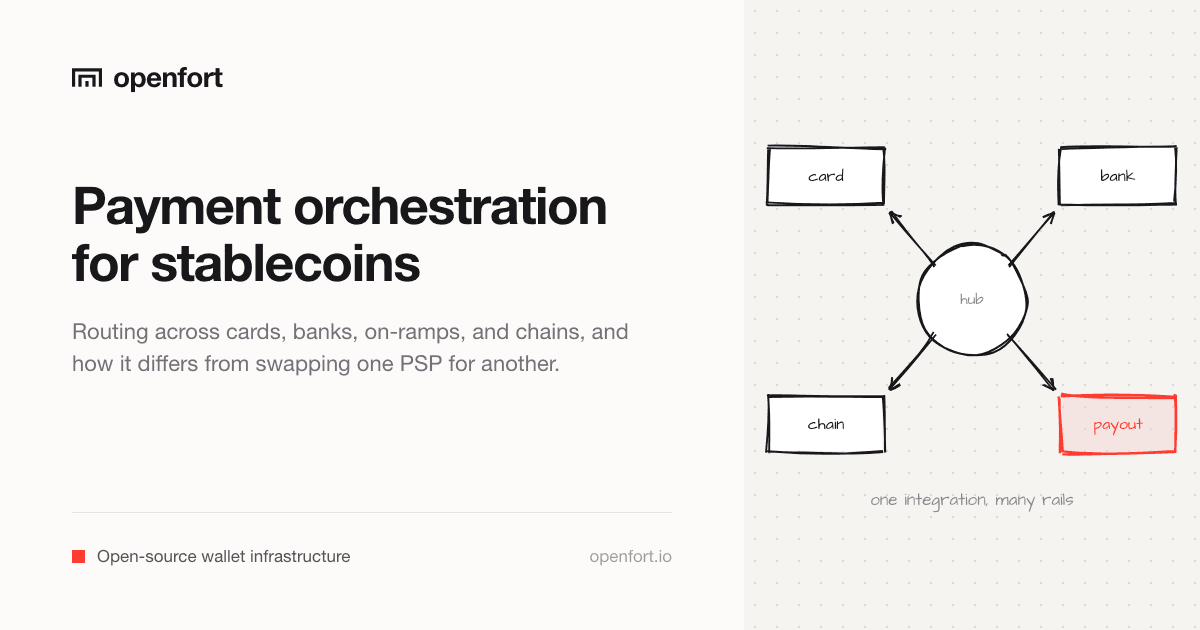
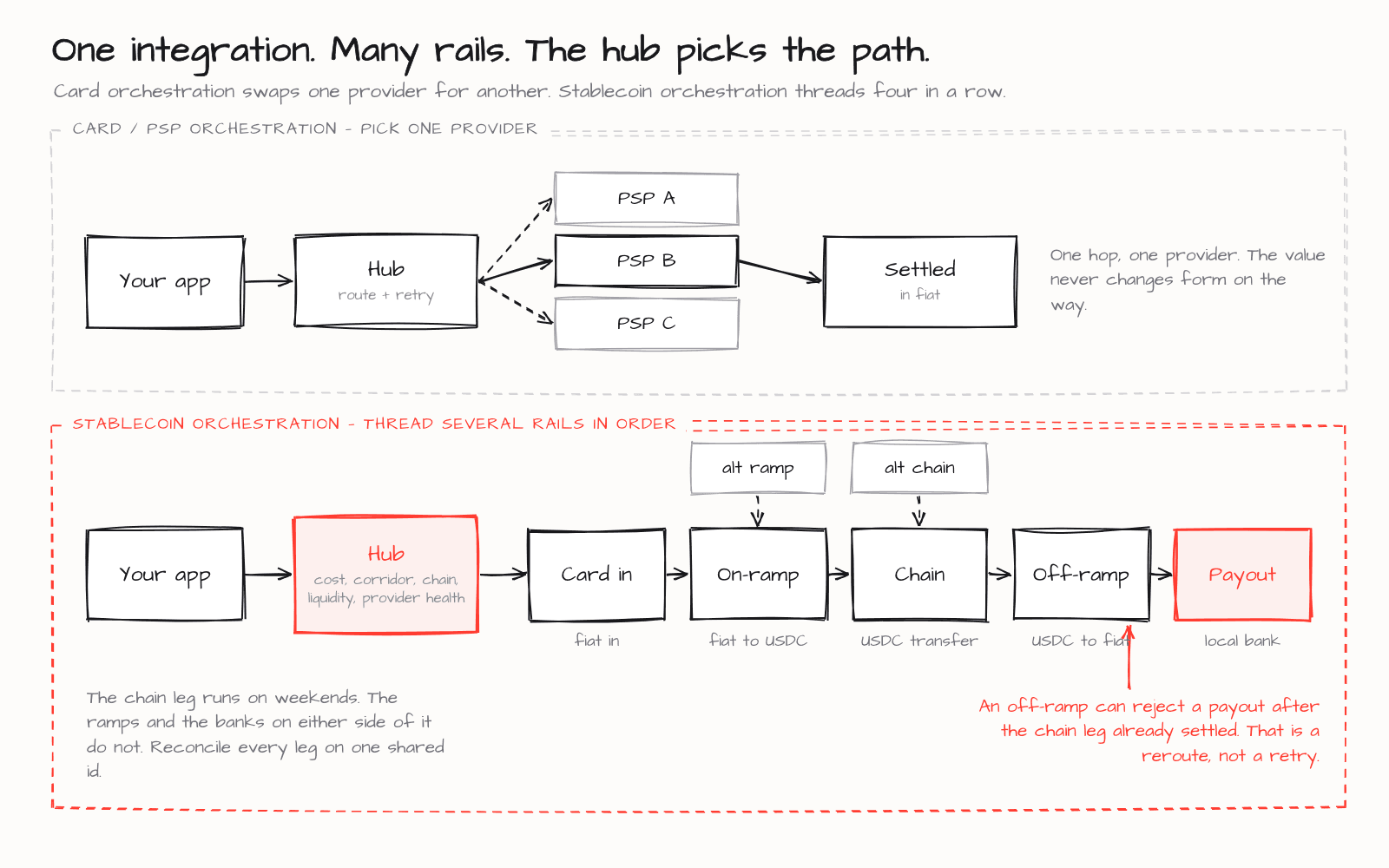
Stablecoin payment orchestration borrowed its name from card orchestration, and the name is misleading. Card orchestration picks one provider and the money never changes form. A stablecoin payment can enter on a card, convert to USDC on a ramp, cross a chain, and leave through a bank in another country, and every one of those legs can fail on its own.
This post covers what orchestration means once the rails stop being homogeneous, then compares Openfort, Fireblocks, Circle, and Crossmint on rail coverage and integration model. For the payment-rail fundamentals underneath it, see the stablecoin payment rails guide and what stablecoin infrastructure is. See how the Openfort platform supports programmable stablecoin payment flows.
What payment orchestration means for stablecoins
Payment orchestration for stablecoins coordinates how money moves across blockchain networks, card networks, bank transfers, and conversion providers. A rail is any network and provider combination that carries a payment. Routing selects which rail should handle a transaction based on factors such as fees, destination, currency, chain support, liquidity, and provider availability.
Many orchestration platforms use a hub-and-spoke model. Your product connects to the hub once, while the platform connects to each payment provider through separate spokes. Depending on the platform's capabilities, the hub can select a provider for each transaction and retry or reroute unsuccessful payments without requiring another product integration. Traditional orchestration platforms use the same architecture to sit between checkout and multiple providers.
Stablecoin orchestration can apply routing rules across fiat and on-chain systems. For example, a customer might pay by card, an on-ramp might convert the funds into USDC, and a blockchain network might carry the payout. If one ramp lacks coverage in the customer's country or one chain becomes too expensive, routing rules can select another supported path.
Settlement describes the completed transfer of value to the recipient or destination account. An on-ramp converts fiat currency into stablecoins, while an off-ramp converts stablecoins into fiat. A payment orchestration platform coordinates those services, but each underlying provider still performs its assigned processing, custody, settlement, or compliance duties. In practice, the orchestration layer acts as a control plane for routing, retries, and reporting rather than replacing every provider underneath it.
How it differs from card and PSP orchestration
Traditional payment orchestration routes transactions among PSPs and acquirers while the underlying payment still moves through card or bank networks. The orchestration layer sits between checkout and multiple providers, applying rules based on factors such as geography, currency, cost, and provider performance. A PSP handles authorization, settlement, and regulated payment functions, while an orchestrator coordinates multiple PSPs through one integration.
Stablecoin orchestration retains smart routing, retries, and provider failover but coordinates a wider set of rails. A transaction may enter through a card or bank transfer, convert into a stablecoin through an on-ramp, move across a blockchain, and exit through an off-ramp. Routing logic must therefore consider chain availability, network fees, liquidity, wallet policies, and the destination's supported payout methods.
The comparison below summarizes how stablecoin settlement can change timing, finality, availability, and routing requirements. These characteristics vary by network, provider, and payment path, as described in this overview of payment orchestration.
| Dimension | Card and PSP orchestration | Stablecoin orchestration |
|---|---|---|
| Settlement asset | Fiat currency | Stablecoins |
| Settlement time | Often subject to processor and banking schedules | On-chain transfer confirmation can take seconds to minutes, while fiat payout may take longer |
| Reversibility | Chargebacks and refunds may reverse payments | Confirmed blockchain transfers are generally final, although providers can process separate refunds |
| Availability | Bank schedules can constrain processing and settlement | Blockchains operate continuously, but ramps and banking partners may not |
| Programmability | APIs, webhooks, and provider rules | APIs plus wallet policies and smart contracts |
| Cross-border path | FX and correspondent banking | Stablecoin transfer plus local ramps |
Stablecoin payment paths can encounter on-chain issues that conventional card routing does not manage directly. A destination chain may become congested, a bridge or cross-chain protocol may lack liquidity, or an off-ramp may reject a payout after the on-chain transfer succeeds. Effective multi-rail payments coordinate the complete transaction path and record each stage for reconciliation.
What to look for in a stablecoin orchestration provider
Rail coverage. You should map each provider against the payment methods your customers use. Check support for on-chain transfers, cards, and bank transfers by country and currency.
On-ramp and off-ramp support. Determine whether you want one provider to coordinate fiat-to-stablecoin conversion or prefer to integrate conversion vendors separately. Review supported payment methods, settlement currencies, limits, and geographic availability.
Payout automation. Programmable payouts let you trigger transfers through schedules, application events, or approval rules. Check whether the provider supports batch payments, retries, webhooks, and reconciliation records.
Multi-chain routing. A provider should route stablecoins across supported networks while managing fees and confirmation status. Confirm whether cross-chain transfers require bridges, issuer-native transfer protocols, or manual treasury rebalancing.
Integration model. APIs and SDKs give you more control over wallets, routing logic, and customer experience. A managed platform reduces development work but may limit customization and infrastructure ownership.
Compliance controls. You should identify which party handles KYC and AML checks in each market. Review audit trails, transaction screening, policy controls, and reporting access. The custody model also determines whether you, the provider, or the user controls signing keys.
Openfort
Best for
Developers who want to control the wallet and product experience while adding several funding methods through one integration.
What it is
Openfort provides self-custodial wallet infrastructure that lets you define transaction policies and control the user experience without taking custody of users' assets. Its open-source, self-hostable OpenSigner stack supports this model. Openfort reports that its infrastructure has completed five independent security audits.
One integration connects embedded wallets, authentication, funding, gas sponsorship, and policy-based transaction controls. You can define how wallets spend funds, automate approved actions, sponsor network fees, and recover accounts without assembling separate wallet and transaction-policy vendors.
Openfort's unified API supports wallet funding through cards, Apple Pay, bank transfers, and tokens. Your application can connect Openfort's supported funding methods to programmable, multi-chain wallets while retaining control of the product interface and transaction rules.
Pros
- Openfort gives you control over wallet design, authentication, recovery, and transaction signing.
- Policy controls can restrict spending by asset, amount, destination, or other application-defined conditions.
- Openfort provides open-source SDKs for development environments that include React, Expo, Unity, Node.js, Swift, and JavaScript.
- Multi-chain smart wallets, gas sponsorship, webhooks, and direct contract interaction support programmable payment flows.
- Multiple funding methods reduce the need to integrate separate card, bank, and token entry points.
Cons
- Openfort expects you to build and operate the customer-facing payment experience, so it requires more development work than a fully managed payment stack.
- Self-custodial architecture gives you more control, but you must configure authentication, recovery, transaction policies, and approval rules.
- Public pricing details for higher usage levels are limited, which makes advance cost comparisons harder for larger deployments.
Pricing
Openfort offers a free starting tier with 2,000 operations and no credit card requirement. Enterprise pricing and higher-volume plans use a sales-led process, and Openfort does not publish detailed rates for those plans.
Fireblocks
Best for
Enterprise treasury and institutional payment operations that need access to banks, OTC providers, and PSP connections.
What it is
Fireblocks combines institutional wallet infrastructure with payment routing through the Fireblocks Network for Payments. Reporting on the Fireblocks Network for Payments states that it connects more than 40 providers and serves over 300 payment companies in more than 100 countries, with support for 60 currencies. The report also cites monthly stablecoin payment volume above $200 billion. Treat these figures as third-party claims because the cited article does not link to primary evidence from Fireblocks.
The Network for Payments coordinates stablecoin conversions, cross-border payouts, treasury transfers, and merchant settlement through connected providers. Fireblocks embeds wallet verification, sanctions screening, transaction monitoring, and Travel Rule tooling into the transaction flow.
Flow adds stablecoin checkout and deposit orchestration for PSPs, fintechs, and platforms. Reporting on Fireblocks Flow states that customers can accept deposits through more than 800 wallets and major exchanges. Flow converts supported incoming assets through third-party liquidity providers and settles the configured stablecoin to a Fireblocks Vault, embedded wallet, or another specified destination. It also screens payer wallets and can refund incorrect deposits automatically.
Pros
- Fireblocks gives institutional operators access to a large network of payment providers and local rails through one platform.
- Flow handles wallet connections, asset conversion, compliance screening, and settlement without requiring a PSP to replace its checkout.
- Fireblocks supports multiple stablecoins and chains, which suits treasury operations that cannot depend on one issuer or network.
Cons
- Fireblocks can require more onboarding and operational support than a developer-focused wallet API.
- Connected partners provide several banking, conversion, and payment services, so availability can vary by jurisdiction.
- Fireblocks may require more operational setup than a smaller fintech needs for a limited payment volume or a narrow set of corridors.
Pricing
Fireblocks publishes no standard rates in the supplied research. Buyers should request a quote based on transaction volume, enabled products, custody requirements, and support needs.
Circle
Best for
USDC-focused products that need managed payments or cross-border transfers through infrastructure provided by the stablecoin issuer.
What it is
Circle combines USDC settlement with Circle Payments Network, Circle Mint, CCTP, and embedded wallets. Circle Payments Network connects participating financial institutions so they can communicate and settle directly. Circle provides the network technology but does not hold funds or become a party to transactions.
Circle presents three payment service levels. Fiat Payments supports global fiat transfers using stablecoin infrastructure. Stablecoin Payments gives you infrastructure for building your own payment flows, while Managed Payments provides a launch-ready option with more operational work handled by Circle.
Circle Mint lets eligible institutions convert fiat and USDC through domestic bank transfers and international wires. CCTP moves native USDC across supported blockchains without relying on wrapped assets. Circle also provides APIs, wallets, and developer tooling for products that need more control than the managed model offers.
Pros
- Circle combines the settlement asset, institutional on/off-ramp, payment network, and multi-chain transfer protocol under one provider.
- Circle Mint gives institutional customers direct access to USDC liquidity and bank transfer support.
- CCTP supports multi-chain routing with native USDC, which reduces the liquidity and bridge risks associated with wrapped tokens.
- Managed and API-based options let you choose how much payment infrastructure to operate yourself.
Cons
- Circle's stack centers on USDC, so it offers less flexibility when your transaction mix requires several stablecoins.
- Circle Mint serves institutions rather than individual users, which may require another ramp provider for consumer flows.
- CPN participants still manage counterparty relationships, eligibility requirements, and compliance obligations.
- Circle's issuer-centered model creates more platform dependency than a provider-neutral orchestration layer.
Pricing
Circle does not publicly publish detailed pricing for CPN, Managed Payments, or its broader payment stack. Contact Circle for product-specific fees and commercial terms.
Crossmint
Best for
Products that need wallets, on-ramps, off-ramps, and checkout through one managed API.
What it is
Crossmint combines embedded wallets with stablecoin payment and token checkout capabilities behind a single API. Its managed offering also includes compliance and cross-chain services. The bundled model reduces the number of vendors you need to connect when launching a stablecoin product.
The cited evidence for Crossmint's scale and network coverage comes from a third party. Moralis's profile of Crossmint reports support for Ethereum, Base, Solana, Stellar, Avalanche, and Polygon, and it states that Crossmint serves more than 40,000 customers. Verify the separate claim about European authorization in an official regulatory register before relying on it for compliance decisions.
Crossmint also provides API-level spending controls for automated payment flows. Agent Payments Stack's Crossmint profile describes REST APIs for setting spending policies for autonomous agents. Confirm the available policy types and enforcement model in Crossmint's current documentation before implementation.
Pros
- Crossmint packages wallets and payment entry points in one integration, which can reduce vendor coordination.
- Its reported network coverage spans EVM chains, Solana, and Stellar.
- Crossmint may support products serving eligible European markets, but buyers should verify its current authorization and permitted activities in an official regulatory register.
Cons
- The supplied third-party sources do not explain card settlement, bank transfer coverage, payout automation, or routing logic in enough detail for a technical assessment.
- Buyers should confirm supported countries, currencies, ramp providers, and settlement paths directly with Crossmint.
- The broad managed bundle may provide less component-level control than a modular wallet and orchestration stack.
Pricing
The cited sources do not provide Crossmint pricing details. Request a quote based on the wallet, payment, compliance, and transaction capabilities you need.
Comparing rail coverage and integration model
Coverage varies by product and region, so confirm supported countries, currencies, and transaction limits during evaluation.
| Provider | Documented on-chain model | Fiat entry points | Payout or settlement model | Multi-chain capability | Integration model |
|---|---|---|---|---|---|
| Openfort | Programmable multi-chain wallets | Cards, Apple Pay, bank funding, and tokens | Wallet automations and application-defined transaction policies | Smart-wallet support across supported networks | APIs and SDKs |
| Fireblocks | Institutional wallet and provider network† | Banking and PSP connections through participating providers† | Payment workflows and connected providers† | Multi-chain platform† | Managed platform and APIs† |
| Circle | USDC settlement rails | Circle Mint and participating payment partners | Managed Payments and Circle Payments Network | CCTP for native USDC transfers | Managed services and APIs |
| Crossmint | Managed multi-chain wallets† | Checkout and bundled ramp services† | Confirm current payout paths and coverage with Crossmint | Multi-chain support reported by third parties† | Managed APIs and SDKs† |
The dagger marks capabilities supported here only by the cited third-party reporting. Confirm current countries, currencies, limits, providers, and network support directly with each provider.
Which provider fits your transaction mix
Choose a provider by examining the payment flows that account for most of your volume or operational work. Treasury transfers, USDC settlement, consumer funding, and embedded wallets each require different routing and custody models. Matching the provider to your primary flow can reduce the number of integrations you maintain and the exceptions your staff must resolve.
Fireblocks fits high-volume institutional treasury and payment operations. Its model suits companies routing funds among banks, OTC providers, PSPs, and digital asset venues. Circle fits USDC-focused payments when you prefer issuer-backed infrastructure for minting, redemption, and cross-border settlement.
Crossmint fits products that need checkout, on-ramps, off-ramps, and wallets through a managed service. That approach can shorten implementation time when your product does not need deep control over wallet behavior. Confirm that Crossmint supports every required country, currency, and funding method before choosing it for a global rollout.
Openfort fits developers who want to control the wallet and product experience. Its SDK and API model combines self-custodial wallets with card, bank, Apple Pay, and token funding, while policy controls let your application govern transactions. Openfort gives developers more control than a fully managed stack, but your team remains responsible for shaping the user experience.
Use the comparison table to decide whether you want API and SDK infrastructure or a managed platform. Then verify corridor coverage against your launch markets. Country support, local banking access, and on-ramp availability can eliminate a provider even when its technical model fits your transaction mix.
When Openfort fits developer-owned payment infrastructure
Openfort fits developers who want to retain control of the wallet and product experience while supporting several funding methods. Its open-source SDK connects embedded wallets with card, Apple Pay, bank transfer, and token funding. You can design the interface and transaction rules rather than adopting a fully managed payment stack.
Openfort's self-custodial model is designed to keep users in control of their assets while its infrastructure supports account recovery and transaction execution. Openfort reports five independent security audits of its implementation. Policy-based controls let you define which transactions a wallet can approve, which helps enforce spending rules without adding approval logic to every application flow.
Openfort says more than 50 teams have processed over 10 million transactions through its infrastructure. The reported transaction volume indicates production use of Openfort's wallet infrastructure, although it does not by itself verify every routing or funding capability.
Review Openfort if your product needs programmable wallets, integrated funding methods, and control over the customer experience.
FAQs
How does stablecoin orchestration differ from a PSP?
A PSP processes payments and may handle functions such as merchant onboarding, authorization, settlement, and risk controls. A stablecoin orchestration platform coordinates providers and networks, while Openfort focuses on programmable wallets, funding methods, and transaction policies within that payment stack. This model lets you retain control of the wallet experience while connecting the providers required for each payment flow.
Does payment orchestration require giving up custody?
Payment orchestration can use custodial or self-custodial wallets, so orchestration does not inherently require one custody model. Openfort supports a self-custodial approach, while managed providers may assume more responsibility for wallet operations. Comparing custody terms and signing responsibilities lets you choose how much control to retain over user assets and the wallet experience.
How does compliance fit into a stablecoin orchestration layer?
A stablecoin orchestration layer can apply routing rules, record transaction activity, and connect external compliance services, but the responsible provider must still perform required KYC, AML, and sanctions checks. Openfort provides policy-based transaction controls and records transaction activity, while regulated partners can handle identity verification and screening. Separating transaction policies from regulated checks helps you assign each compliance duty to the provider responsible for it.
