This series explores the foundational technology required to build successful onchain games. We cover the benefits of blockchain for studios and the technical infrastructure needed to offer a competitive player experience.
- Part 1: Introduction to Web3 Gaming Infrastructure (You're here)
- Part 2: Tools for Web3 Game Development
- Part 3: Best Practices and Case Studies
What is Onchain Gaming Infrastructure?
Onchain gaming infrastructure is the set of tools and protocols that bridge traditional game development with blockchain technology. This includes decentralized networks for asset ownership, smart wallet systems for gasless play, and scaling solutions like Layer 2s and Subnets. A good infrastructure setup allows developers to integrate onchain features (like item trading) without sacrificing the speed or simplicity of traditional gameplay.
Why Use Blockchain?
Blockchain offers several core advantages for the gaming industry:
- Verifiable Ownership: Players have total control over their in-game items, regardless of the game studio's status.
- Security: Digital assets are protected by cryptographic standards rather than just a central database.
- Composability: Developers can build games that interact with other apps and ecosystems, much like Lego blocks.
- The Importance of Cooperation The essence of Community Economics is cooperation. Traditional gaming models are often one-sided and sometimes even exploitative. Blockchain gaming, on the other hand, thrives on mutual benefits. By fostering a cooperative environment, everyone in the ecosystem stands to gain, encapsulating the idea that "a rising tide lifts all boats."
- The Role of Interoperability Interoperability is crucial for the long-term sustainability of Community Economics. It allows for seamless interactions between different blockchain platforms, thereby preventing the formation of isolated ecosystems. This is beneficial for both developers, who can tap into a broader market, and players, who enjoy greater freedom and liquidity for their digital assets.
- The Power of Composability Another noteworthy feature of blockchain is composability, which allows developers to build upon existing applications or smart contracts and players to create traceable content. This accelerates the development process and opens up new possibilities, akin to how compound interest works in finance.
Onchain vs Offchain
In the evolving domain of onchain gaming, developers face a pivotal decision: whether to build their games onchain, off-chain, or a hybrid of both. Onchain gaming, leveraging blockchain technology, offers unparalleled digital ownership, transparency, new design opportunities, and innovative monetization models. In contrast, traditional games rely on centralized servers and databases, with game systems controlled solely by the developer or publisher.
Key Game Design Elements
On-Chain Components:
Tokenization: Introducing digital tokens for in-game items, characters, or collectibles, ensuring genuine ownership and facilitating player-led economies. Decentralized Governance: Implementing DAOs for player involvement in game development decisions, promoting community engagement.
Off-Chain Components:
Game Mechanics and UI: Maintaining intricate game interactions and user interfaces off-chain due to blockchain limitations in processing speed and scalability. Gameplay Dynamics: Processing dynamic gameplay elements off-chain to ensure seamless player experiences.
What Obstacles Players and Developers Face?
For Players
1. Complex Onboarding Experience: Players must navigate through multiple steps including installing browser wallets, potential undergoing Know Your Customer (KYC) verifications, purchasing native tokens, approving obscure transaction requests, and covering gas fees. 2. Security Risks in Self-Custody: Players shoulder the burden of safely storing seed phrases, facing the possibility of irreversible loss or compromise.
For Developers
1. Navigating Unfamiliar Terrain: Teams grapple with complex topics like limited computational resources, adversarial circumstances, and smart contract security, which divert their attention from core game development. 2. Absence of Best Practices: The fast-paced advancements in technology, frequent updates to protocols, and continuously emerging problem-solving methods result in a volatile landscape. 3. Balancing Open Economies: Teams must safeguard the sustainability of token economies without undermining the gaming experience, while also defending against bot activity. 4. User Outreach and Sustained Engagement: In a digital realm filled with bots and pseudonymous identities, executing effective cohort analyses and targeted user acquisition (UA) strategies presents a formidable challenge. 5. Regulatory Conformance: Adapting to an ever-shifting regulatory landscape poses its own unique set of difficulties.
Gaming Infrastructure: The Good, The Bad and the Ugly
The Good: Shared Building Blocks
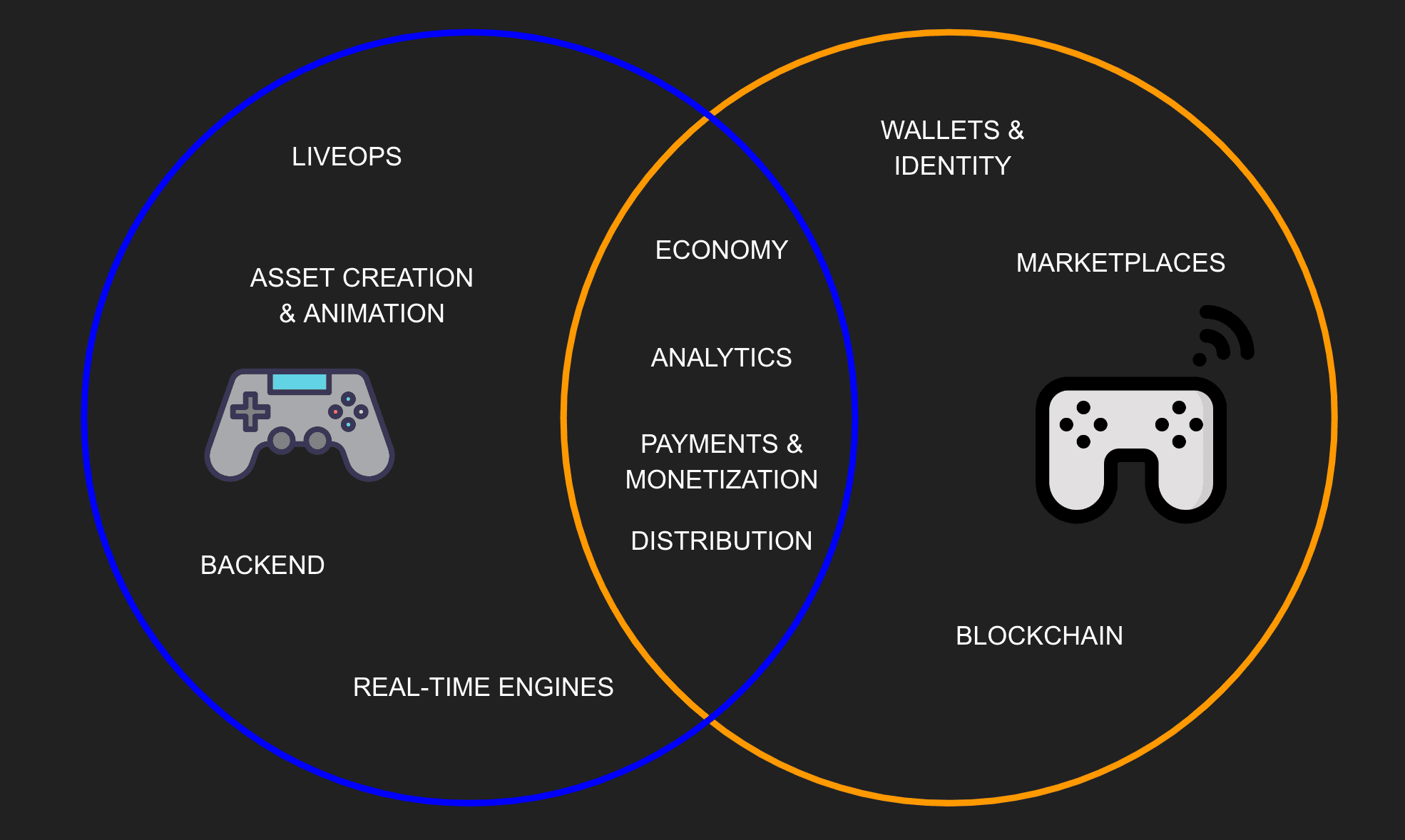
In the realm of blockchain gaming, many of the foundational tools remain consistent with traditional Web2 gaming. Whether it's asset creation, real-time engines, or cloud back-ends, the same companies and tools are often in play. For instance, Lost Dungeon utilizes PlayFab and Azure functions on the backend to host the onboarding and game logic.
These shared building blocks—creative software, scalable servers, and data-driven optimization—are as vital to blockchain games as they are to any Free-To-Play mobile game.
The Bad: The Complexity of Blockchain Integration
The landscape changes dramatically when you delve into the blockchain-specific aspects of game development. Every feature or decision you make necessitates a uniquely blockchain-oriented piece of software.
Although the barriers of entry and exiting are being reduced across chains, the first and most critical decision is selecting your first blockchain, which sets the stage for other functionalities like gas fees, dev tooling, and community.
With time these implementations would be as easy as selecting your right gaming backend. The maturity of the dev tooling is in progress.
The Ugly: The Uncertain Coexistence of Web2 and Web3
While Web2 isn't going away anytime soon, its relationship with Web3 is still evolving. Companies like Epic Games are opening up to blockchain, contrasting sharply with Valve's decision to ban NFTs from Steam. This creates a fragmented landscape where Web2 and Web3 technologies coexist but under varying degrees of acceptance and integration.
At Openfort, we're doing the conscious effort to build integrations with well-known gaming backend providers or identity platforms to simplify how developers can build backends with Openfort in a blink of an eye. Integration with PlayFab, Firebase or starting with Railway it's today, a reality.