Your AI assistant just found a cheaper flight, renegotiated a SaaS subscription, and restocked the office supply closet. All before your morning coffee.
This is not science fiction. OpenAI launched shopping inside ChatGPT in early 2026. Stripe and Tempo shipped the Machine Payments Protocol on March 18, letting AI agents transact through existing Stripe merchant infrastructure. Visa completed hundreds of real-world agent transactions and is targeting millions of AI-agent shoppers by the 2026 holiday season. The infrastructure for agents to spend money is being built — fast.
The question for product teams is no longer whether AI agents will transact. It is whether your product will be ready when they do.
The $3–5 Trillion Opportunity Product Teams Are Missing
McKinsey estimates that AI agents could mediate $3–5 trillion of global consumer commerce by 2030, with US B2C retail alone representing up to $1 trillion. BCG found that 81% of consumers already expect to use AI agents for shopping decisions. Accenture reports that 57% of executives anticipate mainstream agentic payments within three years.
These numbers reflect a structural shift. Agents are moving from answering questions to executing tasks — and execution increasingly requires spending money. An agent that can research a vendor but cannot issue a purchase order is only half useful. An agent that can negotiate a price but cannot pay is a dead end.
The missing piece is the wallet: a programmable account that gives your agent the ability to hold funds, authorize payments, and transact within boundaries you define. Without it, your AI features top out at recommendations and summaries. With it, they become autonomous economic actors.
This is what an AI agent wallet strategy means: a deliberate plan for how your product's AI capabilities will interact with money.
What Happens When Your AI Assistant Can Pay
Consider what becomes possible when an AI agent has a wallet:
Autonomous procurement. An enterprise assistant monitors inventory levels, identifies the best supplier price across three vendors, and places a restock order — all within a pre-approved budget. No human touches the workflow until the goods arrive. For mid-market companies spending $2–10M annually on procurement, automating even 20% of routine purchases can save hundreds of thousands in labor costs.
Subscription optimization. A personal finance agent reviews your 14 SaaS subscriptions, identifies three you haven't used in 90 days, cancels them, and reallocates the budget to a tool you actually need. It handles the cancellation flow, manages the refund, and activates the new subscription — paying from a wallet you've funded with a monthly allowance.
Real-time service purchasing. An AI coding assistant hits a rate limit on a data API mid-task. Rather than stopping and asking the user to upgrade, it purchases additional API credits using the x402 protocol — a single HTTP request, settled in seconds. The user sees the result, not the transaction.
Cross-agent commerce. Your agent needs a legal review of a contract. It discovers another agent that provides legal analysis, negotiates a per-page price, pays via stablecoin, and returns the annotated document. Agent-to-agent services become a new commerce layer — no human intermediary required.
Each of these scenarios has the same prerequisite: a wallet that the agent controls, within limits the product team defines.
Three Strategic Reasons to Act Now
1. User Retention Through Autonomous Features
Products that can act — not just advise — become harder to leave. When your AI assistant manages a user's recurring purchases, optimizes their spending, or handles procurement workflows, switching costs compound with every transaction.
This is the retention flywheel: an agent wallet transforms your AI from a tool into a service. Users delegate more over time. Each delegation deepens the relationship. Bain estimates that agentic commerce will reshape customer loyalty entirely, as the agent — not the brand — becomes the primary purchasing interface.
Product teams that wait will find their AI features commoditized. The assistant that can only suggest a purchase loses to the one that can complete it.
2. New Revenue Models
Agent wallets unlock business models that don't exist without them:
| Revenue Model | How It Works | Example |
|---|---|---|
| Agent-as-a-service | Charge users for autonomous purchasing capabilities | "Premium tier: your agent manages up to $5,000/month in purchases" |
| Transaction fees | Take a percentage of agent-initiated commerce | Marketplace where agents buy and sell data, compute, or services |
| Procurement automation | Charge enterprises for automated purchasing workflows | B2B platform where agents handle vendor selection and payment |
| Agent-to-agent services | Your agent sells capabilities to other agents | Legal review, data analysis, or content generation — priced per request |
These models share a common thread: they turn AI capabilities into revenue-generating services. Without a wallet, your AI is a cost center. With one, it can be a profit center.
3. Operational Cost Reduction
Manual purchasing workflows are expensive. Every purchase order that requires a human approval, every subscription renewal that needs a manager's sign-off, every vendor payment that routes through accounts payable — these are costs that compound.
Agent wallets don't eliminate oversight. They eliminate the routine. Configure spending limits, contract allowlists, and approval thresholds once. The agent handles everything within those boundaries autonomously. Humans review exceptions, not every transaction.
For companies processing thousands of routine purchases monthly, the math is straightforward: reduce the human touch points by 60–80% on transactions under a defined threshold, and redirect that labor toward strategic decisions.
The Product Decision Framework
Building an agent wallet strategy requires four decisions:
Decision 1: Custody Model
Who holds the keys?
- Custodial wallets are simpler but create liability. If you hold the keys, you're responsible for every transaction. Regulatory requirements (MiCA in Europe, state-level money transmitter laws in the US) may apply.
- Non-custodial wallets keep keys with the user or in a shared custody model. The product team configures policies, but no single party — including the provider — holds the complete key. This is the model most agentic commerce infrastructure is converging on.
For most product teams, non-custodial is the right default. It reduces regulatory exposure and aligns with the principle that users should control their funds — even when an agent acts on their behalf.
Decision 2: Control Granularity
What can the agent do?
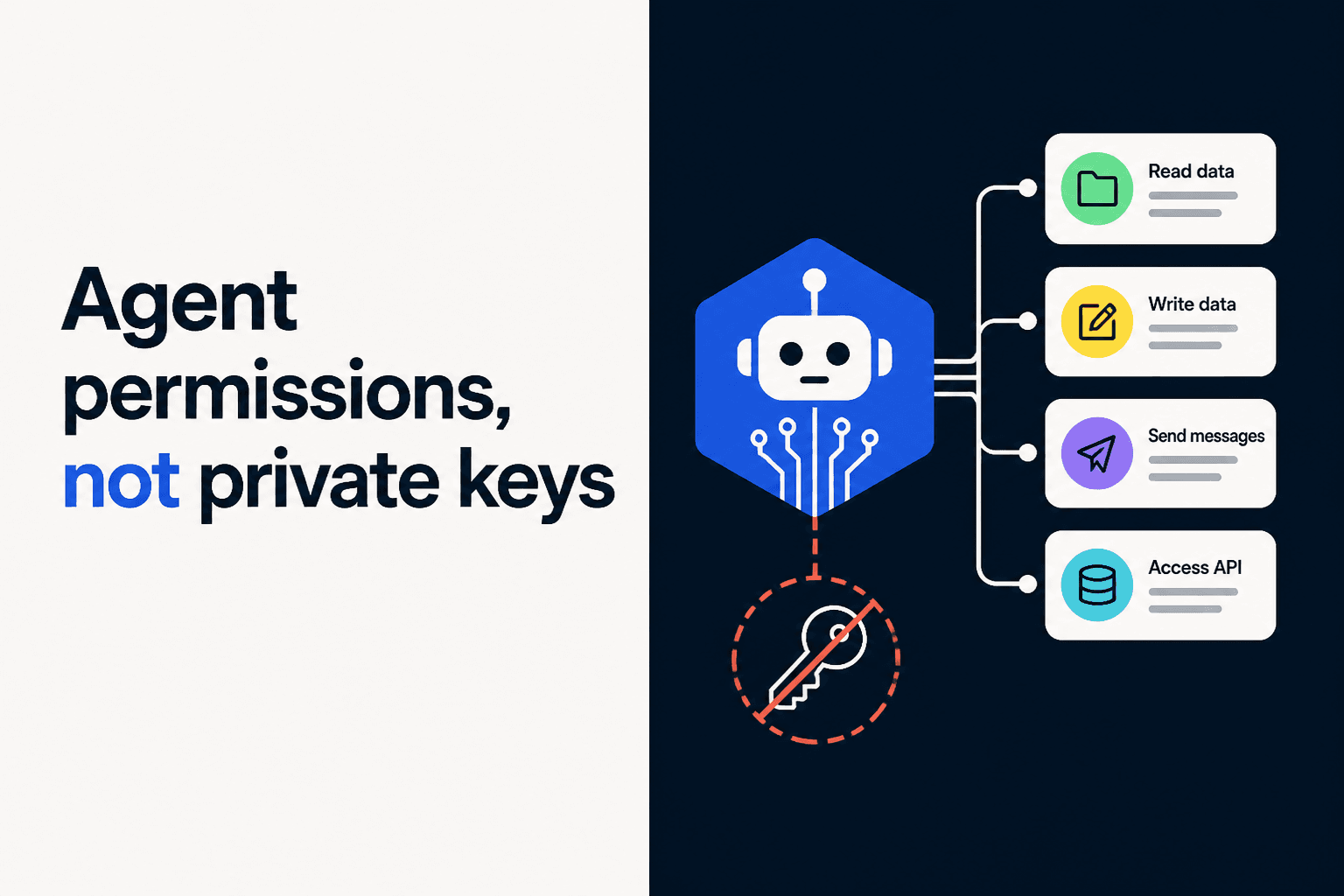
The difference between a useful agent and a dangerous one is the control layer. Your strategy must define:
- Spending limits — per transaction, per day, per month
- Contract allowlists — which protocols and merchants the agent can interact with
- Session keys — temporary, scoped permissions that expire automatically
- Approval thresholds — transactions above a certain amount require human confirmation
- Kill switches — the ability to freeze agent activity instantly
These controls should be enforced at the infrastructure level, not in application code. Policies encoded in smart accounts are verifiable and tamper-resistant. Policies implemented as API middleware are bypassable.
Decision 3: Payment Rails
Which protocols will your agent support?
The protocol landscape is consolidating around four major approaches:
- Stripe ACP/MPP — fiat-native, works with existing Stripe merchants, backed by Stripe and OpenAI
- Google AP2 — identity and trust layer for agent-to-merchant interactions
- Coinbase x402 — crypto-native, HTTP-level payments, dominant in stablecoin transactions
- Visa TAP / Mastercard Agent Pay — card network approaches bridging existing merchant infrastructure
The right answer depends on your users and use case. A consumer product targeting mainstream users may start with Stripe MPP. A developer platform may need x402 for micropayments. An enterprise product may need all of the above. The most strategic approach is choosing infrastructure that is protocol-agnostic — so you're not locked into a single rail as the market evolves.
Decision 4: Build vs. Buy
How much infrastructure do you own?
Building agent wallet infrastructure from scratch requires deep expertise in key management, smart account architecture, gas optimization, and protocol integration. Most product teams should not do this. The build timeline is 6–12 months, and the maintenance burden is ongoing.
Instead, use purpose-built infrastructure. Openfort provides non-custodial agent wallets with programmable controls, session key management, and gas sponsorship out of the box. Integration takes minutes, not months — and you get the security guarantees (four independent audits, open-source key management via OpenSigner) without the engineering investment.
The strategic decision is where to invest your team's time: in wallet plumbing, or in the product features that differentiate you.
Getting Started: The 10-Minute Path
Openfort's SDK reduces agent wallet integration to a few steps:
- Create an agent wallet — a non-custodial smart account with its own address and signing capability.
- Configure session keys — grant the agent scoped permissions (which contracts it can call, how much it can spend, when the permission expires).
- Set up gas sponsorship — your users shouldn't think about gas fees. Openfort's policy engine lets you sponsor transactions by contract, function, or account.
- Connect to your agent framework — Openfort integrates with LangChain, CrewAI, and any framework that can make API calls.
The technical integration is deliberately simple so your team can focus on the strategic questions: what should your agent be allowed to buy? How much autonomy do users get to configure? What revenue model does this enable?
These are product decisions, not engineering problems. And they're the decisions that will determine whether your product captures value from the agentic commerce wave — or watches from the sideline.
The Window Is Closing
The agentic commerce infrastructure is being built right now. Stripe MPP launched on March 18, 2026. OpenAI's shopping features are live. Visa, Mastercard, Google, and Coinbase are all deploying agent payment protocols.
Product teams that define their agent wallet strategy today will ship autonomous features while competitors are still evaluating. The technology is ready. The protocols are live. The market data is clear.
The only question is whether your product's AI will be a spectator — or a participant — in the $3–5 trillion agentic economy.
Ready to add wallet capabilities to your AI agents? Explore Openfort's agent wallet infrastructure or read the docs to get started in minutes.
Related Reading
- The Agentic Wallet Problem — the custody architecture behind agent wallets
- Agentic Commerce: Rewriting the Rules of Online Transactions — how AI agents are reshaping the commerce stack
- How x402 Works — the HTTP-native payment protocol for agent transactions
- How to Build an Agent Wallet — a step-by-step technical guide