TL;DR
EIP-8141 brings native account abstraction to Ethereum's protocol layer, but it's not the only proposal — Base is backing EIP-8130 and Paradigm has floated Tempo. This post gives an honest take on what each proposal does, where they conflict, and what it means for builders shipping AA today on ERC-4337 and 7702. It argues you shouldn't wait for any of them to land before shipping, and shows how to position yourself for whichever wins. Expect the dust to take years to settle — build accordingly. Read it before making long-range wallet-architecture decisions.
On February 28, 2026, Vitalik Buterin described EIP-8141 as "an omnibus that wraps up and solves every remaining problem that AA was facing" since the first account abstraction proposals in 2016. That's a bold claim — and it hasn't gone unchallenged.
Native AA is coming to Ethereum. The debate is over which proposal gets there and what tradeoffs developers should care about. Here's an honest assessment.
What EIP-8141 Actually Proposes
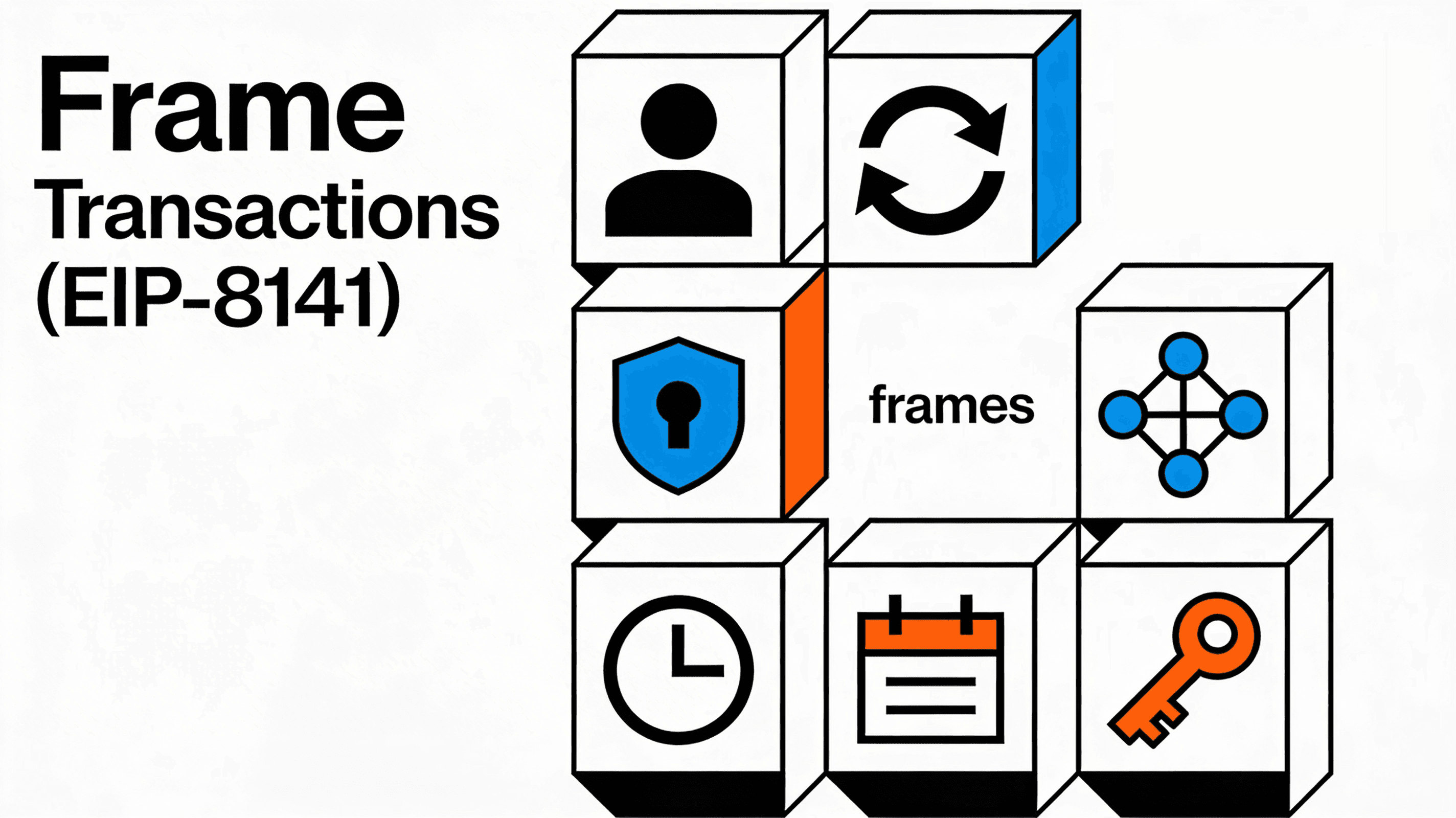
EIP-8141 introduces Frame Transactions — a new EIP-2718 transaction type (0x06) where a transaction is a sequence of execution steps rather than a single call. Each "frame" operates in one of three modes:
| Mode | Type | Function |
|---|---|---|
DEFAULT | Regular call | Executes with caller = protocol ENTRY_POINT |
VERIFY | Static validation | Returns ACCEPT with gas authorization; cannot have side effects |
SENDER | Authenticated call | Executes with caller = transaction sender, only after VERIFY approval |
The minimal protocol requirement: a VERIFY frame must return ACCEPT with gas authorization. Everything else is programmable — signature schemes, gas payment logic, batch execution structure. A basic sponsored transaction looks like:
- Frame 0 (VERIFY): Check paymaster balance, verify signature, return ACCEPT with gas limit
- Frame 1 (DEFAULT): Execute the paymaster's pre-charge logic
- Frame 2 (SENDER): Execute the user's actual call
- Frame 3 (DEFAULT): Execute the paymaster's post-charge refund
This composability is the point. ERC-20 gas payment, for example, gets an elegant native solution: the paymaster VERIFY frame checks the next frame's calldata, confirms it includes a token transfer to the paymaster, and only then authorizes gas. No more TOCTOU races, no "unsafe" postOp patterns.
ERC-4337 vs. EIP-8141: What Actually Changes
The headline is bundler elimination:
| Aspect | ERC-4337 (Today) | EIP-8141 (Hegotia) |
|---|---|---|
| Layer | Application middleware | Protocol consensus |
| Submission | UserOps → alt-mempool → bundlers → EntryPoint | Frame transactions → standard mempool |
| Bundlers | Required | Eliminated |
| Paymasters | Contract-based via EntryPoint | Frame-based gas authorization |
| Latency | Bundler aggregation delay | Direct block inclusion |
What doesn't change:
- Smart account addresses remain valid. No migration, no asset movement.
- Core concepts survive. Custom validation, gas abstraction, batching — all carry forward.
- ERC-4337 keeps working. L2s and chains that don't adopt EIP-8141 stay on ERC-4337. It's additive.
- EOAs keep working. Backward-compatible default code handles SECP256K1 and P256 verification.
The Competing Proposals: 8130 and Tempo
EIP-8141 has competition. Before calling it the winner, you should understand what it's competing against — because the debate reveals genuine tradeoffs.
EIP-8130: Account Abstraction by Account Configuration
EIP-8130 is from Chris Hunter at Coinbase/Base. Instead of flexible frame execution, accounts declare their authentication scheme via an onchain Account Configuration contract. Validation is handled by registered verifier contracts — pure functions that take a hash and a signature and return a boolean.
The key insight: nodes can validate a transaction with an O(1) cryptographic check, without tracing arbitrary EVM code. No simulation, no reputation systems, no ERC-7562 restrictions.
Base's position: "We can heavily optimize this and build out performant mempool/block builder implementations" — something they can't do with EIP-8141's arbitrary validation frames.
The counterargument: EIP-8130 limits what accounts can do during validation to whatever verifier contracts are registered. New signing schemes require deploying new verifier contracts and waiting for node operators to recognize them. With EIP-8141, you can implement any validation logic in account code and it works immediately.
Tempo: A Constrained Approach
Paradigm's Tempo proposal (EIP-XXX, transaction type 0x76) takes a different angle entirely. Rather than full account abstraction, it standardizes a constrained set of transaction-level primitives:
- Atomic batching of multiple calls
- Validity windows (valid_before, valid_after)
- Gas sponsorship via an optional fee payer signature
- 2D (parallelizable) nonces
- Multiple signature schemes: secp256k1, P-256, WebAuthn
What Tempo deliberately excludes: arbitrary validation logic, ERC-20 fee payment at the protocol level, anything that would require reputation systems or tracing.
The rationale: most users need batching, passkeys, and occasional gas sponsorship. They don't need Turing-complete account validation. A narrow, well-defined primitive is more auditable, more implementable across all clients, and good enough for the 99% case.
Tempo is the most pragmatic of the three proposals — and the least ambitious. It was designed for Paradigm's rollup stack first and then proposed for Ethereum. A centralized team can pivot quickly when they hit design issues. Ethereum can't. That's a meaningful constraint when you're enshrining something at the protocol level.
If EIP-8141 fails to ship with clear mempool rules, Tempo is a reasonable fallback for the 99% case. But it punts on the generality that matters long-term — post-quantum migration, hybrid auth schemes, composable paymasters. Those aren't hypothetical. They're the next three years of wallet infrastructure.
The Real Debate: DoS Resistance vs. Generality
The technical heart of the 8141 vs 8130 debate is DoS resistance.
The 8130 camp's argument: With arbitrary EVM validation (8141), nodes must trace transactions to know if they're safe to include in their mempool. Tracing has a cost — and if validation fails after tracing, that's unpaid computation, a DoS vector. The solution (ERC-7562 validation rules + staking + reputation systems) adds complexity and restricts what validation can actually do. The benefit of "arbitrary validation" largely disappears once you layer on all the restrictions needed to make it safe.
The 8141 camp's argument: ERC-7562 already does a decent job protecting bundlers today. Yes, it has edge cases, but the system works at scale. Enshrining a native AA approach that forces every node to run tracing, staking, and reputation infrastructure feels wrong and doesn't scale — especially compared to building those restrictions directly into the protocol. More importantly: 8130 can be built on top of 8141 at the account layer, but not vice versa. 8141 is the more general design.
My take: The 8141 camp is right about the long run, but the 8130 camp is right about the near term.
The generality of frame transactions matters for cases that actually need it: post-quantum signatures, hybrid auth schemes (passkey + secp256k1 + future PQ), scoped session keys with custom expiry logic. These aren't theoretical — they're increasingly real requirements.
But most accounts — the vast majority — just need to check one signature and authorize gas. For those, a well-specified default account implementation on top of 8141 accomplishes everything 8130 does, without the flexibility penalty. The ACD discussion is already moving this way: define a canonical default account, and nodes can operate without tracing for the 99% case.
The remaining question — the one that delayed the ACD decision in March 2026 — is whether the 8141 spec will define those canonical mempool rules clearly enough. That's an engineering problem, not an architectural one.
The Hegotia Timeline
EIP-8141 targets the Hegotia hard fork in H2 2026:
- January 29, 2026: EIP-8141 drafted by Vitalik Buterin, lightclient, Yoav Weiss, and others
- February 18, 2026: Ethereum Foundation includes native AA in its 2026 Protocol Priorities
- February 28, 2026: Vitalik confirms "ships within a year"
- March 12, 2026: ACD call delays formal decision — clients want clearer mempool rules
The delay is not a rejection. Client teams (Besu, Nethermind) want the EIP to define recommended mempool rules before committing — a reasonable ask given that DoS resistance is the open question. The 8141 authors are working on this, and the next ACD call is the likely decision point.
Hegotia also includes EIP-7805 (FOCIL) for censorship resistance — relevant for smart accounts specifically, since it prevents builders from selectively filtering frame transactions.
What Developers Should Do Now
Keep building on ERC-4337. It powers tens of millions of accounts today. Whatever ships in Hegotia won't break your existing infrastructure — the transition is additive.
Adopt EIP-7702 if you haven't. Shipped with Pectra in May 2025, EIP-7702 lets EOAs delegate to smart contracts, giving users smart account features without forced migration. It aligns with EIP-8141's direction and improves UX today.
Don't build on EIP-8141 directly yet. The spec is still evolving on mempool rules and the canonical default account. Follow the ethereum-magicians discussion and All Core Developers calls for updates.
And if Hegotia slips — which it might — your ERC-4337 code is unaffected. Hard forks require consensus across all client teams. Timelines move. The right response is to build on production-ready infrastructure today and let the protocol catch up, not to wait for it.
Bet on infrastructure abstraction, not raw primitives. The developers who built directly on bundler APIs in 2023 had to refactor when the ecosystem standardized. The pattern repeats: developers who build on infrastructure layers — rather than direct protocol calls — get smooth transitions for free when the protocol evolves.
Openfort already abstracts away the ERC-4337 infrastructure layer. When EIP-8141 activates, routing updates at the infrastructure level. Your SDK calls don't change.