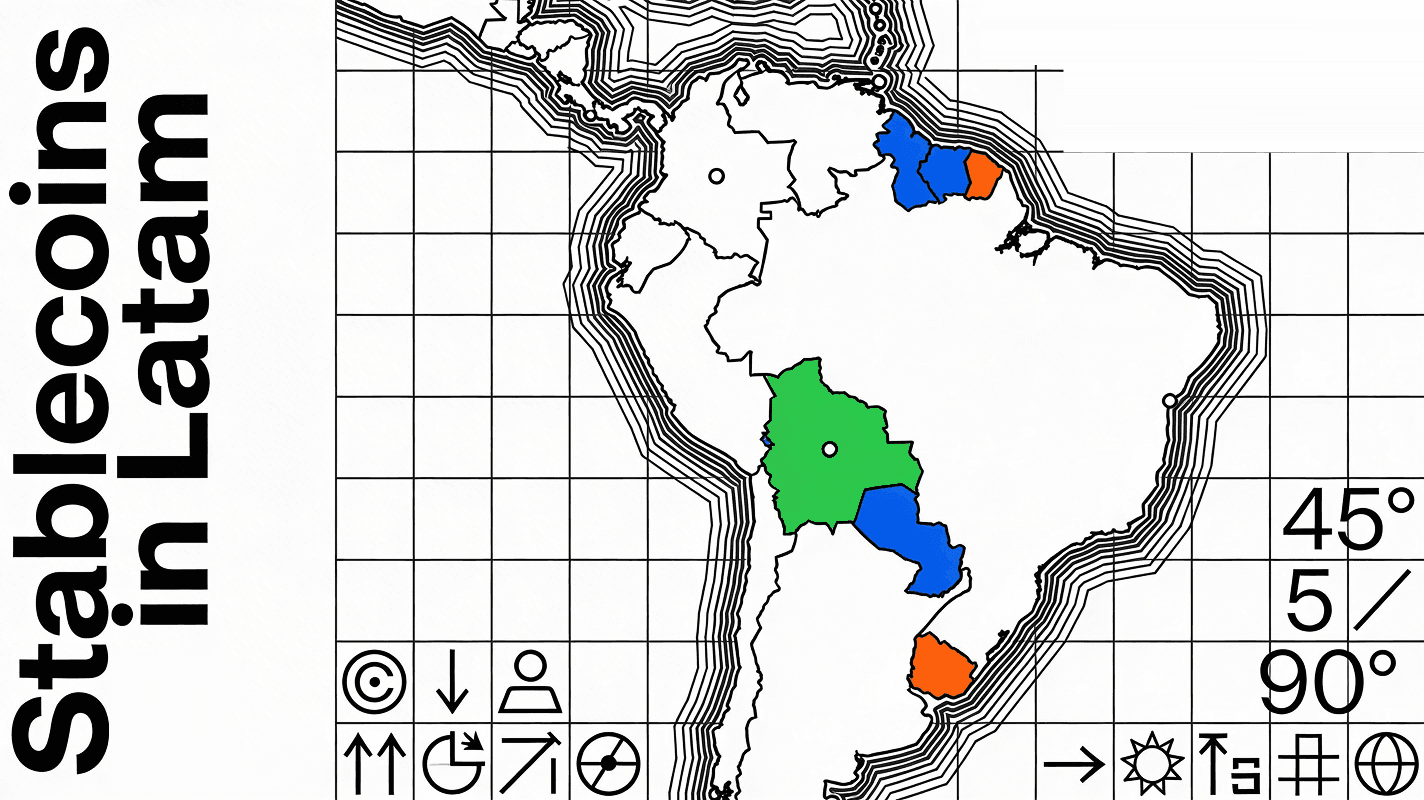
Latin America is now the fastest-growing region for stablecoin adoption, and the drivers are concrete: chronic inflation in Argentina and Venezuela, a $60B+ remittance corridor through Mexico, and developed fintech ecosystems in Brazil and Colombia. This guide covers what a developer building stablecoin payment apps, remittance platforms, or dollar-savings products for the region needs to know — country-level market dynamics, plus the infrastructure stack required to ship.
See how Openfort powers global stablecoin payouts with smart accounts and gas sponsorship.
Why LATAM is the biggest market for stablecoin products
LATAM accounted for 9.1% of global cryptocurrency transaction volume between mid-2023 and mid-2024, with Brazil, Argentina, and Mexico leading adoption [Source: Chainalysis 2024 Geography of Cryptocurrency Report]. But the raw volume numbers understate the story. In LATAM, stablecoins solve problems that don't exist in the US or Europe: inflation hedging, expensive remittance corridors, and limited access to dollar-denominated savings.
This isn't speculative. LATAM users are already transacting in stablecoins at scale. What's missing is the product layer — the fintech-grade apps that make stablecoins usable for people who don't know or care about the underlying infrastructure.
Here's the country-by-country breakdown.
Argentina
Argentina has the highest stablecoin adoption per capita in the region. The driver is simple: inflation exceeded 200% year-over-year in early 2024, and while it has moderated under the Milei administration, trust in the peso remains low [Source: INDEC (Instituto Nacional de Estadistica y Censos)]. Argentines use USDT and USDC as dollar savings accounts — not for speculation, but to preserve purchasing power.
Developers are building dollar savings apps, stablecoin debit cards, and P2P exchanges. Platforms like Lemon Cash and Belo already serve millions of users. The key challenge is capital controls: the "cepo cambiario" restricts dollar access through official channels, which paradoxically increases demand for stablecoin alternatives. Regulatory clarity from the CNV (Comision Nacional de Valores) is evolving but not yet settled.
Brazil
Brazil is the largest crypto market in LATAM and the ninth largest globally [Source: Chainalysis 2024 Geography of Cryptocurrency Report]. Two factors make it uniquely positioned for stablecoin products. First, PIX — the Central Bank's instant payment system — processes over 4 billion transactions per month and has trained 150+ million Brazilians to expect free, instant payments [Source: Banco Central do Brasil, 2025]. Second, Brazil has a clear crypto regulatory framework: the Central Bank oversees crypto asset service providers under a 2022 law, with licensing requirements that went into effect in 2025.
Developers are building stablecoin-PIX bridges (send stablecoins, recipient receives BRL via PIX), cross-border B2B payment platforms, and embedded finance products. The opportunity is the intersection of PIX's ubiquity and stablecoins' cross-border capability — domestic speed with international reach.
Mexico
Mexico is the largest US remittance corridor in the world. Mexicans received over $63 billion in remittances in 2024 [Source: Banco de Mexico]. The average cost of sending $200 from the US to Mexico is around 4-6% through traditional channels like Western Union or MoneyGram [Source: World Bank Remittance Prices Worldwide]. That's $2.5-3.8 billion in fees annually — money taken from families who need it most.
Mexico's 2018 Fintech Law (Ley Fintech) provides a regulatory framework for companies operating with crypto assets, though licensing requirements are stringent. Bitso, the largest exchange in the region, already processes a significant share of US-Mexico remittances using stablecoins on the backend.
Developers are building US-to-Mexico remittance apps, stablecoin payroll platforms for remote workers, and cross-border commerce solutions. The key opportunity: replacing the 4-6% fee with sub-1% stablecoin transfers.
Colombia
Colombia has a growing fintech ecosystem — over 350 fintech startups as of 2025 [Source: Colombia Fintech Association] — and a pragmatic regulatory approach. The Superintendencia Financiera has operated a regulatory sandbox for crypto services, and the central bank (Banco de la Republica) is exploring a CBDC.
Colombia received approximately $10 billion in remittances in 2024 [Source: Banco de la Republica], primarily from the US, Spain, and Chile. Local payment apps like Nequi and Daviplata have high penetration, creating a population comfortable with digital payments.
Developers are building savings products (dollar-denominated accounts for Colombian users), freelancer payment platforms (Colombian developers paid in stablecoins by US companies), and remittance corridors. Regulation is crypto-friendly without being fully codified — a watch-this-space situation.
Venezuela
Venezuela represents grassroots stablecoin adoption driven by necessity. Years of hyperinflation — the bolivar lost virtually all its value over the past decade — pushed Venezuelans to adopt USDT as a de facto parallel currency. P2P stablecoin trading volumes in Venezuela are consistently among the highest in LATAM relative to GDP [Source: Chainalysis 2024 Geography of Cryptocurrency Report].
Developers are building dollar-denominated commerce tools (merchants price in USDT, not bolivares), remittance apps (Venezuela is a major remittance recipient from Colombian and US diaspora), and basic payment infrastructure. The key challenge is sanctions and compliance complexity: US sanctions on Venezuela create legal risk that infrastructure providers and app developers must navigate carefully.
What you need to build a stablecoin product for LATAM
Building stablecoin products for LATAM is not the same as building for the US or Europe. The infrastructure requirements reflect the region's specific user expectations, payment rails, and regulatory landscape.
Embedded wallets with simple onboarding
LATAM users have been trained by Nubank (90+ million customers), Mercado Pago, Ualá, and Rappi to expect frictionless fintech onboarding. No seed phrases. No browser extensions. No wallet addresses visible in the UI.
Your onboarding flow needs social login (Google, Apple), email, or phone number authentication. The wallet is created behind the scenes — non-custodial, but invisible to the user. They see a balance in dollars. That's it.
Phone-number-first auth matters more in LATAM than in the US or Europe. In many markets, phone numbers are the primary digital identity. Email-only flows will lose users.
Gas sponsorship
This is non-negotiable. Your users cannot acquire ETH, SOL, or TRX to pay transaction fees. They may not even know what gas is. The app must sponsor every transaction.
Gas sponsorship works through paymaster contracts (ERC-4337) on EVM chains, or equivalent mechanisms on Solana and Tron. On L2 networks, gas costs are fractions of a cent per transaction — the economics are trivial at any scale.
If the user sends $50, the recipient should get $50. Any gas fee that's visible to the user breaks the mental model that Nubank and Mercado Pago have established.
Multi-chain support
Different chains dominate different corridors and use cases in LATAM:
| Chain | LATAM Use Case |
|---|---|
| Tron | Dominant for USDT P2P trading in Venezuela and Argentina. Low fees, widely supported by local exchanges. |
| Ethereum L2s (Base, Arbitrum, Polygon) | Growing for institutional and fintech use cases. USDC liquidity. |
| Solana | Increasing adoption for payment apps. Fast settlement, low fees. |
| BNB Chain | Popular with retail users through Binance, which has high market share in LATAM. |
Your infrastructure must support multiple chains from one integration. Locking into a single chain means locking out use cases. A remittance app serving the US-Mexico corridor might use USDC on Base, while the same company's Argentina product might need USDT on Tron.
Local on/off-ramp integration
Stablecoin products need fiat rails at both ends. In LATAM, this means integrating with country-specific payment systems:
- Brazil: PIX (instant, free, ubiquitous). Any product without PIX integration is dead on arrival.
- Mexico: SPEI (the domestic interbank transfer system). Also CoDi for QR-based payments.
- Colombia: Nequi and Daviplata (digital wallets with massive penetration), plus PSE for bank transfers.
- Argentina: Local bank transfers, Mercado Pago. The parallel exchange rate ("dolar blue") creates pricing complexity.
- Venezuela: P2P is the primary on/off-ramp. Formal banking rails are limited.
You can integrate these directly or through aggregators like Transak, MoonPay, or regional providers like Latamex. The key point: stablecoin products that don't connect to local fiat rails are just wallets. The fiat connection is what makes them products.
Compliance hooks
KYC/AML requirements vary significantly across LATAM:
- Brazil requires CPF (tax ID) verification and follows Central Bank guidelines.
- Mexico has tiered KYC under the Fintech Law — higher transaction limits require more verification.
- Argentina's CNV and UIF (Financial Intelligence Unit) have their own AML requirements.
- Colombia operates under Superintendencia Financiera guidelines.
Your infrastructure should have integration points for compliance providers (Sumsub, Metamap, Onfido) without baking in a specific one. Different countries, different requirements, different providers. Hardcoding a single compliance flow means rebuilding when you expand to the next country.
Non-custodial infrastructure simplifies compliance in most LATAM jurisdictions. If users control their own keys and the platform never takes custody of funds, the licensing requirements are generally lighter than for custodial services.
Multi-language and multi-currency UX
Spanish and Portuguese are baseline. But "multi-language" in LATAM also means handling regional Spanish variations — Mexican Spanish, Argentine Spanish, and Colombian Spanish have different conventions for financial terminology.
Multi-currency display is more nuanced. Your users think in local fiat: BRL, MXN, COP, ARS. The app should display balances and transaction amounts in local currency while operating in stablecoins under the hood. This means integrating real-time exchange rate feeds and handling the complexity of parallel rates (Argentina's official rate vs. market rate, for example).
Architecture for a LATAM stablecoin product
The architecture follows a pattern: same core infrastructure, customized at the edges for local rails and local UX.
_11[User in Brazil/Mexico/Argentina/Colombia]_11 |_11[Mobile App — local language, local fiat display]_11 |_11[Auth: phone/email/social — no seed phrases]_11 |_11[Embedded Wallet — non-custodial, invisible to user]_11 |_11[Stablecoin Transaction Layer — gas sponsored, orchestrated]_11 |_11[On-ramp: PIX/SPEI/Nequi/local rails] <-> [Off-ramp: PIX/SPEI/Daviplata/local rails]
The key insight: 80% of the infrastructure stack is shared across every LATAM country. Wallet creation, gas sponsorship, transaction orchestration, key management — all identical. The 20% that differs is the edges: auth preferences (phone vs. email), fiat rails (PIX vs. SPEI), compliance requirements (CPF vs. CURP), and display currency.
This is why building on stablecoin product infrastructure matters. You don't want to rebuild the entire stack for each country. You want one SDK that handles the shared 80%, with clean integration points for the local 20%.
Regulatory landscape by country
| Country | Regulatory Status | Key Framework | Stablecoin Stance |
|---|---|---|---|
| Brazil | Clear framework | Central Bank crypto regulation (2022 law, 2025 licensing) | Favorable. Central Bank exploring CBDC (Drex). Stablecoins permitted under regulatory oversight. |
| Mexico | Regulated | Fintech Law / Ley Fintech (2018) | Permitted with licensing. Banco de Mexico oversees virtual asset operations. |
| Argentina | Evolving | CNV regulations, UIF AML guidelines | Permissive for non-custodial services. Capital controls complicate fiat on/off-ramps. |
| Colombia | Evolving | Sandbox approach via Superintendencia Financiera | Crypto-friendly. No specific stablecoin legislation, but digital assets are not prohibited. |
| Venezuela | Complex | No formal crypto framework | De facto stablecoin adoption. US sanctions create compliance risk for service providers. |
A note on non-custodial infrastructure: in most LATAM jurisdictions, non-custodial wallet providers face lighter regulatory requirements than custodial services. If the user controls their private keys and the platform never takes possession of funds, the platform generally does not need a money transmitter or payment institution license. This varies by country and is evolving — consult local legal counsel — but the architectural choice of non-custodial infrastructure has direct regulatory implications.
Getting started
1. Identify your corridor and use case
Pick one:
- Savings: Dollar-denominated savings for users in high-inflation countries (Argentina, Venezuela).
- Remittances: Cross-border money transfer — US to Mexico, US to Colombia, Spain to Colombia.
- Payments: Stablecoin-native commerce or bill payments.
- Payroll: Pay remote workers in stablecoins, let them off-ramp to local currency.
Start with one country or one corridor. Don't try to launch across all of LATAM simultaneously. The regulatory, compliance, and on-ramp requirements differ enough that a multi-country launch multiplies complexity.
2. Choose your stablecoin
- USDC: Better for compliance-focused products. Circle's regulatory posture (US money transmitter licenses, MiCA compliance) makes USDC the default for products that prioritize regulatory alignment. Higher liquidity on Ethereum L2s and Solana.
- USDT: Dominant in P2P markets, especially Argentina and Venezuela. Higher trading volume on Tron. If your users are already transacting in USDT, don't fight the market.
Many products support both. Your infrastructure should make this a configuration choice, not a code change.
3. Set up wallet infrastructure with gas sponsorship
You need embedded wallets (non-custodial, created at signup), smart accounts (for programmable spending policies and session keys), and gas sponsorship (user never pays fees).
Openfort provides this as one SDK — embedded wallets, smart accounts, gas sponsorship, and multi-chain support. Open-source, so you can audit the key management and security model. This is the infrastructure layer: it handles wallet creation, transaction signing, gas abstraction, and account recovery so you can focus on the product.
4. Integrate local on/off-ramps
Options for LATAM fiat rails:
- Transak: Supports PIX (Brazil), SPEI (Mexico), and bank transfers in Colombia and Argentina.
- MoonPay: Coverage across major LATAM markets with local payment methods.
- Latamex (by Ripio): Regional specialist focused on LATAM fiat on/off-ramps.
- Direct integrations: For high-volume corridors, direct partnerships with local payment processors or banks reduce fees and improve reliability.
Start with an aggregator. Move to direct integrations once you have volume in a specific corridor.
5. Build for mobile-first
LATAM is a mobile-first region. Over 80% of internet access in Brazil, Mexico, and Colombia is via mobile devices [Source: GSMA Mobile Economy Latin America Report, 2025]. Design for Android first — Android dominates LATAM market share at 85%+ in most countries [Source: StatCounter, 2025].
This means: lightweight app size (many users have limited storage), offline-capable flows where possible (network reliability varies), and SMS/WhatsApp-based notifications (email open rates in LATAM are lower than US/Europe).
6. Test in one country, expand corridor by corridor
Launch in one market. Get product-market fit. Then expand to adjacent corridors. The infrastructure stack you chose in step 3 should support multi-chain and multi-country deployment without rebuilding — you're swapping out the on/off-ramp integration and compliance provider, not the core wallet and transaction layer.
Openfort provides the stablecoin product infrastructure for LATAM — embedded wallets, gas sponsorship, and multi-chain support under one SDK. Start building free.