
What is Farao?
Farao is a mobile trading app built on Hyperliquid. Instead of asking traders to babysit charts, Farao lets them run AI-powered trading strategies on top of perpetuals via Orus— the app turns a strategy into an automated position and manages it on the user's behalf. The goal is to make sophisticated perps trading approachable from a phone, without the operational overhead that usually comes with it.
The challenge: funding friction before the first trade
Farao already runs on Openfort master wallets, which custody and route funds for each trader's automated strategies. But getting money into those wallets was the hard part of onboarding.
A new trader typically arrives holding assets somewhere else — a different token, a different chain, or a centralized exchange. Bridging and swapping into the exact token and network the strategy needs is the kind of multi-step detour that loses users before they ever place a trade. For an app whose whole pitch is "let the strategy do the work," that first-run friction was the biggest drop-off point.
The solution: headless global deposit addresses on top of master wallets
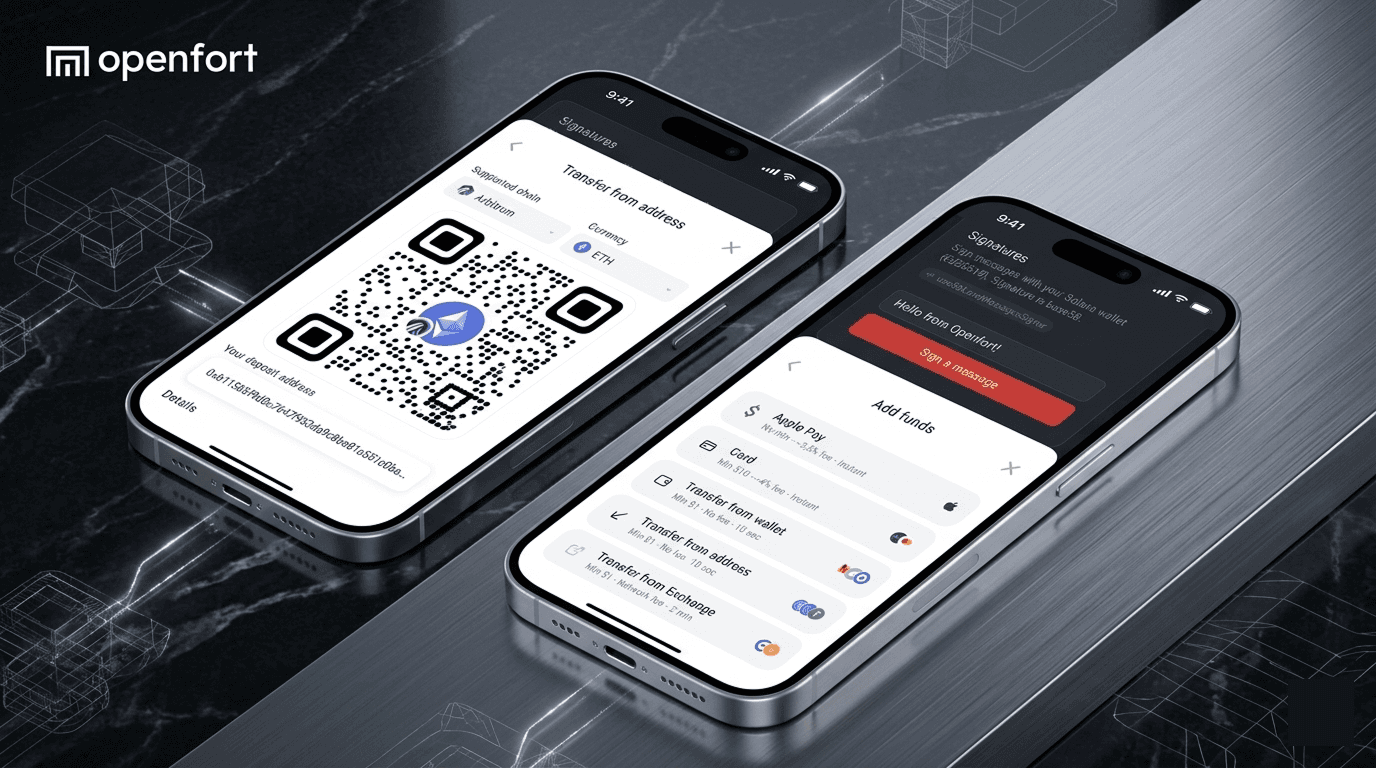
Farao recently integrated the headless version of Openfort's global deposit addresses. Each trader gets a deposit address that accepts any supported token on any supported chain; Openfort bridges and swaps the incoming funds into the token and network Farao's strategies expect and settles them straight into the trader's master wallet.
Because the deposit address is headless, Farao wired it directly into its own mobile UI rather than redirecting users to a hosted flow. Combined with the master wallets already powering each account, it collapses funding and execution into a single path: money lands, gets normalized, and is immediately available to the strategy.
The result: one-step funding, simpler onboarding
Pairing headless global deposit addresses with master wallets removed the bridging-and-swapping detour from Farao's onboarding. Traders fund from whatever they already hold, the strategy starts working, and Farao maintains one funding lifecycle to reason about instead of a patchwork of bridges, swaps, and exchange withdrawals.
It also simplifies the use case itself: the same primitive that onboards a new trader keeps working every time an existing trader tops up, so funding stops being a special case and becomes a background detail.
Related reading
- See how the funding primitive Farao uses works in Openfort Funding — global deposit addresses, fiat onramps, and wallet or exchange transfers behind one integration.